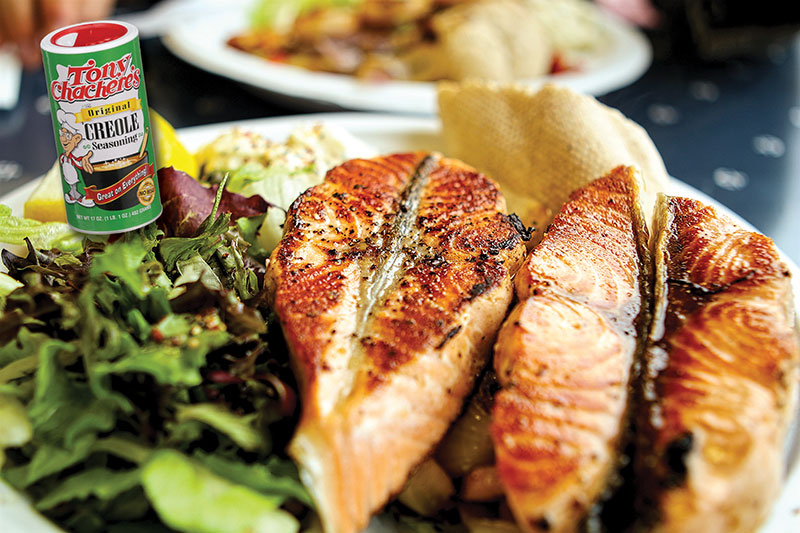
Simple and delicious, bronzed salmon will delight your guests and leave you looking like a gourmet.
by Dave Mull
You’ve had a great time on the water – the salmon were destroying your lures as fast as you put them in the water and, along with a bruised belly from the rod butt, you now have a nice haul of freshly cleaned fish. What better way to celebrate than by throwing an impromptu party on a warm afternoon at the marina with bronzed salmon fillets as the centerpiece.
Salmon keeps for about four days in the fridge without losing that fresh-caught taste. Because freezing causes ice crystals form in the flesh, salmon meat can get a little mushy after it’s thawed so when baking, broiling or frying, fresh fish is best.
The same goes when bronzing, which is similar to blackening, the technique Chef Paul Prudhomme popularized for preparing Louisiana redfish. You can find recipes for blackening fish online, and they’ll make salmon delicious, too. Some blackening methods just cook the fish over a medium heat, and you can cook the fillets up in your galley or home kitchen. Bronzing is different, much more of a sizzling, smoky spectacle and best done outdoors.
The simple life
Where blackening calls for butter and a mixture of sugar and different spices to coat the fillets, bronzing needs just two simple ingredients – olive oil and seasoned salt. Do it at the marina and your boating pals will line up for seconds thinking you’re a gourmet chef.
All you need for bronzing are a big L.P.-fueled outdoor burner like you would use to deep fry a turkey and a cast iron skillet. The technique is as simple as the ingredients and gear.
A saltwater fishing friend from Texas taught me the basics years ago. The key, he said, was to heat the cast iron pan till you see white ash forming in the middle. You want that pan to be searing hot.
While some blackening recipes keep the skin on the fillets, start with skinless fillets for the higher heat of bronzing. Cut the fillets into serving-size portions, which usually works out to three or four chunks per side of the fish. Put these into a 1-gallon Ziploc bag and add a few tablespoons of olive oil to coat them. Then, add some Tony Chachere’s Cajun Seasoning or other spicy salt to taste. For two pounds of salmon in a 1-gallon Ziploc, I like to use about one heaping teaspoon. Squoosh everything around so the spices get well-distributed, and you’re ready to go.
Let the feast begin
You’re going to want to set up the burner well away from your dining area because when you lay a fillet in your nearly red-hot skillet, there will be considerable splattering and lots of smoke. Start out with one fillet at a time – you can keep finished fillets in a warm oven if you want to serve them all at once. Or do as we do and serve the fillets as they’re done to whoever is ready with their plate.
In the hot pan each fillet will cook fully in just three or four minutes. The key is to watch the edge of the fillet while it’s in the skillet. You will see the fish lightening up as it cooks. When the growing lightness gets about halfway through the fillet, it’s time to flip. Cook the second side until it is cooked through, remove from the pan and let it settle for a minute or two – the fish will continue to cook. Now it’s ready to serve.
You can have tartar sauce ready (just mix some dill relish with mayonnaise) or simply cut up some lemon and lime wedges. But most folks I’ve served bronzed salmon to seem to like it just fine without additional condiments. It certainly disappears in a hurry, and that says it all.
MA FRANK PIXABAY

DAVE MULL Diehard angler Dave of Kalamazoo, Michigan, has contributed boat tests and features to Lakeland Boating for three decades. His current goal is catching a 30-plus-pound Great Lakes denizen from his Old Town kayak.