Inspecting your boat’s lifeline system.
by Capt. Frank Lanier
Although their maintenance can literally be a matter of life and death, lifelines rarely get the attention they deserve. Here’s how to keep your lifeline system ready, willing and able.
The system as a whole: Mention lifelines and boat owners typically think of the wire running along the perimeter of a vessel’s deck, but it’s imperative to view the role played by other components of the system. Stanchions ensure lifeline wires remain at the correct height, provide rigidity to the system, and help absorb the initial impact of a hurling body. Bow pulpit and stern rails transmit impact force to the opposite side of the boat, providing additional strength from the stanchions located there as well.
Wire lifelines: The first decision with lifeline wire is whether to use vinyl-coated or bare wire. Coated wire is popular because it looks nice and is easier on the hands. The problem is this vinyl coating can trap water, which wicks beneath it causing accelerated, often unnoticed, corrosion, until unexpected failure occurs.
Uncoated wire allows you to visually inspect its condition at all times. The overall diameter of bare wire is also smaller than the same size of vinyl-coated wire, allowing you to increase wire size for additional safety when changing from coated to bare wire.
Rope lifelines: The use of Spectra and other high-tech, low-stretch lines instead of wire has increased in popularity. The cost of rope versus stainless steel wire is similar, with the added attractions of less weight and no corrosion. Downsides include greater susceptibility to chafe and UV damage. These issues are more difficult to detect than wire corrosion, which can result in more frequent replacement.
Lifeline inspections: Ensure all clevis pins are pinned (secured) and all turnbuckle barrels are secured with turnbuckle nuts and pins if possible.
Clean and polish fittings, swages and other hardware, then inspect each with a magnifying glass for stress cracks and corrosion.
Inspect vinyl-coated wire closely for damaged coating and signs of rust. If chafe, cracking or wear of the coating is noted, replace it.
Check uncoated wire for broken strands by encircling the wire with a handful of tissue paper, then lightly dragging the tissue paper along its entire length in both directions. Broken stands will be indicated as they snag the paper.
Remove lifelines annually and inspect for kinks, damage or corrosion, paying attention to the wire at end fittings and where it transitions through stanchions.
Check that all lifeline hardware is in good condition and adequately sized.
Lifelines should be tight, but not to the point of bending stanchions or deforming pulpit and stern rails. If you can deflect a lifeline more than 2 inches by pressing down with your thumb between two stanchions, it’s probably too loose and must be adjusted.
Stanchions: Stanchion bases must be strongly constructed and through-bolted to the deck with properly sized hardware and backing plates. In some cases, the stanchion and base is a one-piece unit, while in others, the stainless steel stanchion slides into a socket in the base and is held in place with a set screw or machine screw. The best setup in this case is where the stanchion is secured via a bolt passing through both the stanchion and base, with an additional set screw to tighten the stanchion in the socket itself. If Allen screws are used, there should be at least two, with both threaded through the base and set into dimples in the stanchion.
Stanchion inspections: Release tension on lifeline wires and give each stanchion a good wiggle. If loose, determine the cause and correct.
Inspect stanchions and their bases for bends, cracks, broken welds and corrosion.
Tighten stanchion screws and all base mounting bolts/hardware regularly, replacing any that are stripped or damaged.
Bow pulpits & stern rails: Stern rails are often burdened with supporting aftermarket equipment such as solar panels and outboards. Keeping arches, davits and other equipment independent of the lifeline system is the best way to maintain its structural integrity.
Inspections: Check that each mounting base is through bolted, verifying the presence and integrity of properly sized backing plates.
Ensure all mounting hardware is in good condition, tight and secured with marine-grade stainless steel lock washers or Nyloc nuts.
As bow pulpits and stern rails typically utilize welded bases, you don’t have to worry about loose through bolts or set screws; however, you’ll need to check all welds closely for hairline cracks and corrosion.
Inspect all lifeline attachment points for distortion, corrosion, cracked welds, etc.
Top image: Inspect lifelines annually for kinks, corrosion and damage due to chafe

Vinyl coating can trap water, leading to accelerated corrosion and failure
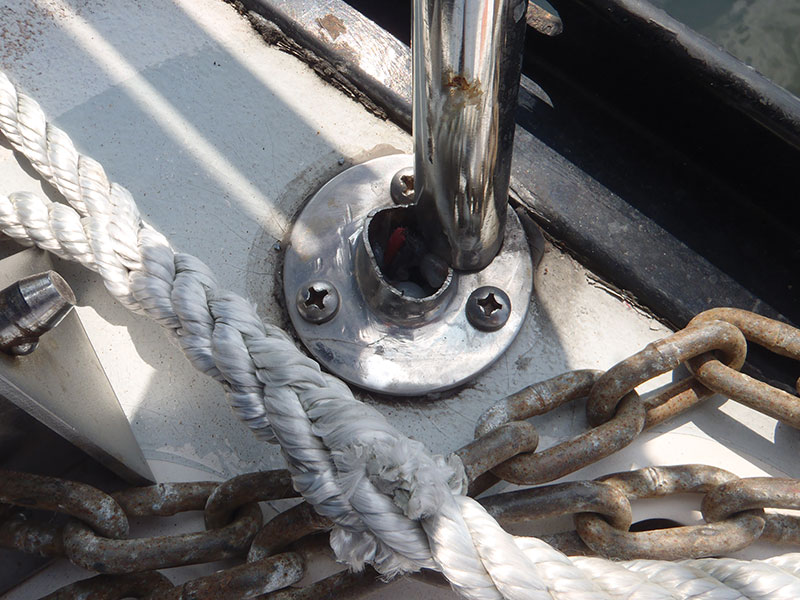
Inspect stanchion and pulpit bases for cracks, broken welds and corrosion
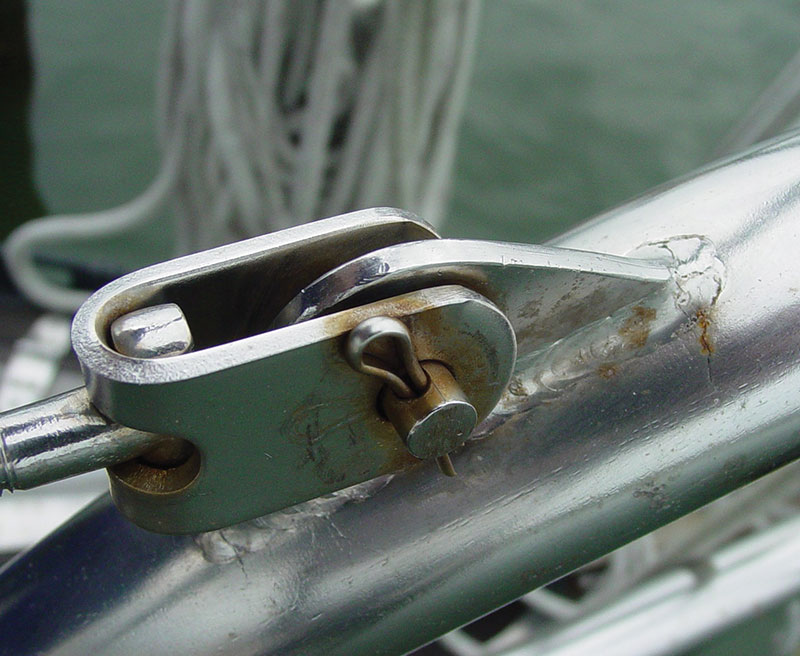
Ensure all fittings are properly secured. The prongs of this cotter pin are not sufficiently spread apart, meaning it can fall out when rotated

CAPT. FRANK LANIER is an award-winner journalist, boat maintenance guru and owner of Capt. F.K. Lanier & Associates, Marine Surveyors and Consultants. Check out his YouTube channel “Everything Boats with Capt. Frank Lanier.” CAPTFKLANIER.COM