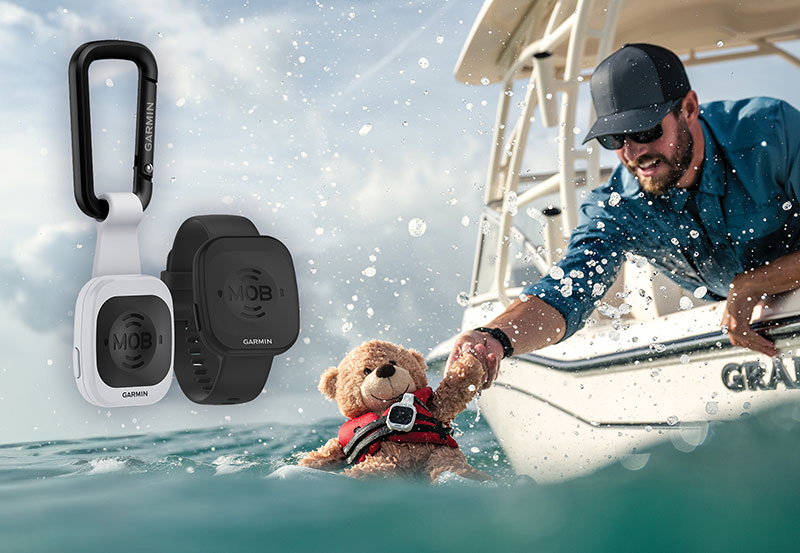
Garmin’s new OnBoard man overboard system provides peace of mind.
by Glenn Hayes
Going overboard — whether it’s crew, captain, pet or even equipment — is never a good thing. We have all heard the horror stories of solo captains falling overboard only to watch their vessel powering away into the horizon, pets having to tread water for hours until they are rescued, or drunk passengers going overboard, unbeknownst to anyone onboard.
If you are like me, the thought of any of these scenarios can put a knot in your stomach and can add to the anxiety of heading out into open water. Factory-supplied kill switches can help prevent some of these situations, but anyone who spends time on the water knows they are rarely used and really only protect the captain.
For those who want a little extra peace of mind, there are safeguards for these scenarios, with one of the best being Garmin’s new OnBoard wireless man overboard (MOB) detection and engine cutoff system.
What is OnBoard?
Revealed late last year and sold as a retrofittable package that can work with compatible Garmin displays, Garmin’s new wireless OnBoard system will integrate with any engine system equipped with an engine cut-off switch. It can protect everyone aboard, even the four-legged crew. The system replaces the traditional tethered kill switch with a wireless safety network. Small wearable tags communicate with a hub installed on the boat, allowing the system to constantly monitor whether the captain and passengers are still onboard.
The initial package includes a GOS 10 Hub — the brain and heart of the system. This small module wires into the ignition system using the included wiring harness, which contains an external audible alarm that alerts everyone onboard to a MOB situation. The module is also tied into the Garmin displays aboard via an included NMEA 2000 cable and a T-connector.
The package includes an external antenna that enables excellent signal reception, even on larger vessels. Also included in the package is a single white wireless tag, a quick-release wrist mount for the tag, a quick-release carabiner mount and a key float, giving multiple options for wearing the tag.
Although the initial package includes only one tag, the OnBoard system can accommodate up to eight. Each tag is easily programmed through the compatible onboard Garmin display. Each can be allocated individually as a captain’s tag or a passenger tag.
How does it work?
If a tag suddenly goes out of range — such as when someone falls into the water — the system triggers an alarm and automatically marks a man-overboard waypoint on the boat’s chartplotter, indicating where the signal was lost. If the designated captain’s tag disconnects, the system can automatically shut down the engine to prevent the boat from continuing without its operator. All of this happens instantly, allowing for a very quick return to that waypoint and recovery.
Another useful feature of a captain’s tag is that it allows for remote shut-off of engines by the tag holder anywhere on the vessel; this is a well-thought-out safety feature and a great capability from anywhere onboard. If the tag is programmed as a passenger, all the same procedures occur, except for the engine shutdown.
Any combination of passengers and captains can be programmed, allowing engine shutdown with more than just the actual captain. Because these tags are small, compact, comfortable to wear and wireless, passengers and crew can move about the boat freely without being tethered to the helm, unlike with a traditional engine cut-off. Tags can be easily clipped to pets and to any equipment that may go overboard.
The system retails for $499.99, and additional tags run $149.99 each. The tags are available in black or white and are quite small (roughly the size of an Apple Air Tag). Because of its compact size and the different ways to wear the tag, it is an easy sell to captain and crew to don a tag and be protected. They are small, lightweight, unobtrusive, and do not get in the way, attaching to wrist straps similar to watch straps. It can also easily attach to a specialized carabiner that clips onto almost anything.
While some may think the cost is high, they may not fully appreciate the safety it provides or how seamlessly and effortlessly it delivers peace of mind. All it would take is one overboard event to justify its relatively moderate expense. The Garmin Onboard system is certainly worth considering if you already have compatible Garmin displays aboard.
Top image: Photo credit Garmin
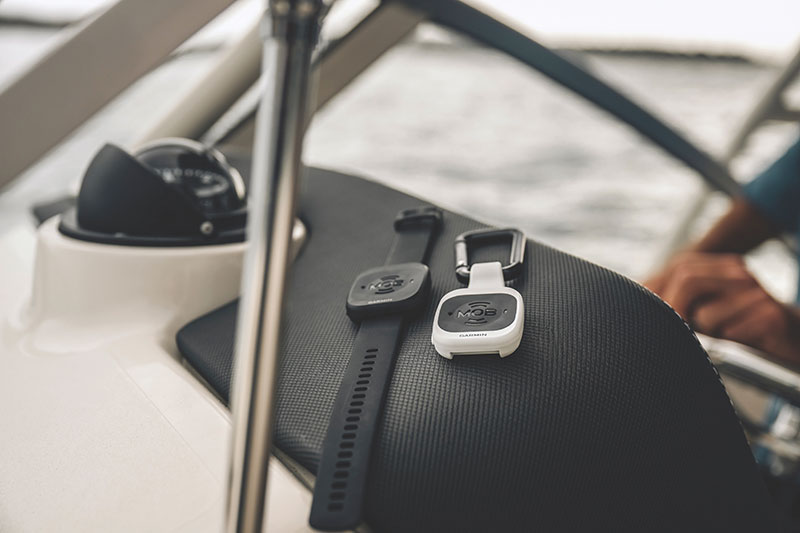
OnBoard tags can be worn as a wristband or on a carabiner / credit Garmin
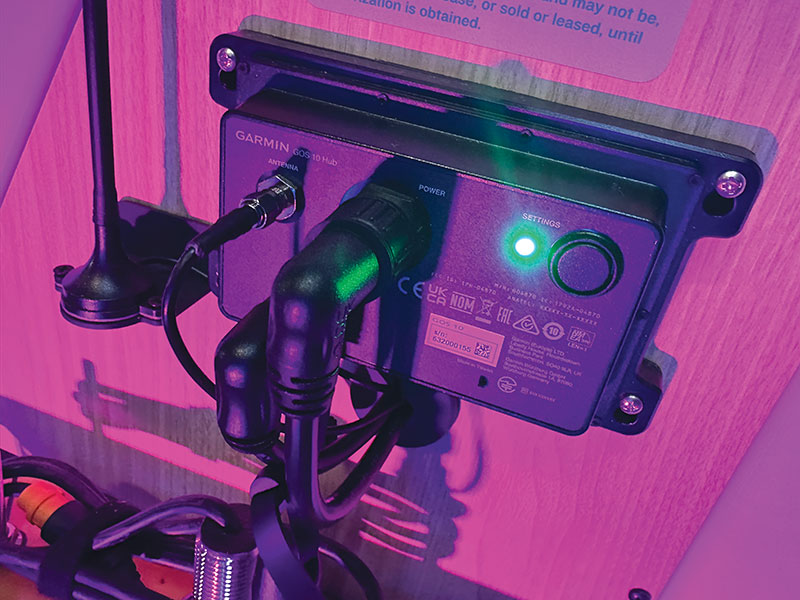
The OnBoard GOS 10 Hub, the heart of the system / credit Glenn Hayes

GLENN HAYES is a marine writer and photographer whose background in the marine industry and in marine electronics spans almost three decades and many thousands of miles at sea traveling the world. He can be reached at HAYESSTUDIOS.COM