Go low and slow to catch lakers.
Story & photos by Dave Mull
Lake trout are often the most reliable fish for Great Lakes trollers to catch, and many charter captains consider them their bread-and-butter fish. When salmon and steelhead are hard to find, lake trout are usually still available around deep, rocky areas. Although they have the reputation of lazy bottom feeders, they have risen in popularity for table fare, in theory because they’re eating more gobies and fewer oily alewives. One rarely hears them called “greasers” as fishermen often called them back in the day. Three- to 7-pound lakers are especially tasty when fried or baked.
To target these members of the char family, trollers keep lures moving slowly right on the bottom.
A careful approach
Several years ago, I was a tournament observer for a Lake Michigan contest out of Racine, Wisconsin, riding along with the crew of a local boat. I had front– row seats to see how that fishing team successfully targeted these lovely fish.
Racine has a large expanse of rocky bottom, where lake trout live year-round. The approach called for two crewmembers and two downriggers, one on each corner of the transom. While the captain kept the boat moving at just 2 mph, the crew members constantly monitored their cannonball depth, letting the big lead weight brush bottom. They made constant adjustments, flipping the downrigger toggle switch, raising and lowering the weight to keep it barely off bottom. It was a tense situation, as losing a cannonball was a real possibility. The windy day I rode along, the crew was on top of their game, catching their limit of lake trout in short order.
My longtime trolling mentor, Bud Roche, came up with a system that worked great for lake trout with less chance of losing the downrigger weight. Known around his home port of New Buffalo, Michigan, as Uncle Bud, he added a length of chain to the bottom of a downrigger weight. By carefully lowering the weight near the bottom, he could tell when the chain made contact, still keeping the cannonball a few feet above. The chain kicked up enough silt that it attracted fish and apparently triggered them into biting the flasher/fly combo, which he adorned with a strip of herring fillet.
Gear
Possibly the most popular lure for lake trout is a floating Spin-N-Glo in front of a tinsel fly combined with either a dodger or flasher. Anglers usually fish the Spin-N-Glo/fly combo on a long leader — 4 feet long and longer — behind the attractor. This deadens the action of the fly behind the whirling flasher, which makes it easier for a lake trout to grab. Some anglers prefer to forego the tinsel fly and rig two Spin-N-Glos.
My favorite setup for lake trout is a 1-pound lead weight or a 12-ounce Torpedo weight on a wire line rod. These rods most commonly have roller guides that stand up to braided, 30-pound test wire line that can cut into standard rod guides. The advantage is that you can easily let the weight down to find the bottom and reel it up a bit to keep it just above the tarmac. If the weight gets stuck on something, it usually pulls free. If it breaks off, it’s much cheaper to replace than a standard downrigger weight. The wire line combo makes catching trout even more fun as it transmits every head shake the fish makes.
Learn from the pros
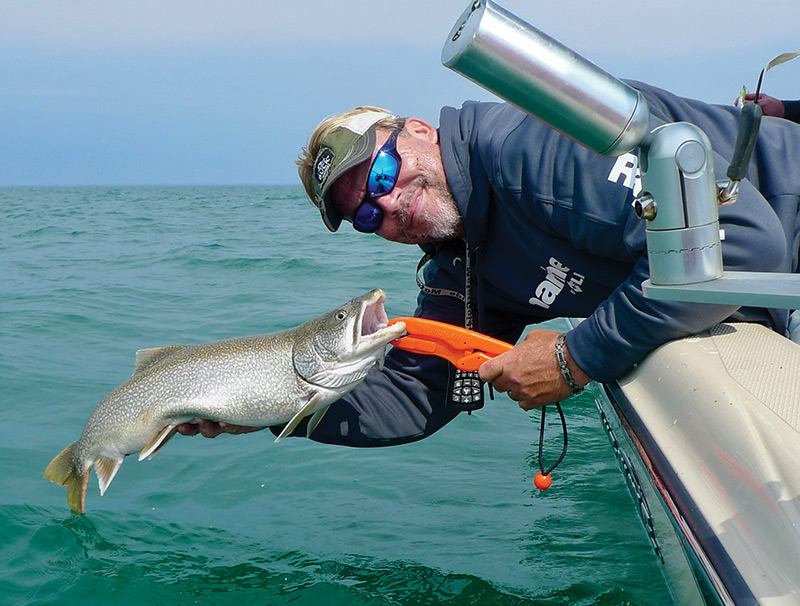
One spring, I was on a writers’ junket to Lake Ontario where we fished the Niagara Bar at the mouth of the Niagara River. One of the hosts, pro saltwater angler Mark Davis, who has produced and starred in the “BigWater Adventures” television show for nearly two decades, figured out a system that was deadly for lake trout roaming the bar in about 40 to 50 feet of water.
He had trailered a 28-foot center console up from his home base in South Carolina. Lacking downriggers or wire line rods, Davis simply dangled a 1-ounce weight about 3 feet below a three-way swivel, and attached a deep-diving Mag Lip lure from Yakima Baits to a 7-foot leader. With a spinning rod and large capacity reel designed for saltwater species, he let out enough monofilament so the wiggling hard plastic bait was just ticking bottom. Trolling just fast enough to let the Mag Lip lures wiggle, we caught loads of trout.
This season, go low and slow to dredge up some lakers.
Top image: Mark Davis, host of “BigWater Adventures,” readies to release a Niagara Bar laker
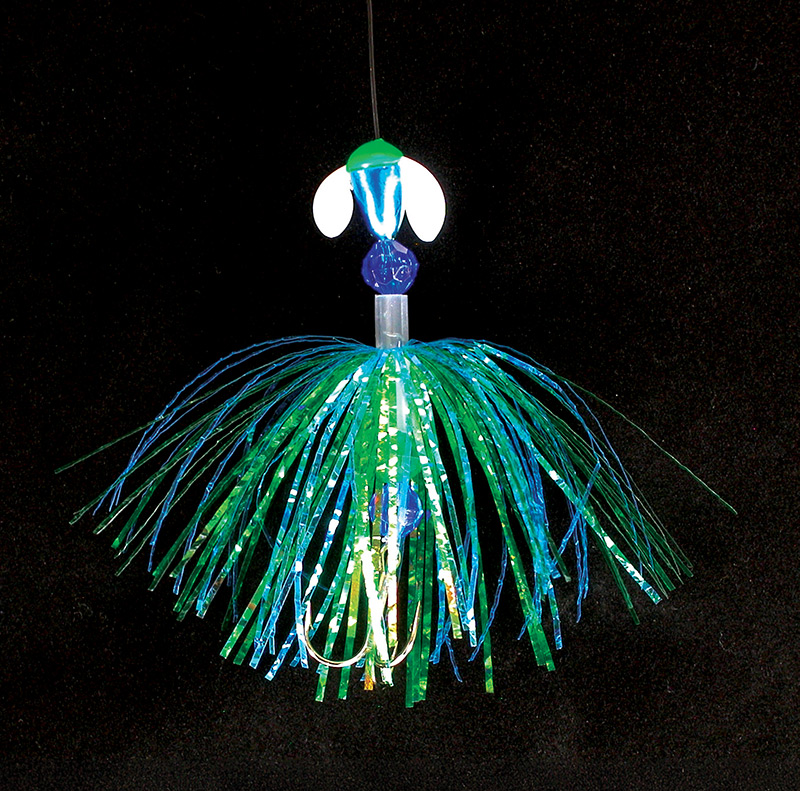
Some anglers enjoy lake trout success with two Spin-N-Glos fished behind a metal dodger
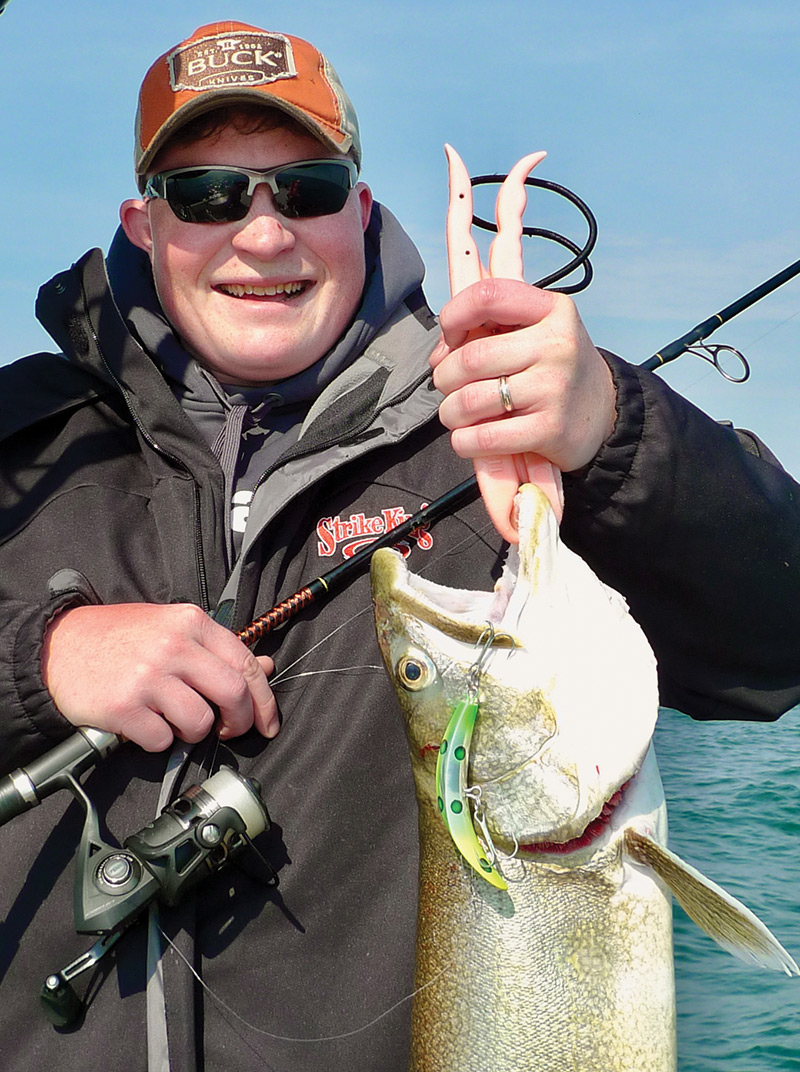
A Mag Lip lure, fished slowly and ticking bottom, dredged up this Niagara Bar lake trout
DAVE MULL Diehard angler Dave of Kalamazoo, Michigan, has contributed boat tests and features to Lakeland Boating for three decades. His current goal is catching a 30-plus-pound Great Lakes denizen from his Old Town kayak.