Increase trolling success with speed and temp electronics.
by Dave Mull
Electronic “speed and temp” probes not only tell you the water temperature top to bottom, but they also tell you how fast your lures are running down deep.
How important is that info to veteran trollers?
“I’d rather give up sonar and GPS than my speed and temp,” Capt. Dave Engle, of Best Chance Charters in Saugatuck, Michigan, once told me.
The temperature relayed from a probe at the down- rigger ball to the topside display lets anglers know if they are in the right zone for their target species.
“Over the years, I’ve determined that my biggest kings come out of water that’s 43 degrees,” says Capt. Dan Keating, now retired, who ran Blue Horizons Charters out of the Chicago area.
Vital information
Knowing the temperature and at what depths it changes can also key anglers into the most productive trolling patterns. For instance, if the water is in the mid-40s starting at 60 feet, and warmer water is above, savvy anglers focus on that area where the temperature break touches the sloping bottom. Since salmon don’t often wander into warm water, the area where the break meets the bottom can concentrate fish.
The probes also have a paddlewheel that monitors speed down deep — also vital information. The Great Lakes are rife with underwater currents that go in a different direction from surface currents. When setting lines, you can watch a spoon snap back and forth enticingly at the surface, but if your boat is going the same direction as a subsurface current, you will likely lose that spoon’s action at depth. The deep current follows and pushes the spoon, which deadens the lure’s action. By watching the speed at depth, the captain can increase their boat’s speed to compensate for the following current, ensuring the spoons and other lures don’t lose their seductive attraction. The sensor also lets the captain know if they are trolling against a subsurface current, so they can change directions and not allow the lures to “burn out” because a strong current flows against them.
Catch more fish
The first speed and temp unit was the Sub-Troll 900 from Moor Electronics, designed in the 1980s. Although that company went out of business in 2015, many captains still use Sub-Trolls. This unit was the first to send a probe down with the downrigger weight and transmit a radio signal up the downrigger cable and on to a dash-mounted display. The Sub-Troll, like other speed and temp units, determines speed at depth with a paddlewheel on the probe. Companies that currently make speed and temp units include FishHawk, Depth Raider, Smart-Troll and Scotty, the Canadian company best known for downriggers, which now offers the Scotty Seeker system.
With one exception, all of these units work much like the original Sub-Troll, with a probe that attaches to the downrigger ball and sends depth and speed information topside. The exception is the Smart Troll, which can handle multiple small probes. Anglers can attach the Smart Troll probes to a downrigger, but also to Dipsy Divers and ahead of the lure on weighted leadcore and copper lines to see how deep those lines run in real time.
Like most electronics for fishing, speed and temp probes are not cheap. Smart Troll kits range from $1,100 for units that come with a single probe to $2,450 for kits that include six probes.
A Scotty Seeker kit lists for about $1,474, while a Depth Raider kit retails for $649 on Amazon. A FishHawk kit lists for $1,249.99 on Amazon.
Speed and temp probes might not be the first electronic system you install, but after you see how it can help catch fish, it likely will be the last unit you want off your boat.
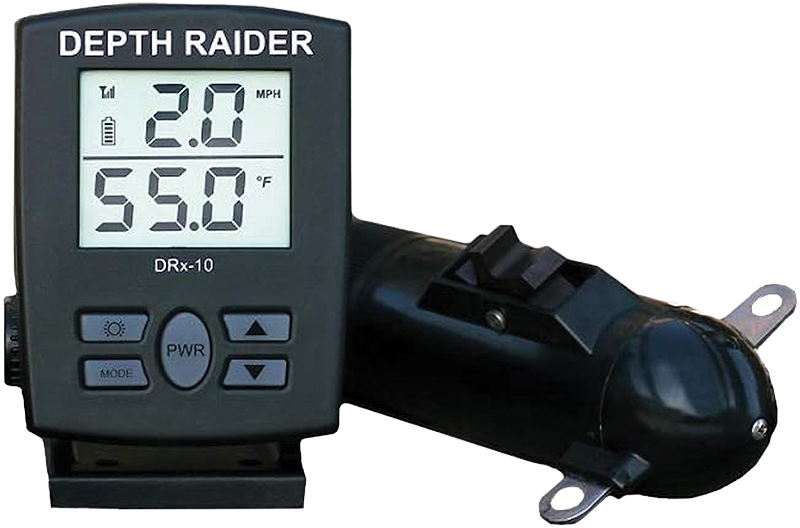
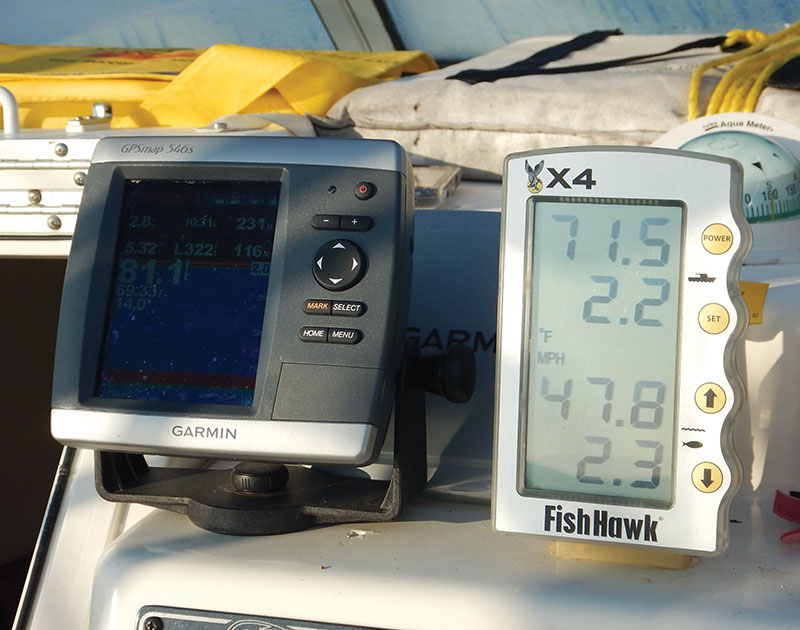
The FishHawk display (top) and Depth Raider (above) show surface speed and temperature, as well as the speed and temperature down at the downrigger ball.
DAVE MULL Diehard angler Dave of Kalamazoo, Michigan, has contributed boat tests and features to Lakeland Boating for three decades. His current goal is catching a 30-plus-pound Great Lakes denizen from his Old Town kayak.