Late-fall trolling delivers hefty salmon for anglers willing to bundle up.
Story & photos by Dave Mull
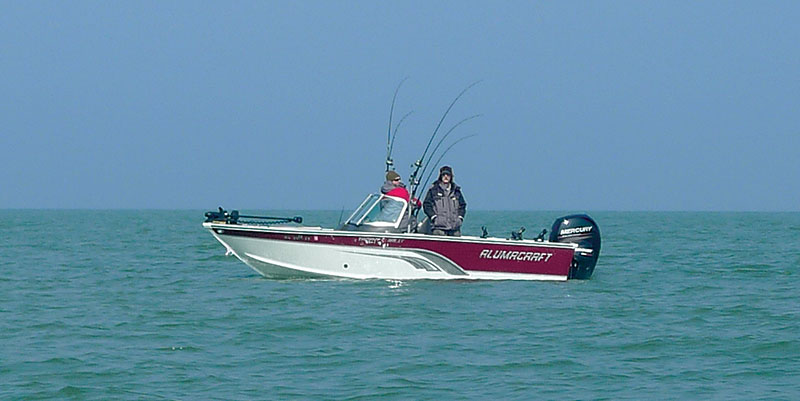
The seagulls just ahead of our 18-foot aluminum boat form a squealing, splashing cloud as they wheel and dive into Lake Michigan in the brisk cold of early December, just out from Milwaukee.
“Get ready,” says Josh Swanton, the boat owner who had invited our small gang of Michiganders to fish. “Almost to the sweet spot.”
As we approach the corner of the rock breakwater in front of the harbor and slide amidst the squalling birds, a corner downrigger rod springs skyward, and another 6-pound king salmon is welcomed aboard. That fish is among a massive school that’s pushing baitfish to the surface, and the gulls took advantage.
The sweet spot
Lake Erie and Lake Ontario walleye trollers are well aware of how good the fall fishing for that tasty species can be, but many anglers only think of salmon and steelhead fishing in rivers when freezing temperatures arrive. Yet salmon trolling in the big lakes can be fantastic late in the year. Plus, these salmon and trout bulk up ahead of the approaching winter and aggressively attack lures. The fish suspend high in the water column following baitfish; a shallow spread of lures can produce fast action.
On that day of furious activity out of Milwaukee, the size of the lure mattered to the fish. We caught almost all of ours on the same spoon, the smallest on Swanton’s boat. While the six or seven other larger spoons we’d set out went largely untouched, the fish ate the little silver and white one like they were starving. Then a fish in the cooler regurgitated a small alewife almost the same size as the spoon, and suddenly, it all made sense.
While nearshore structure that holds bait is always a good place to find fish, they also congregate offshore, usually following schools of alewives and other prey.
Fun fishery
Longtime friends Harry Glover and Bud Roche often pursue cohos well into December on southern Lake Michigan out of New Buffalo, a little port near the Indiana/Michigan state line. They set a simple spread of dodgers and flies from Glover’s diesel-powered 30-foot Dorado.
“We get out to 200 feet of water (8 to 10 miles from port) and set three downriggers and a couple of small Dipsy Divers, one on each side,” says Glover, noting the divers are set on “3” to run shallow. They set the orange divers out just far enough so that they disappear from view.
“We catch the occasional 6- or 7-pound king, but mostly it’s fat cohos,” says Roche.
The duo targets the upper 30 feet of water using small dodgers and Spin Doctor flashers with small flies. Orange attractors work best, “and the flies are the small coho flies, tinsel-tied on a treble hook,” says Harry. “We usually troll downwind, about 2.2 to 2.5 mph.”
“When you get into them, it’s hard to keep three rods in the water,” says Roche. “You often get hit while letting the lure out.”
This writer has had great fall-time success closer to shore out of New Buffalo, catching kings, lake trout and cohos setting out dodger-fly combos and crankbaits such as Brad’s ThinFish, and jointed No. 9 Rapalas and Storm Junior Thundersticks. We set the lures behind two or three colors (20 or 30 yards) of lead core on online planer boards that take lures out away from the boat. The setup is almost exactly like what works in the spring.
It’s a fun fishery upon which few anglers capitalize. It’s best done with two crews in separate boats, just in case one breaks down (tow services are shut down for the winter). Safety is priority one, but priority two is catching fish. Usually, the weather is cold enough that you don’t need ice for the cooler.
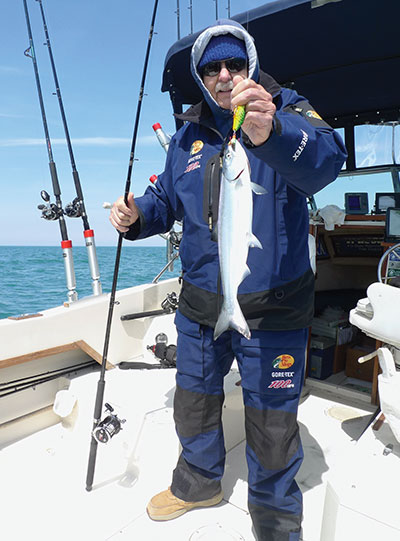
Bud Roche shows a coho that ate a body bait in late fall
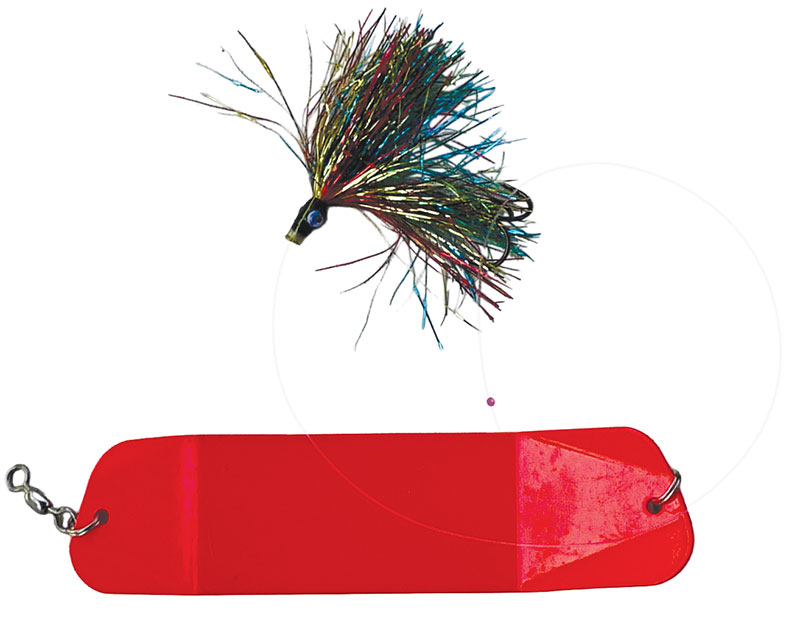
A small dodger like this Z Dodger with a short fly behind it is deadly for big water kings and cohos in the late fall
DAVE MULL Diehard angler Dave of Kalamazoo, Michigan, has contributed boat tests and features to Lakeland Boating for three decades. His current goal is catching a 30-plus-pound Great Lakes denizen from his Old Town kayak.