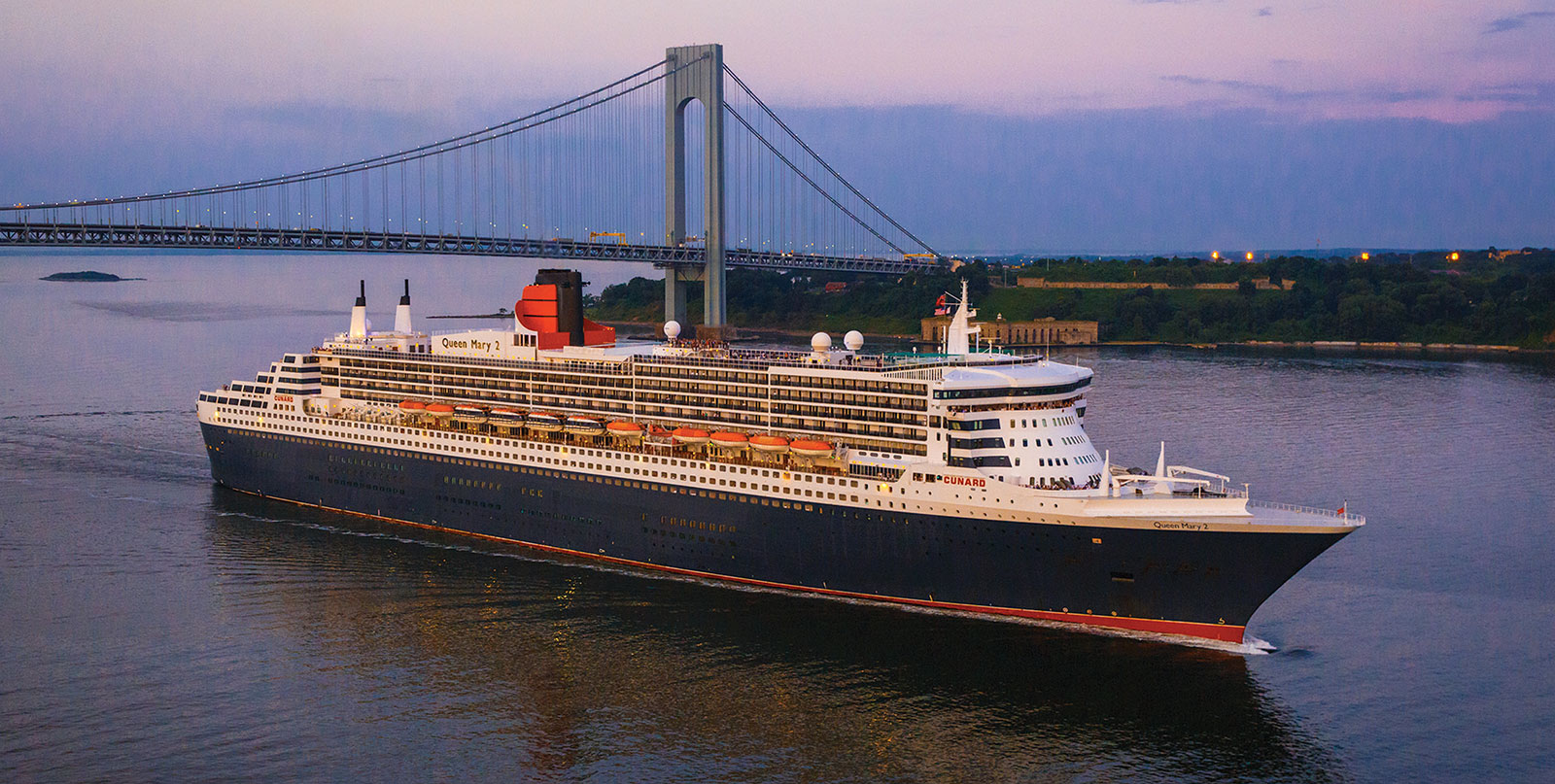
On a storm-tossed North Atlantic crossing, Queen Mary 2 proves that the golden age of ocean travel endures.
Bundled up against the January breeze, little knots of passengers wandered the upper decks in the deepening twilight. Not much was happening. It was well past 5:30 p.m., and Cunard’s Queen Mary 2 (QM2) still sat quietly in her berth at Brooklyn’s Red Hook Terminal.
Suddenly, the public address system came to life, and we heard Captain Andrew Hall’s voice for the first time. A late fuel barge meant we wouldn’t depart until at least 8 p.m.
He also advised that passengers should be prepared for “complex weather” on our eight-day transatlantic crossing to Southampton, England. This weather, he said, would create “significant seas.”
A murmur of anticipation rippled through the cold air. We were about to experience a winter storm on the North Atlantic.
Thankfully, we were aboard the world’s only working ocean liner.
A storied legacy
A transatlantic crossing had been on my bucket list since I was 9 years old, when I found a copy of Walter Lord’s “A Night to Remember” in our living room bookcase. I read that book so many times that the binding fell apart.
More than 40 years later, my childhood dream of crossing the North Atlantic aboard a real liner was coming true, and in more ways than one. According to her designer, Stephen Payne, QM2 would not exist if it weren’t for Titanic.
“The wreck of Titanic was discovered by Dr. Robert Ballard of Woods Hole Oceanographic Centre in September 1985, and that caused a tremendous upsurge in interest,” Payne said in a lecture titled “Titanic: Conception, Construction, Catastrophe and Contradiction.”
At that time, Cunard’s Queen Elizabeth 2 (QE2) had been doing the North Atlantic run between Southampton and New York for nearly 20 years. Launched in 1969, she was considered to be the last ocean liner as air travel became the preferred mode of travel between continents.
That is, until filmmaker James Cameron’s “Titanic” rekindled public fascination in 1997.
“Suddenly QE2 was sailing full,” Payne observed in his lecture. “That spurred Carnival to buy Cunard (in 1998) and invest in the building of a new transatlantic ship.”
Built at Chantiers de l’Atlantique — the birthplace of SS France and SS Normandie — for $800 million and launched January 12, 2004, the 1,132-foot QM2 was the largest, most expensive ship in the world. She was also the most innovative, offering desirable 21st-century conveniences and luxuries without compromising her ocean liner pedigree.
With an impressive eight decks of balconies, she can look like a cruise ship at first glance. Yet she carries the legacy of classic liners like Normandie, the original Queen Mary, and even Titanic (the White Star Line merged with Cunard in 1934) in her bones.
One more time
QM2’s ardent fans know this. They embark in New York or Southampton during the offseason because they love the ship, and they want to experience a time and place where the veil between eras is surprisingly thin.
Kirsten Husband of Cleveland, Wisconsin, is one of those passengers. She discovered QM2 in 2019, when she researched how she might be able to cross the Atlantic Ocean just one more time in her life.
She crossed for the first time in 1968, when her Austrian mother booked passage aboard Canadian Pacific’s Empress of England so the two of them could visitfamily in Europe.
“Back then, it was cheaper to sail than fly,” Kirsten says. “My mother chose an English ship that sailed from Montreal to Liverpool. We spent three weeks in England and then went on to the continent. We thought we would take a German ship home, but we loved the English ship so much, we changed our ticket.”
One day, in the ship’s writing room, 15-year-old Kirsten met an English passenger who would change her life.
“A very handsome young man popped his head out to ask, ‘How do you spell the word opportunity?’” she remembers with a laugh. “Nothing happened. He was 10 years older than me and had a girlfriend. But I sent him a Christmas card that year, and the rest is history.”
The passenger’s name was John Husband. He and Kirsten eventually would marry and share 46 years together. John passed away in 2017.
“About a year and a half after he died, I felt I had to cross the Atlantic one more time,” Kirsten says. “And when I first read about Queen Mary 2, I saw a voyage with the same dates as my first one — August 14 to 21. I thought it was a sign.”
Although the coronavirus pandemic derailed her transatlantic plans five times, Kirsten finally boarded QM2 in Southampton in October 2022. She says today’s crossings are a very different experience.
“Back then, it wasn’t a luxury vacation,” she says. “It was just how people traveled. We shared a cabin with two other women, and we had one porthole.”
The ship was less stable than QM2, as well. Kirsten recalled a storm in which even the crew were seasick.
She wasn’t fazed as a teenager, but decades later, she hesitated when she saw QM2 storm footage on YouTube.
“It was scary, and I thought all those people were crazy,” she says. “Then, on my first crossing, I found myself in a storm, at the window, with a huge smile on my face. It was exhilarating.”
Prepared for weather
Knowing that the light winds and calm seas wouldn’t last long, I made sure to join the crowd of walkers on the wraparound teak promenade deck during our first day at sea. As I lapped the ship (three laps equals 1.1 miles), I examined the long lines of traditional wooden steamer chairs, the empty pool at the stern, and the enormous propeller blades perched at the bow.
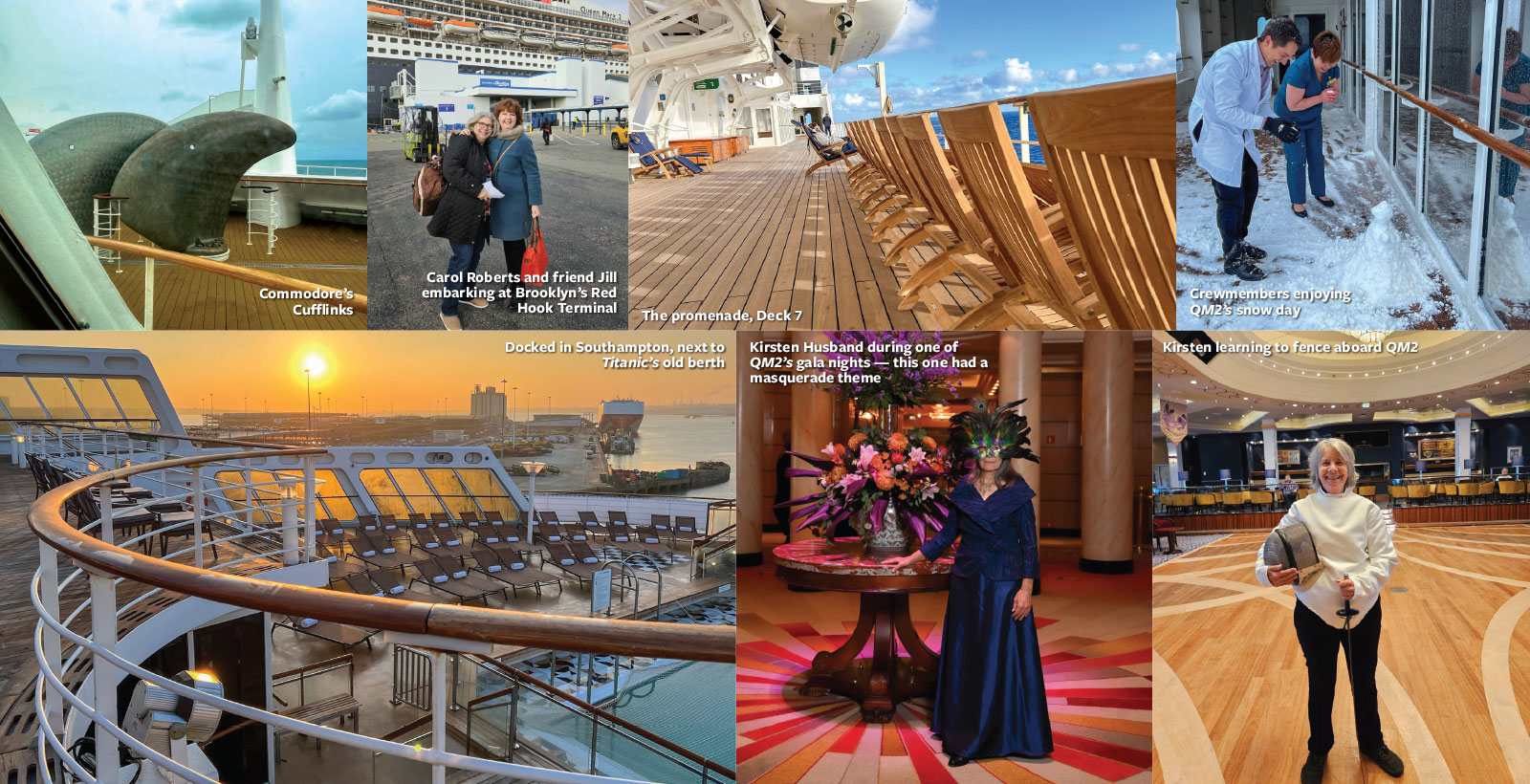
Called the Commodore’s Cufflinks, these are spare blades for QM2’s four electric, rudderless Rolls-Royce/Alstom Mermaid Pods. Each 320-ton unit in this pod propulsion system weighs as much as a fully loaded Boeing 747, and two of the units rotate 360 degrees.
Standing next to the propeller blades, I gazed at the heavy-duty doors separating this forward deck from the promenade, the ship’s formidable bridge screen, and the near side of her V-shaped breakwater farther forward. QM2 clearly is not a cruise ship. She was designed and built to make the North Atlantic run in all types of weather and still maintain her schedule.
“To achieve that, the ship needs to be built much more like an arrow, very fine at the front,” Payne told Sky History TV in the United Kingdom. “Structurally, it must be a lot stronger than a cruise ship. It needs more power to maintain the speed in rough weather.”
“QM2, as QE2 before her, was designed and built to cope with the sometimes challenging conditions of the North Atlantic, year-round,” agrees Capt. Hall. “QM2, being somewhat larger than QE2, arguably handles such conditions (better) than QE2 once did.”
An ocean liner also must have plentiful, spacious public rooms, because passengers’ time outdoors might be severely limited. Chilled by the freshening breeze, I retreated indoors to Sir Samuel’s cafe for the captain’s noon briefing.
The forecast was unchanged. It hinted at a Force 10 blow, possibly Force 11.
Storm Force 10
Capt. Hall’s “weather-optimized route” across the Atlantic initially took us northeast. Somewhere between Nova Scotia and Sable Island, conditions started to deteriorate, and full Force 10 conditions arrived within 48 hours.
Sustained winds of 55 to 63 mph gusted to 72, and the seas built to an awe-inspiring 33 feet. As the temperature plunged, snow squalls whirled, caking the outdoor decks in white.
Yet QM2 handled it all without fuss. She moved with the waves but did not deliver scend, a nauseating combination of pitch and roll that maritime historian John Maxtone-Graham calls “diabolical.”
That is due to the liner’s four stabilizers, a remedial skeg (a vertical steel divider between the two aft propellers) and a modified Constanzi stern, which combines the best attributes of the modern transom with those of a classic liner. Add her flared bow and deep draft, and you have a solid, stable performer that can easily handle some of the most demanding conditions on the planet.
Once we turned east onto the Great Circle route, the wind and seas were behind us. We could still feel the ship rise and fall, and she sometimes landed with a bang and shudder, but her motion was smoother.
“Generally, most people will find following seas most comfortable, as the ship can be considered to be surfing along in the conditions,” Capt. Hall says.
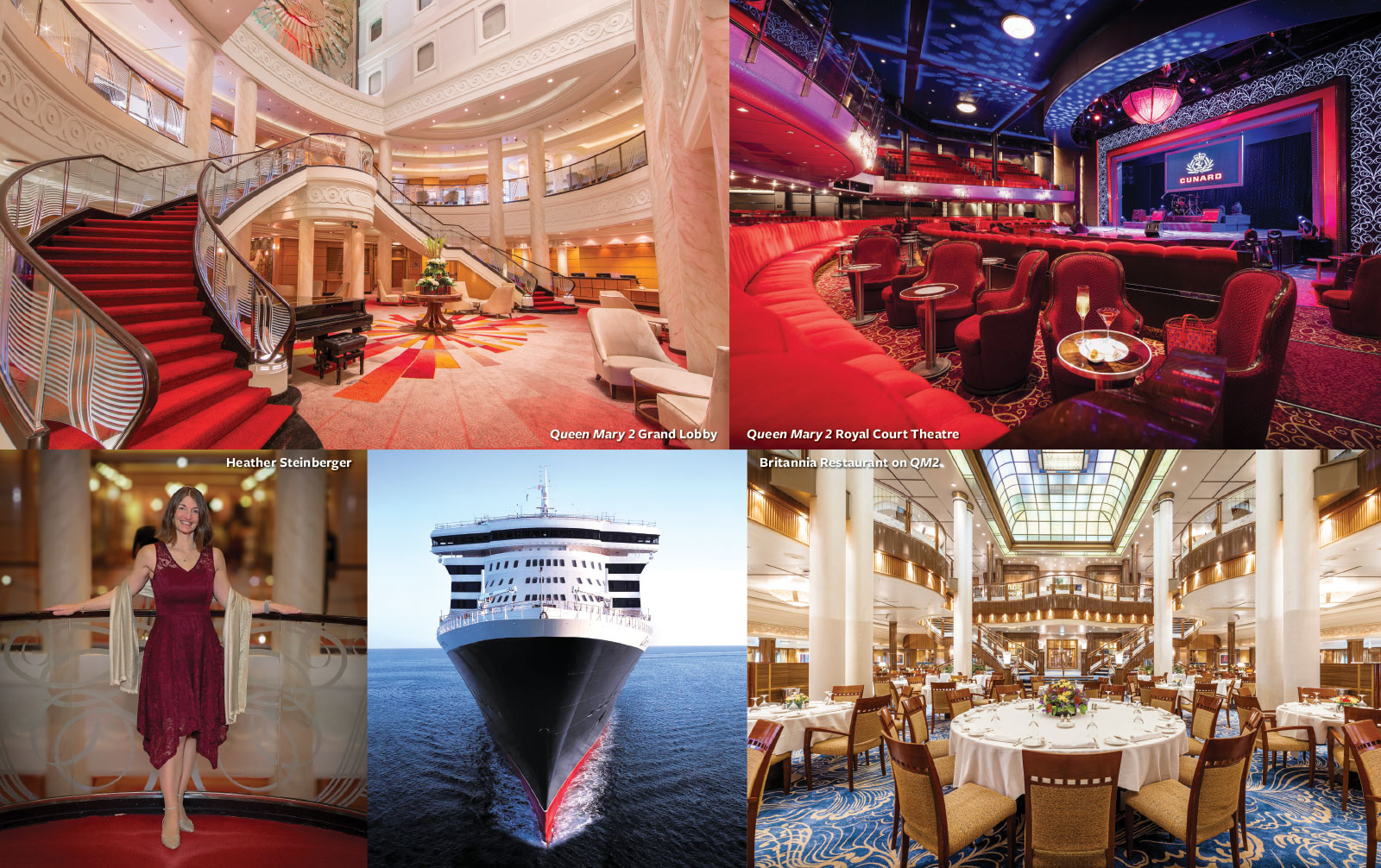
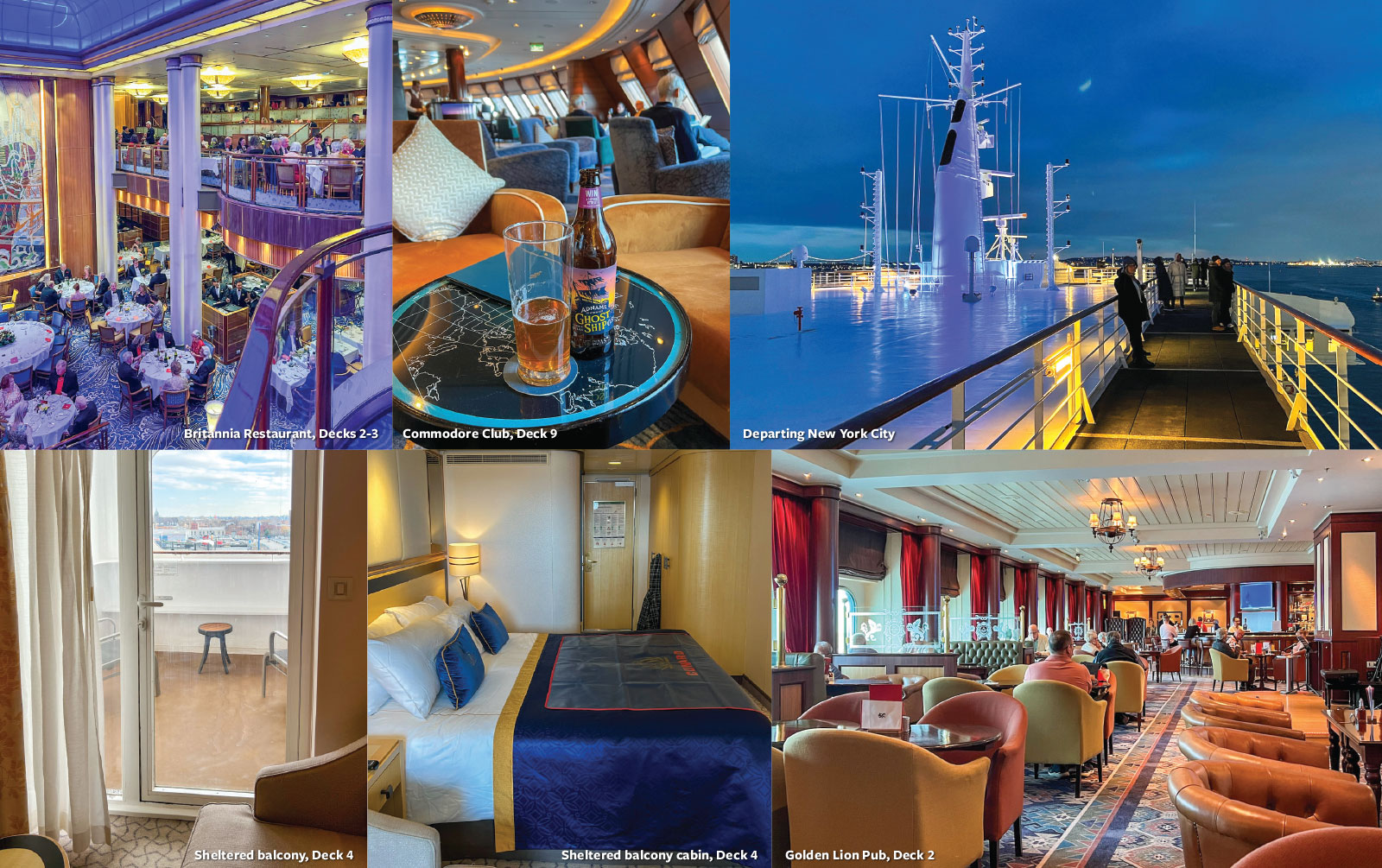
So, shipboard life continued uninterrupted. We attended lectures, planetarium shows and afternoon tea. Following time-honored tradition, we dressed for dinner in gowns and cocktail dresses, tuxedos and even full Scottish regalia, descending the Grand Lobby staircase and strolling the ship’s broad central companionway to the soaring, two-deck Britannia Restaurant.
Despite the rambunctious conditions, we lingered over multiple-course dinners and then drifted between theatrical performances in the Royal Court, ballroom dancing in the Queen’s Room, and nightcap music in the Chart Room or Commodore Club.
Occasionally, we felt the ship surf down the face of a large wave, and in the trough, the lower-deck windows were briefly submerged in swirling, dark water. After a gasp or two and a ripple of laughter, the cheerful buzz of conversation resumed.
More than a ship
Throughout the storm, we filled the window seats in the tucked-away corridors on Deck 3L. When it eased slightly, we marveled at the snow on the promenade deck, where passengers and crew built tiny snowmen and playfully threw snowballs at one another.
“Slightly adverse sea conditions may not be that unusual, but it is rare that we have snow on deck,” Capt. Hall tells me afterward. “The Mareel Spa team built an excellent snowman, and I think we were slightly sad to see him (or her) melt.
“It’s nice to see some exciting conditions from time to time, and to see Queen Mary 2 handle exactly what she was designed for,” he continues. “For me, though, I rather prefer flat, calm conditions.”
We all knew we were experiencing something remarkable. We were forging bonds with one another. And we were grateful aboard this particular ship.
“When you step aboard QM2, you’re not a spectator,” Kirsten says. “You’re on the stage, and it’s genuine. You’re part of something, the magic and adventure of it all.”
Oneonta, Alabama, resident Carol Roberts agrees. When she and a longtime friend planned to visit England in January 2024, they decided QM2 was a better choice than an airplane.
“Jill said it wouldn’t cost that much since we would share a room,” Carol says. “It was the opportunity of a lifetime, so I said yes and didn’t look back!
“The storm was glorious. I found a seat (on Deck 3L) as often as I could just to watch the waves and the sky. After crossing in January, I couldn’t imagine a better time to cross. And of course, I met some very interesting people, which is always fun.”
Kirsten said meeting her fellow passengers is her favorite part of crossing the North Atlantic aboard QM2, after the ship. She said being a solo passenger is key.
“If you travel with a partner or your family, you don’t engage as much with strangers,” she explains. “I never attended a single solo-passenger meetup, but it was so easy to meet people. I never felt ostracized. You invite each other to sit down, to join. You are together for this experience, and even if you don’t keep in touch, you never forget the people.”
What’s more, Cunard sets aside tables in Britannia Restaurant for solo passengers, allowing you to connect with the same people each evening and get to know them better. For me, the storm and my dinner table were major highlights of sailing aboard QM2.
“I would tell solo travelers, especially women, don’t be afraid,” Kirsten says. “Just go do it.”
A crossing, not a cruise
After more than three tempestuous days, the storm blew itself out. The wind finally backed to the south, sea conditions eased, and the heavy overcast broke.
Passengers filled the teak deck chairs on the liner’s starboard side, reading books and napping in the weak winter sunshine. The busy English Channel lay just over the eastern horizon, and the dream was almost over.
That afternoon, as I strolled along the promenade deck in the fading light, I caught a glimpse of an ornate table setting in one of the Grill’s restaurants. The contrast between warm, timeless elegance and storm-tossed ocean took my breath away.
This is the spirit of the North Atlantic run. As old-timers will tell you, a crossing is not a cruise, and this ship is one of a kind.
“Queen Mary 2 is a very special ship,” Capt. Hall says. “She has an understandably loyal and dedicated following by both her guests and crew.”
Kirsten counts herself among them, noting that she intended her 2022 QM2 transatlantic crossing to be “one and done.” She has completed three additional transatlantic voyages since then and said she would do another in a heartbeat.
Perhaps that is why Queen Mary 2 will not be the last ocean liner, any more than her predecessor was. She offers a chance to relive the golden age of ocean liners — with its rare blend of luxury, adventure and human connection — and reminds us that the journey can matter as much as the destination.