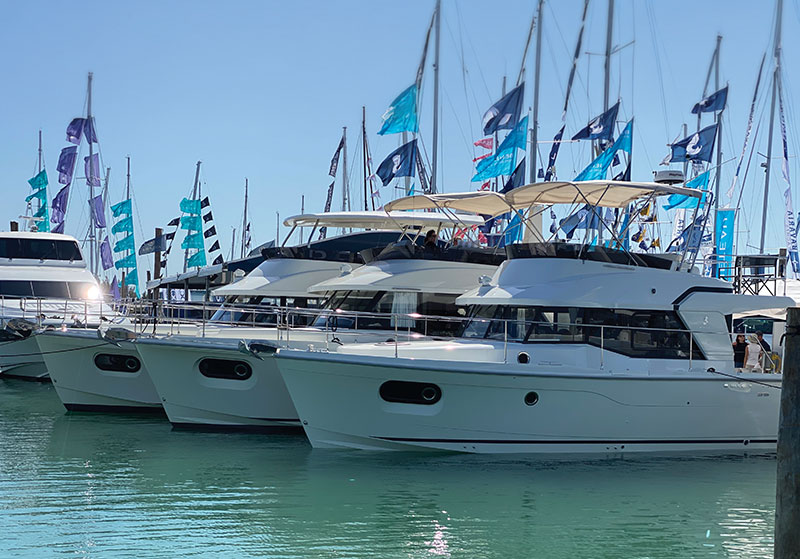
Tips for finding your dream Loop boat.
Story & photos by Tom & Brenda Lahey
You have decided that America’s Great Loop adventure is for you! Now it’s time to pick a boat. There are very few wrong boats for doing the Loop. Choosing a boat for the Loop involves determining the level of comfort you desire, your budget and how much of the Great Loop route you want to visit.
The basics
The Loop has been completed in just about every type of vessel imaginable. Canoes, kayaks, PWC, fishing boats, pontoon boats, cuddy cabins, houseboats, trawlers, cruisers, sailboats, catamarans and even yachts. When considering your Loop boat, the minimum requirements for most boaters are an enclosed cabin, sleeping accommodations, a galley and a head. Once these basic needs are accounted for, comfort, economy, performance and capabilities will guide your choices.
Size matters!
To do the “Great Loop” rather than the “Great U-Turn,” there is one obstacle, which is the 19-foot, 6-inch bridge on the Chicago Sanitary and Ship Canal. To go from Lake Michigan to the Mississippi River, this is the one bridge that you must pass under that doesn’t move.
When considering a boat, make sure it has an “air draft” (the distance from the surface of the water to the tallest portion of the boat) of less than 19 feet, 6 inches. For many boats, this may mean lowering masts and antennas, or removing radar domes, anchor lights and Biminis.
Other parts of the Loop, especially the canals, also have height restrictions. The Eastern Erie Canal and Oswego Canal have a maximum air draft of 21 feet, the Western Erie is only 14.6 feet, the Champlain Canal is 16 feet and the Trent-Severn Canal is 20 feet.
Water draft (the distance from the water surface to the lowest point on the hull or propellers) is an important consideration, as some stretches of the Loop have shallow water. The suggested maximum draft for a Loop boat is 5 feet.
Beam is the final consideration. For most monohull boats, the beam will not be an issue. If you are considering a catamaran, remember that locks on the Trent-Severn can be as narrow as 23 feet, and many marinas have limited dock space for wider boats.
Looping boat styles
The most popular boat type on the Loop is the trawler. Brands such as Grand Banks, Ranger Tugs, Mainship and DeFever are a few classic Looping boats. These are abundant, offer good fuel economy and provide plenty of living space.
Cruiser-style boats are also quite popular and offer comfortable accommodations, with many capable of faster cruising speeds. Brands like Sea Ray, Cruisers Yachts, Carver, Silverton and Bayliner are among the most popular.
Powered catamarans with large, wide living spaces are another popular choice. PDQ, Leopard and Endeavor lead the list.
Each year, several sailboats and sailing catamarans complete the Great Loop. In sections with height restrictions, some boatyards specialize in stepping (raising/lowering) the mast to facilitate passage.
Some choose to carry the mast in a cradle on deck, others have it shipped ahead, and some just leave it at home for the entire Loop.
According to the America’s Great Loop Cruisers’ Association (AGLCA), the average boat length in 2024 was 40.8 feet. Of the 270 completions, 7% were under 30 feet, 33% were 30 to 39 feet, 49% were 40 to 49 feet, and 11% 50 feet and above. While many smaller boats travel the Loop, consider that there are many areas of open water. A larger boat will provide greater stability and a smoother ride when the wind and waves pick up, giving you more options on travel days.
Economies of scale
When selecting a boat, most Loopers try to find a compromise between livability and economy. As with all things boating, everything is a compromise. Larger boats provide more living space, larger beds and more storage. Smaller boats offer ease of operation, lower operating costs and, for trailerable boats, the option of jumping around the Loop.
A key consideration is the operating cost. Larger boats will use more fuel, which for many is the largest expense. Marinas typically charge by the foot for dockage, so the longer the boat, the more expensive the marina stay becomes. Also, in some parts of the Loop, dockage space for larger vessels is limited. Boats 50 feet or more in length or wider than 15 feet may find available dock space limited.
If you can not commit to a full year or more to do the Loop in one go, a smaller, trailerable boat may be the answer. We frequently meet Loopers who are doing the Loop in sections, as time and finances allow. The smaller tugboats, like Ranger and Nordic, offer good living accommodations in a compact, trailerable size.
One or two engines
One of the more hotly debated boat choices is whether to go with one engine or two. Single-engine boats are typically simpler, more fuel-efficient, and less expensive to purchase and maintain. Twin engines provide some redundancy and, in many cases, the option to go faster in open water, giving you more time in port or to get ahead of bad weather. Bear in mind that large portions of the Loop are in canals and rivers where speeds are restricted, so much of the Loop will be completed at 10 mph or less. Where a faster vessel comes into play is in open water, such as the Great Lakes, crossing bays or the Gulf. While the ability to “outrun” weather is a common reason for purchasing a faster boat, the reality is that watching and avoiding bad weather is the safest course of action.
Fuel is another consideration. Vessels that operate on diesel are more fuel efficient, especially larger ones. Both gasoline and diesel are abundant along the Loop route. Price per gallon varies widely, but by using guides and talking to other boaters, you can find the best deals. Waterway Guides and CRUISERSNET.NET both publish weekly fuel price updates.
One and done or ongoing ownership
Many Loopers purchase their boat just for the trip, then sell it when they cross their wake at the end. For others, cruising is an ongoing passion, and the Loop is just one trip of many. If you are considering purchasing a boat just for the Loop, you may be willing to make compromises in features that a long-term cruiser or liveaboard boater may not. Also, consider your start and end points to maximize resale potential. Boats in Florida sell much more quickly than boats in the north.
How to find a boat
The first step to finding your Great Loop boat is to do some research and make a list of your “must-haves,” “nice-to-haves,” and “don’t-wants.” Walking the docks at your local marinas and looking at boats is a great way to get an idea of the size and style of boats. Attending boat shows and AGLCA events gives you an opportunity to talk to owners and see boats up close. Many AGLCA events include “Boat Crawls,” where owners open up their boats for tours.
Once you have an idea of the style and features you’re looking for, browsing the multitude of boat listing websites will let you find specific boats and view photos and videos. When you are ready to buy, we recommend finding a yacht broker to work with. This is referred to as the buyer’s broker. They will represent you and watch out for your best interests. Brokers have access to private listings and can frequently find specific makes and models. They will advise you on the overall condition and help you fine-tune your selection criteria. Finally, a broker will work with the listing broker to get the best deal and help to negotiate after a survey. Look for a broker with knowledge and experience of Loop-capable boats.
Don’t just look in your local area. The southeast, especially Florida, is the biggest boat market and offers the most choice in Loop-capable boats. Many who locate a boat outside their home area will start their Loop from the boat’s location, especially if they plan to sell it at the end of their trip. This can also be a great way to start your trip with the main Loopers group if you live in a northern climate. By purchasing a boat in Florida, you can begin your Loop adventure in early spring when many of the northern waterways are still frozen!
The survey
When you think you’ve found your perfect Loop boat, work with your broker to schedule a survey. Similar to a home inspection, a survey will determine the boat’s actual condition. A full survey includes a systems survey, engine survey and hull survey. These are frequently conducted by three different surveyors with expertise in each area. During the survey, the boat will undergo a “sea trial” and be run at various rpms to test engine performance. It will also be hauled out of the water to allow for a complete inspection of the hull and running gear (propellers, shafts, thrusters, etc.). The engine survey will inspect all hoses and pumps, and the fuel, cooling and electrical systems. The surveyor will take samples of the engine and transmission fluids for analysis.
A complete survey on a Loop-class boat will cost several thousand dollars. Don’t skimp on the survey! Boats are typically sold as-is. Once you take delivery, repairs are at your expense. Get your own surveyor from independent, certified surveyors.
There are very few “wrong” boats
As you can see, when it comes to the Great Loop, there really is no wrong boat. Aside from the 19-foot, 6-inch bridge in Chicago, there are route options that allow most boats to complete the Loop. The best boat may be the one that you already have! It really comes down to your budget and the level of comfort you want on your trip. As the saying goes, “Loop your own Loop!”
Top image: Three sizes of trawlers at the Miami Boat Show
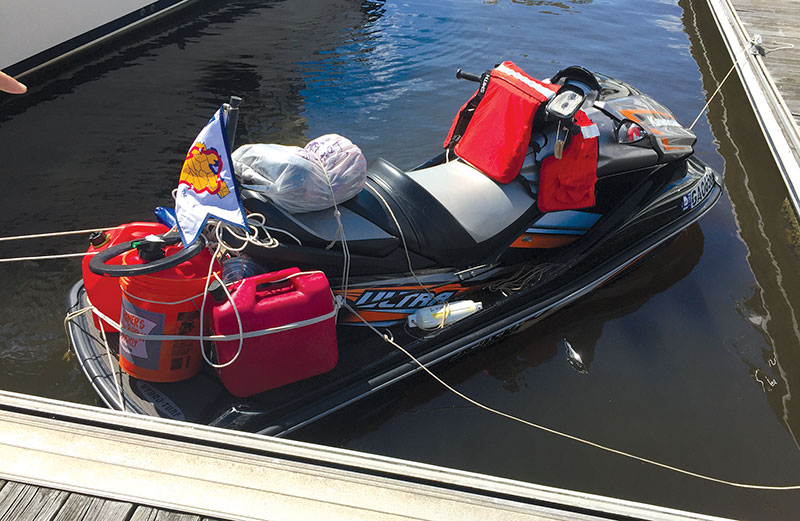
A PWC all decked out for the Loop
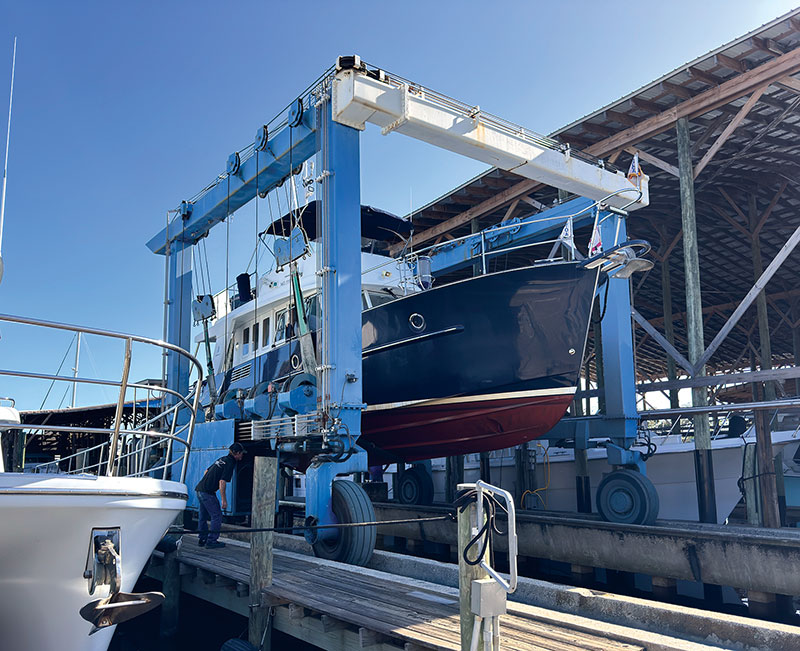
Hauling out for a survey
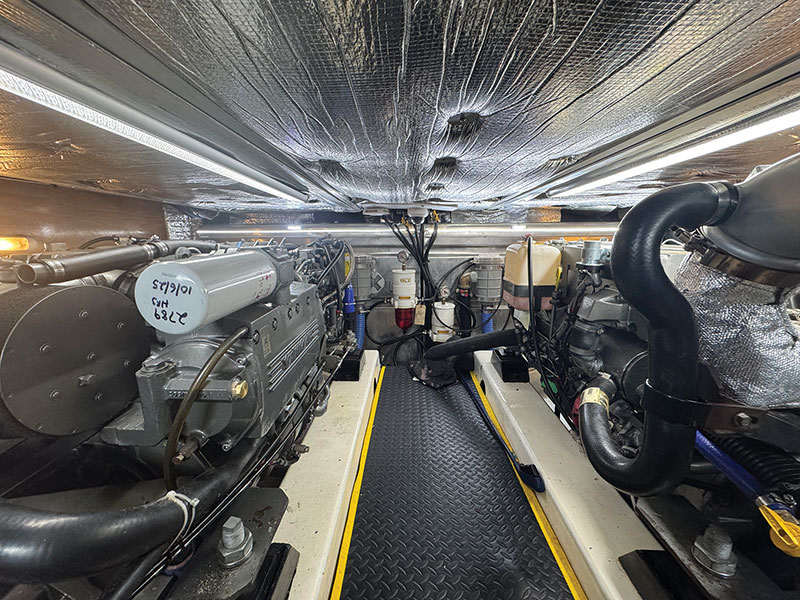
A nice clean engine room