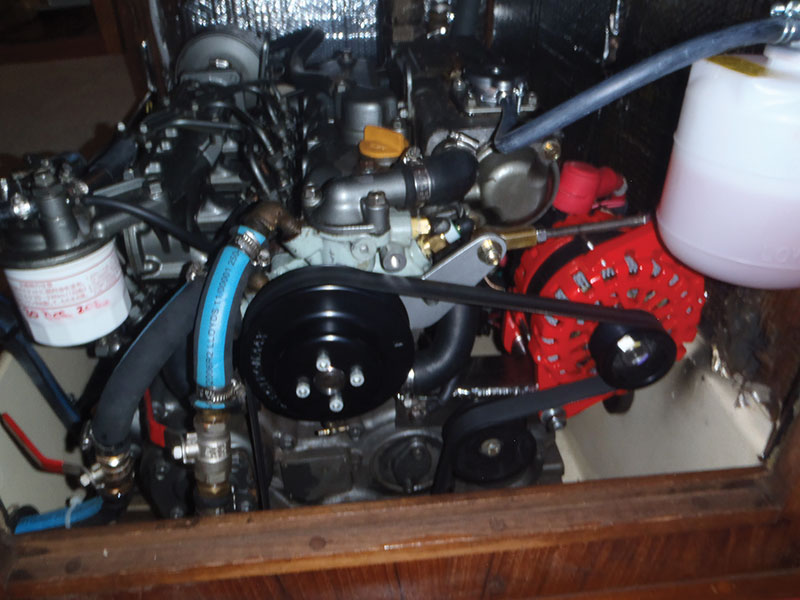
Alternator belt
Make sure you know these 10 diesel engine components.
by Capt. Frank Lanier
Familiarity with your diesel engine is crucial for conducting routine maintenance and effecting repairs when emergencies arise. Here’s a “by the numbers” look at 10 diesel engine components that every boat owner should know on sight and why.
1. Raw water seacock and strainer: Marine diesels have cooling systems just like their terrestrial counterparts; however, instead of air, they use the water your boat is floating in (via a heat exchanger) to keep things cool. The raw water seacock is simply an on/off valve located at the intake through-hull that provides “raw” water (the water outside the hull) to the cooling system. The seacock allows you to shut off this water when the engine is not in use or in the event of a problem (such as a ruptured hose). The raw water intake strainer is located in line between the seacock and engine raw water pump. Its purpose is to prevent debris and other stuff from reaching the engine, where it could damage the engine raw water pump or cause overheating issues due to clogging. The bowl of the strainer should be clear, allowing you to readily see if it’s dirty or clogged.
2. Engine raw water pump: As the name implies, it draws raw water in and pumps it through the open or raw water side of the engine’s cooling system. Inside this pump is typically a replaceable rubber impeller, the vanes of which can fail and break off due to age or overheating when running the pump dry (forgetting to open the engine raw water seacock is a common cause of this). Opening the engine raw water seacock before cranking your engine and checking the exhaust for ample water discharge after starting are two important items for every boat owner’s engine startup procedure.
3. Coolant system (fill and reservoir): Like the radiator in your car, the closed cooling system contains and circulates coolant (aka antifreeze) throughout your engine to prevent overheating or freeze damage. External reservoirs (if installed) allow you to check coolant levels at a glance.
4. Primary and secondary fuel filters: Fuel filters keep gunk from reaching your engine and can clog if you take on bad fuel or when sediment in your tank is stirred up due to rough conditions. Primary filters are normally mounted external to the engine on a bulkhead or other suitable structure. They contain replaceable elements and typically have a clear bowl, providing you with a visual clue as to the condition of the fuel. Secondary fuel filters are normally a screw-on, cartridge-type unit mounted on the engine. They have a finer (smaller diameter) element to catch any contaminants that make it past the primary filter.
5. Fuel lift pump: Practically every diesel engine has one. It lifts fuel from the fuel tank, pulls it through the primary fuel filter, then pushes it through the secondary fuel filter and into the fuel injection pump, which then sends fuel to the individual cylinders for combustion. It’s also where the manual hand priming lever is normally located, which allows you to bleed air from the fuel system.
6. Air filter: A diesel engine needs two things at a minimum to run: Clean fuel and air. The air filter keeps your engine from ingesting airborne dirt and grime. A clogged air filter means loss of clean air for combustion, which can lead to any number of problems, from sputtering and loss of power to engine shutdown.
7. Battery and primary switch: You need power to start your engine and that comes from the starting battery. It can be a single battery or a battery bank (two or more batteries connected in parallel to mimic a single, large battery). Most boats have DC volt meters (typically at the main DC control panel) to help monitor battery charge; however, a handheld multimeter can also be used. The battery switch (typically big and red) allows you to turn battery power to the engine on or off.
8. Alternator: The power you need to start your engine comes from the starting battery, but it’s the alternator that keeps the battery fully charged and ready. Alternators are powered by the engine via a pulley and belt system (newer engines use a serpentine belt, rather than the old V-belt design found on your granddad’s Buick). If the belt fails, the alternator stops charging the batteries, which in turn will eventually discharge and fail to start the engine.
9. Starter: Another easy one that does just what it says, which is to crank the engine (using power from the battery) until it starts.
10. Dipstick: Not your know-it-all dock neighbor, but rather the device that lets you check oil levels in your engine and reduction gear (aka transmission) — something that should be done every time before getting underway.
Raw water pump impeller
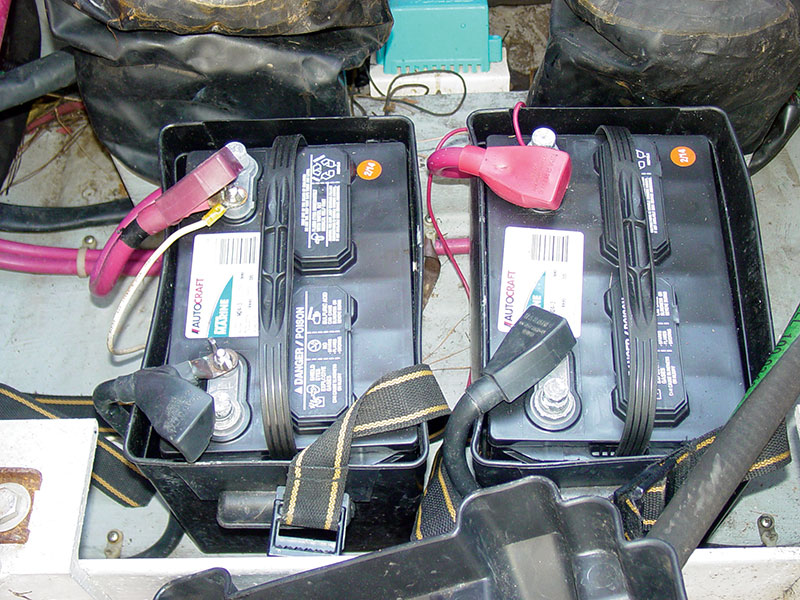
Starting batteries

CAPT. FRANK LANIER is an award-winner journalist, boat maintenance guru and owner of Capt. F.K. Lanier & Associates, Marine Surveyors and Consultants. Check out his YouTube channel “Everything Boats with Capt. Frank Lanier.” CAPTFKLANIER.COM