Fun and delicious.
by Dave Mull
Want to try something completely different this fall or spring? Then head to Lake Superior or Lake Huron and try your luck catching splake.
The splake is a hatchery-created hybrid, and its name combines the ‘sp’ from speckled trout (a common nickname for brook trout) and the ‘lake’ of lake trout, as hatcheries fertilize lake trout eggs with brook trout milt. Exact origins of splake are hard to find, but they were first created sometime in the 1870s. Both Wisconsin and Michigan started stocking splake in earnest 100 years later, in the 1970s, after invasive sea lamprey decimated native lake trout populations. Since splake grow faster than either of their parent species, the thought was they might spawn before becoming large enough to interest the lamprey while providing a sport fishery to fill the lake trout void.
It turned out that splake spent a lot of time nearer to shore than lake trout do, creating all-new fishing opportunities for shore-bound and small boat anglers.
Because of this, splake remain popular and stocking continues, even though lamprey control has allowed lake trout to rebound. It doesn’t hurt that many Great Lakes anglers consider splake to be the best tasting trout around.
Splake are discernible from their parent species mainly by the shape of their tails. Whereas a brook trout’s tail is squarish and a lake trout’s tail is markedly forked, the splake’s tail is in between. It’s fairly common to catch splake in the 5-pound range, and state records in Wisconsin and Michigan are both more than 17 pounds.
Where and when
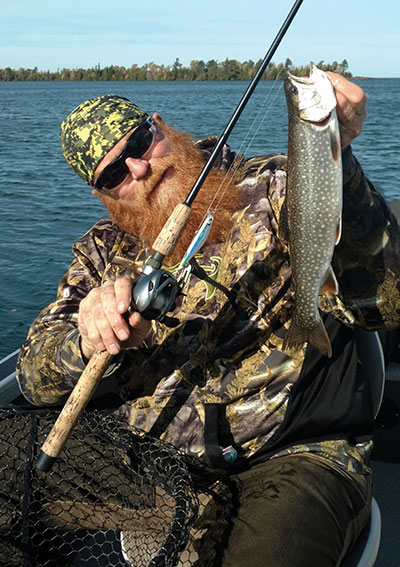
The best places to target splake right now are in the Michigan waters of Lakes Superior and Huron, where stocking continues. Hessel Bay in Lake Huron, and both Copper Harbor and Munising Bay on Lake Superior, are three great areas to try your luck. Catching a splake had been on this writer’s bucket list since childhood. I finally caught my first in mid-October about eight years ago. Captain Travis White joined me on my 17-foot MirroCraft in the shallows of Copper Harbor, way up near the tip of the Keweenaw Peninsula. We used the small boat’s bow-mount electric trolling motor to position ourselves, and cast for the fish.
White had assured me that the fish would be numerous and aggressive, but on that day only the first part of that proved true.
Despite being able to see large numbers of 4- and 5-pound splake swimming around us in the clear water, hovering near the lakebed in 10- to 15-foot depths, they turned out to be more difficult to catch. Travis’s first lure was a white and chartreuse Berkley Gulp Jerk Shad, a heavily scented soft-plastic lure rigged on a single hook and twitched to imitate a darting baitfish. I started with a 3-inch soft plastic swimbait. They’re both proven lures, but the splake refused to cooperate.
After a couple of fishless hours, I switched to a Rapala RipStop jerk bait, a flashy hard plastic minnow lure meant to be fished fast and erratically.
On the very first cast it caught a fish, a wriggly splake of about 2 pounds and just a bit longer than the 15-inch minimum size limit. On the second cast, the RipStop caught another one, this fish a little bigger still.
“We might get our limit after all,” I chuckled hopefully. Of course, that remark applied an instant curse to us and we didn’t catch another keeper.
Later that week I set the MirroCraft up for trolling and my late, great friend Steve Tracey and I spent a couple long days on Munising Bay, another area that has received yearly splake plants. Rapalas and Storm ThunderSticks taken to the side of the boat with online Church Planer Boards provided steady action.
If you’re unfamiliar with splake, then make this the year to change that. They’re a lot of fun and simply delicious.
Wisconsin DNR

Wisconsin DNR
Dave Mull
DAVE MULL Diehard angler Dave of Kalamazoo, Michigan, has contributed boat tests and features to Lakeland Boating for three decades. His current goal is catching a 30-plus-pound Great Lakes denizen from his Old Town kayak.