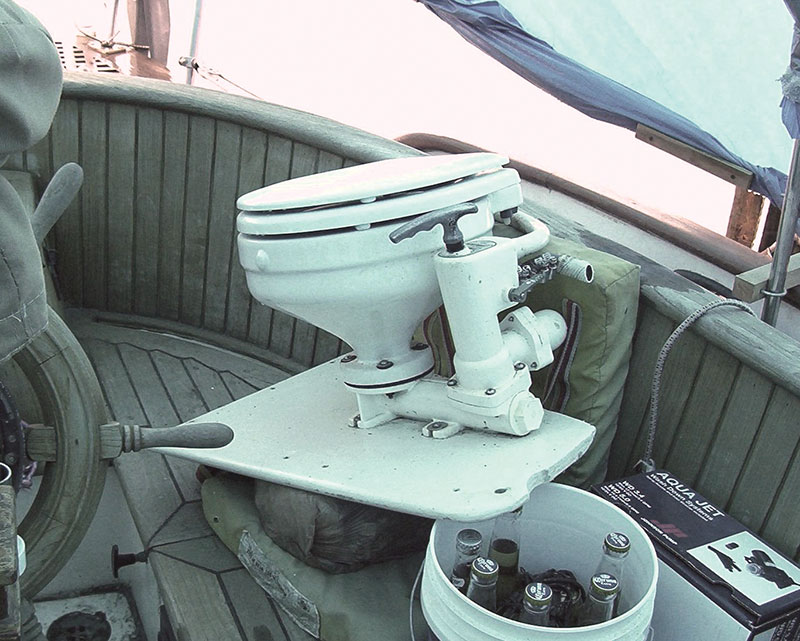
The most important seat onboard isn’t the one at the helm.
by Capt. Frank Lanier
While it’s often said the two best days of owning a boat are when buying and selling it, I’d argue there’s a third – the day you replace that old, temperamental marine toilet with a modern, efficient unit. Here are some options to consider when upgrading your own throne.
The number of styles may seem overwhelming at first, but marine toilets can really be broken down into five basic types.
Gravity-feed toilets work just as the name implies, with the unit positioned directly above an integral holding tank. Bowl contents drain directly into a removable tank (normally of 2 to 5 gallon capacity) which can later be dumped in the appropriate receptacle ashore. Flush water (if provided) is often supplied by an internal reservoir, although some larger units can be plumbed to draw flush water from the vessel’s freshwater system. Some can also be plumbed to a deck fitting, to allow remote pump-out.
Manual pump toilets utilize an integral hand pump to bring flush water into the bowl, where it mixes with the sewage and is then pumped clear. If plumbed to your freshwater system, it will include a tie into that system, a holding tank and pump-out options (deck fitting and/or overboard, depending on the vessel’s area of operation) as well as the various hoses and fittings needed to connect it all together.
Systems utilizing raw water for flushing will additionally require a below-the-waterline through- hull fitting, seacock and plumbing from the seacock to the toilet flush water intake.
Macerating toilets are designed to puree solid waste, much like a garbage disposal. This is typically accomplished by an electric grinder (aka the macerator) that uses blades to simultaneously chop and pump waste clear of the bowl. Flush water can be raw or from the vessel’s freshwater system. Installation will include the same elements of a manual head, plus the required electrical components, including wiring to the pump, circuit protection, a control panel and so forth.
Vacuum heads use an electric or manual pump to generate a vacuum in the system, which pulls sewage from the bowl to a holding tank when the toilet is flushed.
If you’re committed to having a green yacht, composting toilets utilize peatmoss to turn waste into compost. As they’re completely self-contained, they can be an attractive alternative to traditional toilets. No plumbing is needed; however they do require installation of a fan and vent pipe. Although early units were large and bulky, newer models have the same footprint as a standard toilet, making them a viable choice for most any vessel.
General installation tips
Although you will always want to follow the manufacturer’s instructions (which will list specific requirements for their particular system) the following general tips apply to most any toilet installation:
LOCATION
- Select a location that provides sufficient clearance around and above the toilet, ensuring there is room to operate the pump (if manual) and conduct maintenance.
- Make sure the seat and lid can swing up and over at least 110°, to prevent closing when the vessel heels or pitches.
MOUNTING
- Select a mounting surface that’s flat, rigid and strong enough to provide adequate support.
- The support area should be at least 2 to 3 inches wider and deeper than the base of the toilet and have sufficient clearance below the mounting surface to access and secure toilet mounting hardware.
- Use properly sized, marine grade mounting hardware including stainless steel through bolts, washers and self-locking nuts.
HOSE
- Use marine grade, spiral-reinforced smooth-bore flexible hoses for both inlet and discharge.
- Secure all hose runs against movement, provide chafe protection as needed and install so that hoses do not exert any leverage on toilet fittings to avoid leaks later on.
- Keep hose runs as short as possible and avoid sharp bends, which can cause kinks.
- Install double marine-grade stainless steel hose clamps at each fitting wherever possible.
- Install vented loops as required to prevent flooding.
Finally, keep in mind that your toilet is only one part of your vessel’s sanitation system. Correct installation and maintenance of the system as a whole is essential for proper, long-term operation and reliability.
Top image: Capt. Frank Lanier

CAPT. FRANK LANIER is an award-winner journalist, boat maintenance guru and owner of Capt. F.K. Lanier & Associates, Marine Surveyors and Consultants. Check out his YouTube channel “Everything Boats with Capt. Frank Lanier.” CAPTFKLANIER.COM