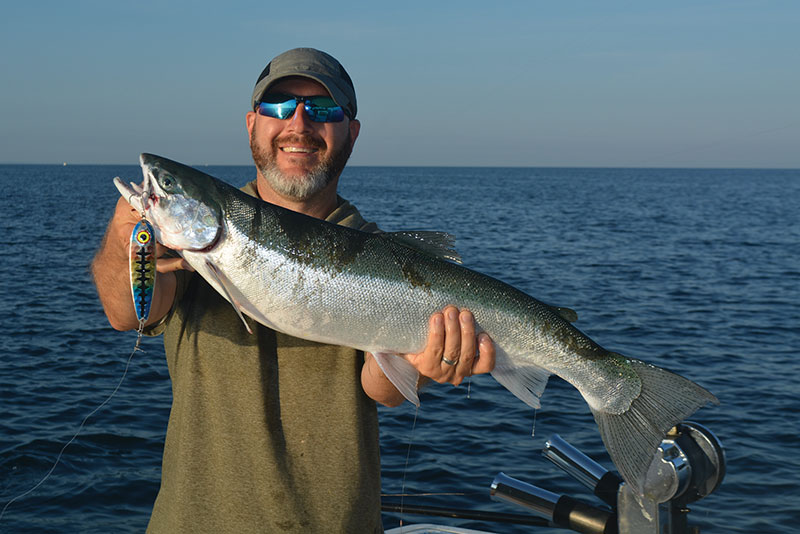
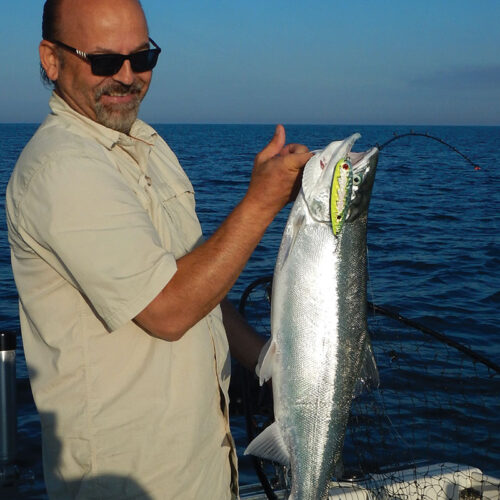
How to catch steelhead trout in the Great Lakes.
by Dave Mull
The steelhead somersaulting through the air behind my Uncle Marty’s boat back in 1973 hooked me on Great Lakes trolling for life.
Neither one of us really knew what we were doing when we motored out onto Lake Michigan from Michigan City, Indiana, on that fine June day. The lake was gentle, and Unc set four lines on downriggers and added an unweighted flat line on a big spinning rod pulling a jointed balsa minnow run right down the middle. The 17-year-old me — first time ever trolling on Lake Michigan — steered the 24-foot pre-owned Sea Ray that Unc had recently bought.
After a long morning of not catching, we trolled towards port to quit. Less than a mile from the harbor, the spinning reel drag screamed, and a silver torpedo vaulted from the water. Somehow, we got the 14-pound fish in the net; it was the biggest fish I’d ever reeled in. I was shaking with excitement, and more than 50 years later, the sight of that leaper with its aquamarine back is still clear in my mind.
A bit about steelhead
Steelhead are sea-run rainbow trout native to the Pacific Ocean. In 1876, Michigan hatched eggs imported from California and stocked the babies in Michigan’s Au Sable River, a tributary of Lake Huron. Other streams and rivers received plants soon thereafter, and steelhead now naturally reproduce in tributaries of all five Great Lakes. Some rivers still receive supplemental stockings.
Steelhead spend spring and summer feeding in the big lakes and return to streams and rivers in the fall. They live there all winter, spawn in the spring, and head back to the big water to repeat the cycle.
Steelhead tolerate warmer water than most of the other salmon and trout, and can often be found near the surface. They are ideal targets for the more casual troller. We’ve cruised in boats not rigged with downriggers and simply set one rod out with a stickbait (a jointed orange Rapala balsa minnow is always reliable) and hooked into steelhead.
How to catch them
For a full steelhead trolling spread, focus on the upper part of the water column, from about 40 feet down up to the surface. Steelhead are insect eaters, happy to also dine on alewives, stickleback minnows and any other small fish that they find. My best steelhead trolling rods incorporate segments of 27-pound lead core line. A 100-yard spool of lead core consists of 10 10-yard segments, each a different color. Typically, we use online planer boards from Offshore or Church and set the shallowest lines with no weight on the outside. Next out is a three-color lead core combo, then a five-color and a 10-color closest to the boat. The planer boards clip to the backing ahead of the lead core.
Lead core is a fine wire of lead encased in woven Dacron or other strong textile. It is thick, and water resistance causes it to rise with increased speed, then sink when it slows down. This rise and fall — exaggerated when behind online planer boards with the boat trolling in gentle “S” curves — provokes strikes.
Spoons, small dodger/fly combos and fish-imitating hardbody baits all garner bites from these silver beauts, which have a particular affinity for orange lures. These lures also catch steelhead when run behind diver disks, such as Dipsy Divers.
To rig segments of lead core, start with 20-pound monofilament for backing, tie the segment of lead core to the backing, and then add a 10- to 20-yard leader of 20-pound monofilament to the lead core. Add a big snap swivel and attach a second leader of 15-pound fluorocarbon line, about 10 feet long. Fluorocarbon is nearly invisible in the water, and the swivel keeps the planer board from sliding all the way to the lure after a fish hits.
While stream anglers in cold months can successfully release steelies, fish that battle through warmer summer water are unlikely to survive. Fortunately, they are delicious fried, baked, broiled or smoked.
DAVE MULL Diehard angler Dave of Kalamazoo, Michigan, has contributed boat tests and features to Lakeland Boating for three decades. His current goal is catching a 30-plus-pound Great Lakes denizen from his Old Town kayak.