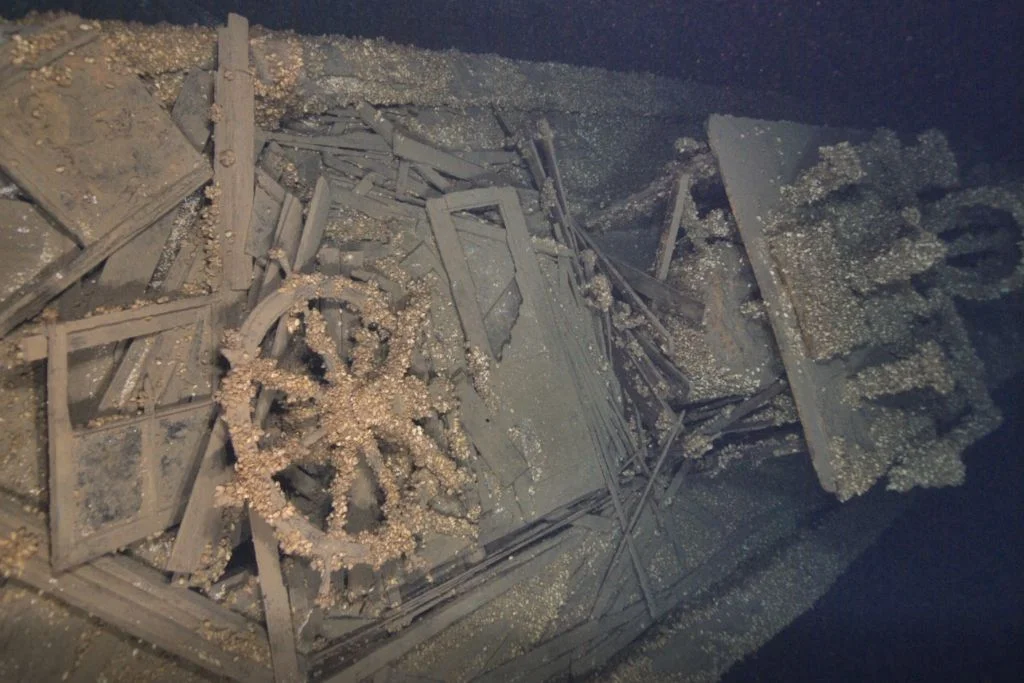
A team of eight students, scientists and engineers from the University of Rhode Island conducted the first survey of known shipwrecks in Lake Ontario National Marine Sanctuary. The survey utilized a new state-of-the-art remotely operated vehicle named Rhody to document 17 shipwrecks in the area, discovering new shipwrecks in the process.
Funded through the NOAA Ocean Exploration Cooperative Institute, the trip included maritime archeologists from NOAA’s Office of National Marine Sanctuaries. The ultra high-resolution survey conducted from the trip will help NOAA identify and preserve shipwreck sites in Lake Ontario.
Rhody’s small size allows for quick mobilization and easy transport, making it ideal for the process. “We needed something with a small for factor, making it easy for a student team to mobilize,” says OECI Associate Director Jason Fahy, who fostered a partnership with Norwegian company JM Robotics for the ROV. “Rhody is small enough to be carried by two people, but capable enough to host the high-end, powerful sensors we typically utilize in deep ocean exploration.”
The ROV includes the VOYIS Discovery Stereo Camera, designed to collect two simultaneous, high-resolution images that are then used to construct 3D models of each shipwreck. Student Ashly Martinez Rodriguez will work over the summer to generate the 3D models, which consist of tens of thousands of images for centimeter level accuracy and a photorealistic appearance.
To learn more, visit web.uri.edu.
PHOTO: NOAA OCEAN EXPLORATION COOPERATIVE INSTITUTE