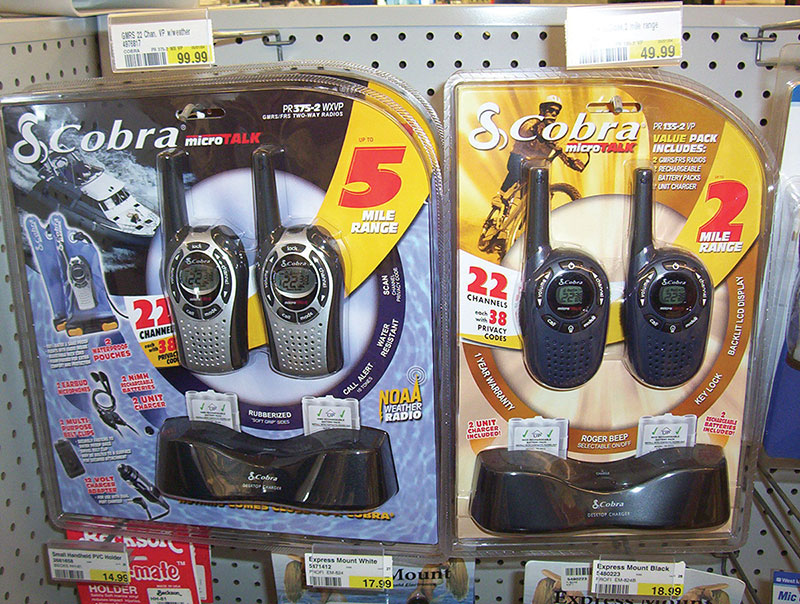
The rules and benefits of FRS (Family Radio Service) radios.
by Capt. Frank Lanier
You’ve probably seen them — those Buck Rodgers-looking handhelds that folks are using to keep in touch with friends and family members while at the ski slopes or the mall. You’ve also probably said to yourself, “Hmmm… those would be kinda handy to have on the boat.”
Well, they are handy to have onboard, and while they may conjure nostalgic memories of those brickbat walkie talkies you used as a kid, these are a lot better.
The units themselves are collectively known as FRS radios, short for Family Radio Service, which, as the name implies, is one of the Citizens Band Radio Services established to allow folks to communicate with family and friends on group outings. They’re also the only radios boaters can legally use to communicate between their vessel and crewmembers ashore (the use of VHF is illegal in this respect).
FRS is the result of over 25 years of effort by the Federal Communications Commission (FCC) to establish an unlicensed, personal radio service. After heavy opposition from current spectrum users (and equally enthusiastic support from radio manufacturers), FRS was finally approved by the FCC on May 15, 1996.
FRS offers 14 channels of unlicensed communications, meaning no licenses or permits are required for use. The radios have a max output of 1/2 watt (500 milliwatt) effective radiated power and integral (non-detachable) antennas providing up to 2 unobstructed miles of communications, although 1 mile or less is more realistic for good, clear comms in most cases.
Another benefit is price. I’ve seen lower-end units as cheap as $20 a pair, with more advanced units in the $80-$100 range or higher. That being said, in my experience, the range provided by most units appears to be pretty much the same, regardless of cost.
When to use
FCC provisions allow you to operate anywhere they regulate radio communications, as long as you meet the following:
- You’re using an unmodified FCC-certified unit (i.e. one with a manufacturer’s identifying label on it).
- You’re not a foreign government representative.
- The FCC hasn’t yanked your authority to use them.
These provisions grant authority for unlicensed use of FRS radios anywhere in the world, except areas regulated by other U.S. agencies or within the territorial limits of any foreign government.
The rules
Unlicensed use does not mean unregulated use, and there are cans and cants that users must be aware of.
First off, you can’t modify FRS radios, meaning they can’t be “souped up” by adding external antennas or power amplifiers — in short, anything that isn’t certified as part of the unit by the FCC.
Use is also limited to two-way communications, meaning you can’t use them to broadcast music, sports or do other types of one-way communication. The exceptions to this are brief test messages, traveler’s assistance or “emergency messages,” which the FCC defines as “concerning the immediate protection of property or the safety of someone’s life.”
Additional restrictions (not surprisingly) include no swearing or use of the system for any illegal purposes.
On the plus side, you can use your FRS unit for business-related communications, and there is no age or citizenship requirement.
Features & caveats
While most boaters won’t need many of the bells and whistles found on higher-end models, consider the following before splurging.
Many of the cheapest units only broadcast to channel 1 (462.5625 MHz), making it the most crowded channel of the system. If you’re using your radio sporadically or in more remote areas where other radios are unlikely to be present, this should be fine. Otherwise, units that have all 14 channels might afford more privacy.
Speaking of privacy, some manufacturers advertise certain models as having a “privacy” or “scrambling” code, giving the impression they’re capable of encoded operation. In reality, this feature still allows anyone to listen in on your conversations — you just won’t be able to hear them if they try transmitting to you (unless they have the same codes set).
Voice-activated microphone/headset combinations or push-to-talk earbud/microphone setups are also available. These systems may work OK in calm, windless areas; however, in many cases, ambient noise continually sets them off, and if you try to offset this by reducing sensitivity, they cut out when you’re speaking.
Some features only function with other radios from the same manufacturer or even the same model. This goes for accessories too; in most cases, they’re not standardized and must be from the manufacturer of your particular radio to work properly.
FRS radios are easy to use, are relatively inexpensive, and allow for boaters to communicate with crewmembers ashore.

CAPT. FRANK LANIER is an award-winner journalist, boat maintenance guru and owner of Capt. F.K. Lanier & Associates, Marine Surveyors and Consultants. Check out his YouTube channel “Everything Boats with Capt. Frank Lanier.” CAPTFKLANIER.COM