U.S. Coast Guard Station Niagara shares summer boating safety tips.
Coast Guard Stations along the Great Lakes are unique for slow winters that give way to round-the-clock action in the summer months. Winters are for ice fishing and recreation, and while Coast Guard crews train in ice rescue operations, those cases tend to be fewer than the peak recreational boating season from Memorial Day to Labor Day.
During the summer holidays, it’s common for Coast Guard Stations to be called out for multiple search and rescue cases a day. These cases can vary in severity from collisions and boat fires to boats taking on water or mechanical failures. Crews run on little sleep and a lot of adrenaline during the high-tempo summer months.
One station that sees an uptick in search and rescue cases is Coast Guard Station Niagara, located at the mouth of the Niagara River on Lake Ontario. The station is staffed 24 hours a day with crews ready to respond to emergencies on the water; however, many of these emergencies are preventable with proper preparation and boater education.
BE PREPARED
Petty Officers 2nd Class Brian Riedel and William Moore are boatswain’s mates at Station Niagara. Boatswain’s mates are one of the largest “rates,” or jobs, in the Coast Guard. They are specially trained in boat operations and navigation. At a station like Niagara, boatswain’s mates are often qualified as small boat coxswains, which means they are the ones in charge of the rescue boats and the crews sent out to assist mariners in distress. Riedel has been stationed in Niagara for the past two years; before that, he was stationed in Juneau, Alaska, while Moore was previously stationed in Florida. Coast Guard personnel rotate between duty stations typically every three to four years, so they often have a range of experience based on the different settings they’ve worked in.
“Boats are fun. I love driving boats. Boats are a great time,” Riedel says. “We tend to think about how much fun we are going to have, but we don’t always consider: Are there holes in the hull? Is there oil in the engine? Do we have enough life jackets? Do we have a fire extinguisher?”
While many of these questions might seem obvious, Riedel’s experience has taught him that recreational boaters often let their guard down and aren’t as prepared or knowledgeable as they should be. Circumstances can change rapidly on the water.
“On Lake Ontario and its tributaries, a common mistake we see is not having the required gear onboard or proper documentation,” Moore agrees. “I would advise boaters preparing for a day on the water to inspect their required safety items’ condition and expiration dates.”
Comparing boating to driving, an everyday task for many, Riedel puts it in simple terms: “If you get a flat tire on your car, you can pull over, but on a boat, there is nowhere to go. Whatever issue you have, you are stuck in that spot.”
“People should treat boating as a recreational activity, but also consider that you are still operating a motor vehicle,” Riedel cautions. “You should take it as seriously as you do when you get in your car, not only knowing your vessel is safe to operate, but also knowing how to operate it — just like you would with a car. If I don’t know how to drive a manual car, I’m not going to hop in a manual car and try to drive somewhere.”
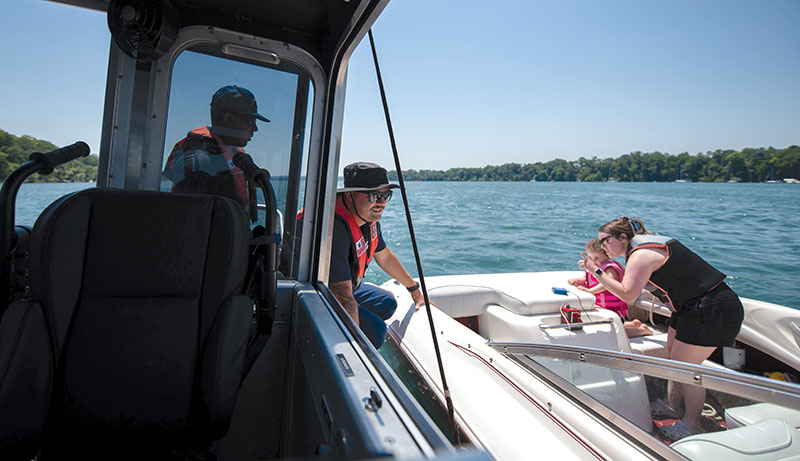
(Main photo) Petty Officer William Moore (center), a boarding officer at USCG Station Niagara, speaks with a boater during a safety boarding on the Niagara River during Operation Dry Water
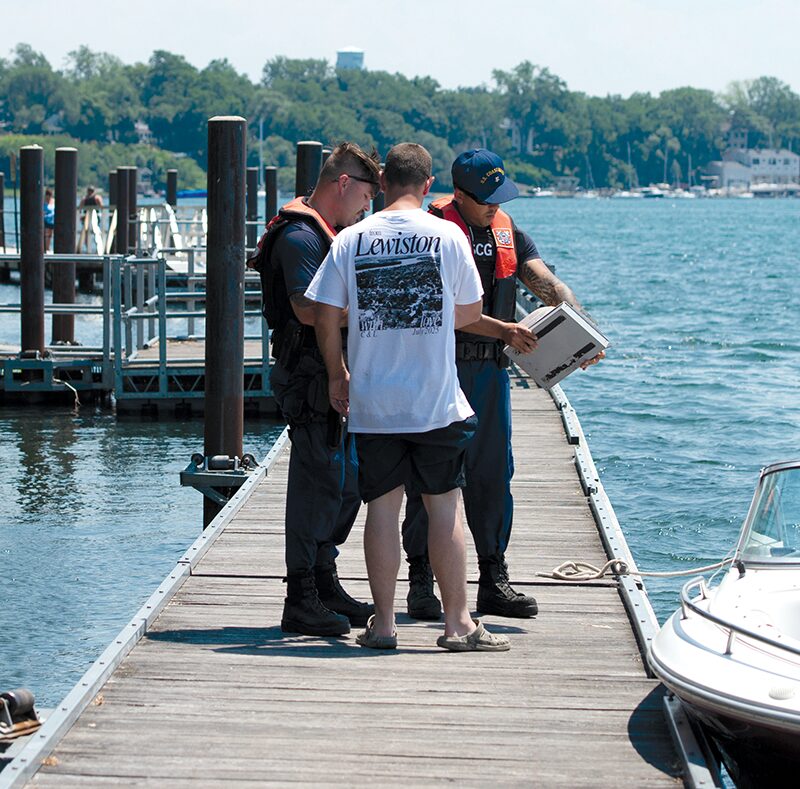
Coast Guard boarding team members conduct a safety boarding of a recreational boat at a dock on the Niagara River
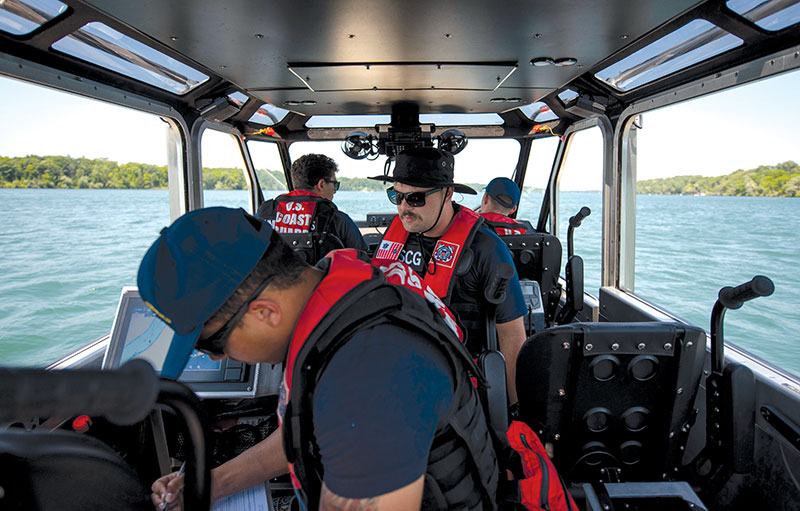
A crew from USCG Station Niagara prepares for a safety boarding of a recreational boat on the Niagara River during Operation Dry Water
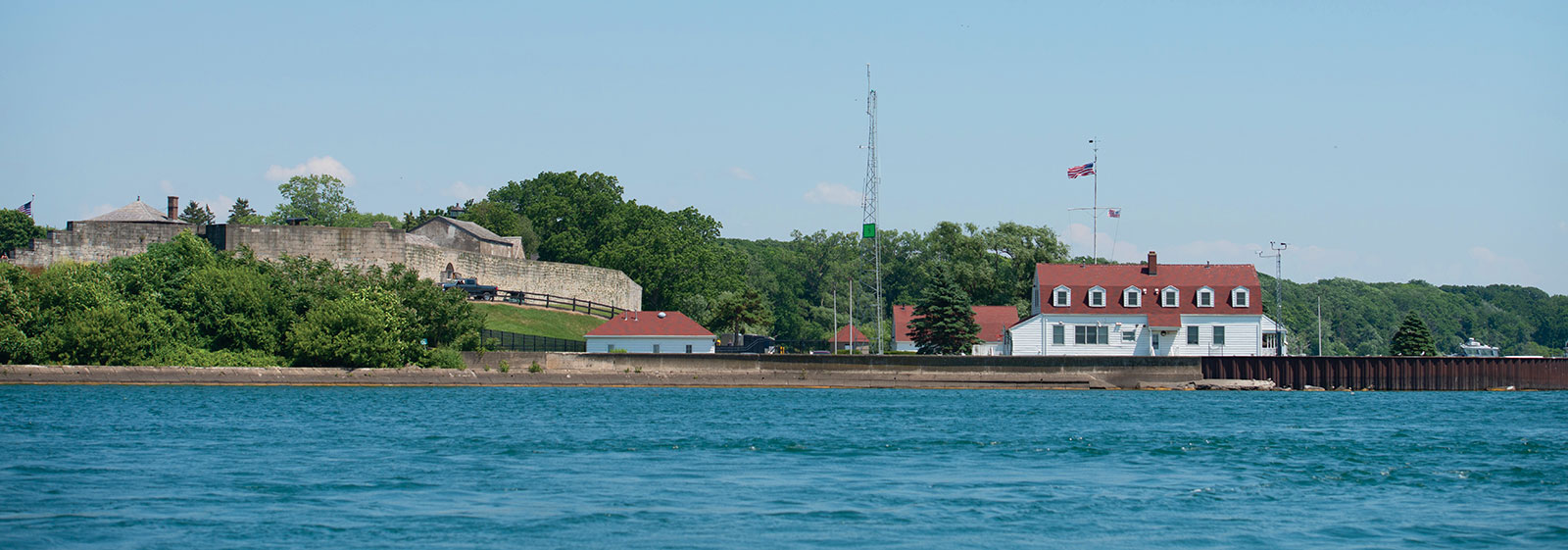
U. S. Coast Guard Station Niagara on Lake Ontario
LIVESAVING KNOWLEDGE
Preparation on the water can be put in two categories: Equipment and knowledge.
Boaters should ask themselves: Do I have all the required safety equipment onboard, and is it in good shape?
What equipment is required will vary by state and the type and size of boat, but the basics include life jackets for everyone onboard, fire extinguishers, a waterproof marine radio and visual distress signals, such as flares. Boaters should also be dressed for the weather. That might mean wearing layers on spring or early summer trips when air and water temperatures haven’t risen to summer peaks, or it might mean having proper protection from the sun in mid-July.
Moore advises boaters to carry at least two types of communication devices. For example, boaters should have a charged cellphone and a VHF marine radio. He also suggests having a way to charge your phone.
Moore also encourages boaters to file a float plan with friends or family.
“Let someone know your plan,” he says. “Let someone know where you’re going to be, and what time you’re expected to be back, so that person knows when to start getting worried and make the proper phone calls in the event an emergency occurs.”
Equipment is essential, but knowledge can also be lifesaving.
PREVENTATIVE MEASURES
Boaters should ask themselves if they have the necessary skills to operate their boats. If they feel like they lack experience or knowledge, they can seek out a boating class to gain more confidence. Each year, Coast Guard crews encounter unprepared boaters who are either excited to get back on the water after the long winter or are new to recreational boating. In the haze of excitement, mistakes can be made.
“We had a case where a gentleman bought a sailboat, picked it up from the slip, and brought it out on the lake,” Riedel says. “His outboard engine died, and he wasn’t really familiar with how to sail.”
When boaters become stranded in situations like this, they can call for commercial help from a towing company, but sometimes that isn’t available, or the situation deteriorates and becomes more dangerous because of weather or medical conditions.
This gentleman didn’t know how to sail, but he had a way to call for help, and Station Niagara answered that call.
“He had sat in his boat for a couple of hours and began getting seasick and disoriented. We went out there, got his boat in tow and brought him aboard,” Riedel says.
This was a case with a favorable ending, and it is a good example of the importance of equipping yourself with knowledge and the right gear.
“He was excited to sail his boat, and I’m sure he didn’t wake up that day and say, ‘I’m purposely going to get on a vessel I don’t know how to work and get myself in trouble.’” Riedel reflects. “It happens. It’s an accident, but there are preventative measures we can all take to keep ourselves and our passengers safe.”
The key to a safe summer boating season is having the proper safety equipment, a well-maintained boat, and good knowledge of navigation rules and how to operate your boat. Coast Guard crews across the Great Lakes are always ready to respond and do the job they signed up for. In an emergency, boaters should not hesitate to call for assistance. Being properly equipped and knowledgeable can prevent emergencies or buy boaters the much-needed time while rescue crews respond.
Riedel puts it this way: “Know your boat, and be aware and reflective on your knowledge and ability in operating your boat.”