A step in a new direction.
By Charlie Levine
Watching a man motor around the harbor in a small boat that’s been purposely cut in half to show off its unsinkable qualities will leave a lasting impression on a person.
Photos Courtesy of Boston Whaler
If you’ve been to a boat show in the last 30 years, I think you know what I’m talking about. Boston Whaler never shies away from pushing the needle.
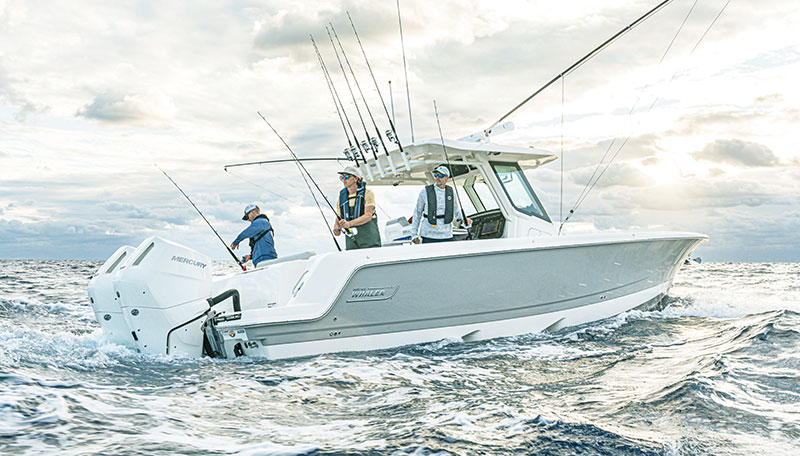
Boston Whaler’s foam-filled Unibond construction has earned a devoted following around the globe and on the Great Lakes alike for its unsinkable strength and reliable ride. The company is not afraid to incorporate the latest design and manufacturing trends if it helps them build a better boat, and the completely redesigned 330 Outrage is a prime example.
When Whaler announced that the all-new 330 Outrage — which debuted at the 2026 Miami International Boat Show — would feature the brand’s first-ever “WhalerStep” stepped hull, the boating world took notice. Stepped hulls are nothing new, but this marked a major departure for Whaler.
Stepped hulls first appeared in the early 1900s to create a hydroplane effect. The steps introduce air under the hull to reduce drag, increase speed and improve efficiency. The design really proved its might in offshore racing, and over the last 20 years or so, many center console builders — especially those who specialize in high-speed, hardcore fishing boats — started incorporating stepped hulls and never looked back. But putting a two-step hull on the 330 Outrage, which already ran great (and sold well), came with some risks.
After running the 330 Outrage with Kevin Donnelly, Boston Whaler’s senior naval architect, I can say the steps did their job.
 Getting on plane
 Getting on plane
I didn’t hammer the throttles down on the 330 Outrage, yet the boat jumped right up on plane in less than five seconds thanks to the steps and the twin V10, 425-hp Mercury Verado outboards with 18-inch props (the standard 330 Outrage comes with twin 300s). Great Lakes boaters accustomed to fighting a climbing bow in chop will appreciate how the 330 Outrage gets on plane with hardly any bow rise. You never lose an inch of visibility. At cruise, with the engines trimmed up, is where fuel economy increases.
“The boat is capable of running flatter, more bow down and pitch stable, which gives it that improved ride quality,” Donnelly says. “It’s like having your trim tabs halfway down without having to put your trim tabs halfway down.”
The 330 Outrage uses what Brunswick — Boston Whaler’s Fond du Lac, Wisconsin-based parent company — calls a T-step hull design. Donnelly explained that aft of the rear step, an unstepped portion of the hull creates a keel-like geometry that grips the water laterally in the corners, preventing any skittish behavior that plagued earlier stepped designs. I put the 330 Outrage in a hard-over turn at 32 mph, and the boat held tight, leaning into the turn without sliding out. In the calm waters, it carved a turn so tight that I could nearly reach out and touch the water.
The performance dividends proved real. The smaller 290 Outrage, which has the same stepped hull design, picked up nearly 20% in fuel economy. The 330 Outrage — already a well-balanced, great-running boat — gained about 7% in fuel economy and added roughly 1.5 to 2 mph at wide-open throttle. With the 425-hp Mercury outboards, the 330 Outrage cruises at 40.9 mph at 4500 rpm, netting 1.36 mpg. The boat holds 300 gallons of usable fuel, so if you drop the cruise down to 34 mph, you’re looking at a range of 369 miles. On our test day, running both directions to account for the current, we averaged 61 mph at wide-open throttle without a Seakeeper on the boat. With the standard 300s, you’re looking at a 40 mph cruise at 4500 rpm, netting 1.45 mpg and a top end of 53 mph. The smaller engines won’t deliver the torque of the 425s, but you do get more range.
 A reimagined layout
 A reimagined layout
Donnelly was very candid, saying the hardest part of this project was redesigning the boat without taking anything away from its predecessor.
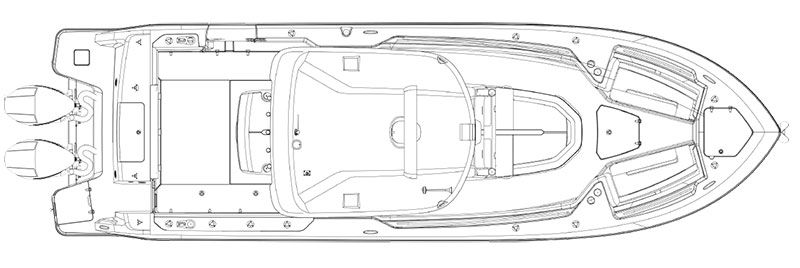
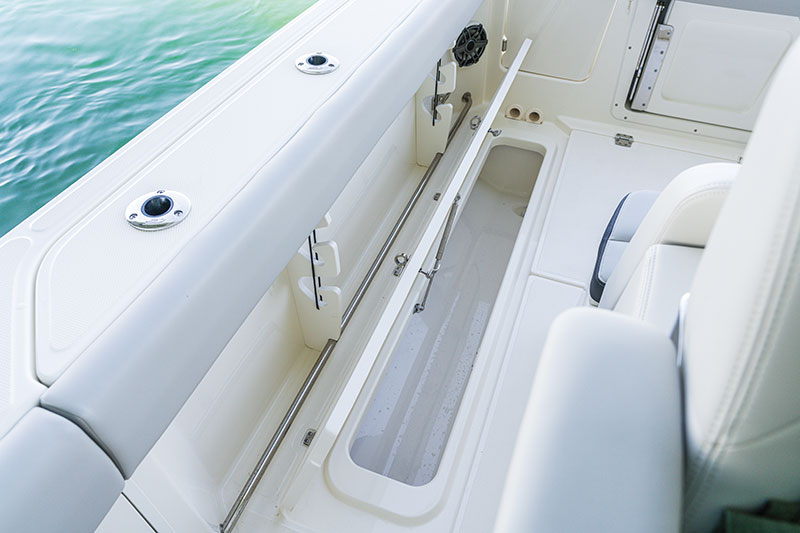
From the helm aft, the layout is similar to the previous 330 with a 44-gallon centerline livewell and mechanical space. The aft-facing seat, now with integrated armrests, has been stretched to accommodate an optional Seakeeper gyro stabilizer beneath it while retaining the seat. On the previous generation, adding a Seakeeper meant losing that seat. The seat’s backrest converts into a table/workstation for rigging baits or cutting limes, depending on what the moment calls for. Whaler utilizes every inch of possible storage space. There are three drawers in the console, cupholders where you need them, and two 52-gallon in-deck insulated fishboxes with pump-out.
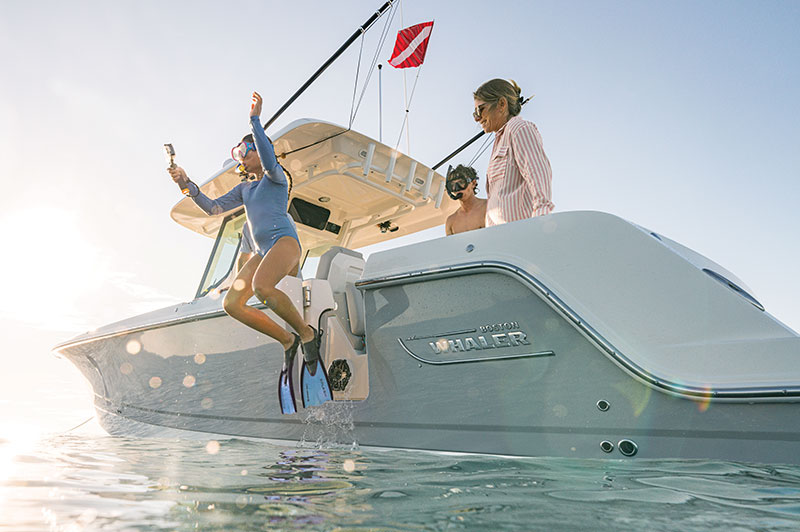
At the transom, Whaler increased the length of the wings of the swim step on either side of the engines, extending them further back. A recessed boarding ladder makes it safe and easy to get back in the boat after taking a dip at your favorite anchorage.
Moving forward, the changes become more dramatic. The helm is one of the more visually striking improvements. The clean, driver-centric design features dual 16-inch Simrad displays, which are factory-installed as part of the fully integrated Brunswick ecosystem that includes Mercury’s engine management. All of the technology onboard works seamlessly together, without any compatibility issues that may come from mixing platforms. The top of the uncluttered dash offers fairly deep cubbies with USB charging ports for phones, and plenty of room for sunglasses or binoculars. I liked the integrated compass under the electronics box. Call me old school, but I kind of freak out when there’s no analog compass on a boat.
The actuated vent in the tempered glass windshield lets air flow in and makes it easier to talk to friends in the bow. Visibility is great, especially with the fold-down platform that lifts the captain up several inches.
 The bow transformation
 The bow transformation
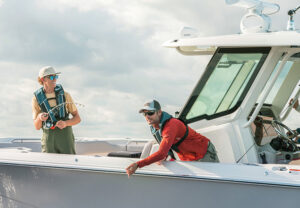
The previous generation featured a rear-facing bench bow lounge. The new 330 is completely different, with two forward-facing lounge seats that are tucked into the hull in a way that does away with fold-down backrests. The seats are arranged to face each other around a pedestal table, creating what Donnelly calls a “genuine social zone.” Four people can sit comfortably, face each other, and have a conversation. Drop the table down and add a filler cushion to create a nice sunpad for naps, or remove the cushions and you’ve got a wide forward casting deck.
The tabletop and post stow neatly underneath the lid of a massive storage compartment on the forward side of the console. When the table is stowed, you have clear access to the anchor locker without having to step on a cushion. The boat is also designed to accommodate a bow-mounted trolling motor, with a pre-rig option including a plug, and an onboard charger. The batteries live inside the forward lounge under a storage lid, keeping weight centered and bow storage uncluttered. This is a welcome option for Great Lakes anglers who follow depth contours on the walleye grounds or want to use the trolling motor’s digital anchoring function to stay put without tossing over the danforth.
Fishing credentials
 Fishing credentials
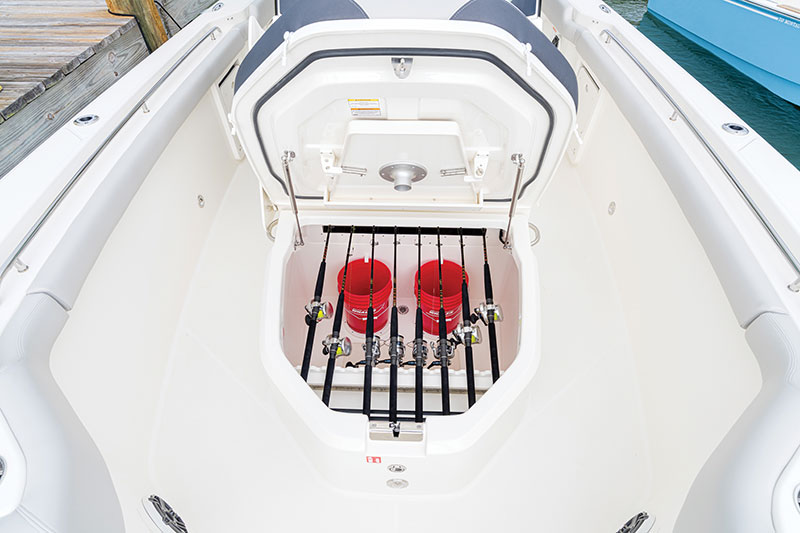
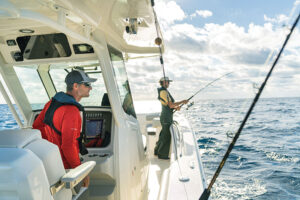
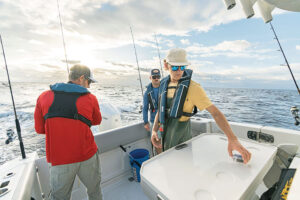
The 330 Outrage offers everything you need to fish and troll, including plugs for electric downriggers under the cockpit gunwales. You can add a second livewell in the leaning post. The boat comes with 13 standard rod holders and a rocket launcher. But my favorite fishing feature is the rod storage under the forward lounge. Whaler smartly designed this holder to extend into the head compartment so you can keep your full rods locked away out of the elements. This is ideal when making a long run across the lake, or if you want to leave the rods onboard at the marina. The rods don’t interfere with the head in the console, which is tall enough to easily make a wardrobe change. There’s also a teak floor inside the console and a sink with an extendable faucet.
The bottom line
For Great Lakes anglers who fish Lake Michigan in September or motor to remote Lake Superior shorelines, the new 330 Outrage delivers a faster hole shot, flatter running attitude in beam chop, better fuel economy for longer runs and a layout that gets the bow right.
The 330 Outrage is an appreciated departure from its predecessor. The boat has a striking profile with a straight sheerline that gives it a sexy, sporty look. You can tell the design team took its time on this boat. The swing-in side door is a prime example. The gunwale is recessed, so when the door is fully open, it sits nearly flush and won’t impede access up the side deck to the bow. That’s smart design, and you see examples like that all over the boat.
Boston Whaler set out to improve the boat without erasing what made it great. I’d say they hit the mark.

Bow storage capable of holding full-length fishing rods
Wings on either side of the outboards
Trolling motor option

Only offered with Simrad electronics package
Could use more standard cold storage in the bow (they offer a cooler as an option)
Specifications
- LOA: 33’10”
- Beam: 102″
- Draft: 25″
- Weight: 13,225 lbs.
- Fuel Capacity: 300 gals.
- Water Capacity: 39 gals.
- Max Power: 850 hp
- Base Price: $473,000 (w/ 2 x 300s)
- Website: bostonwhaler.com
Dealers
- B&E Marine
bemarine.com - The Boat House
boathouseh2o.com - Colony Marine
colonymarine.com - Gage Marine
gagemarine.com - Irish Boat Shop
irishboatshop.com