Cruising Canada’s canals, Georgian Bay and North Channel on the Great Loop.
Story & photos by Tom & Brenda Lahey
Canada is one of the highlights of the Great Loop. The people are wonderful, and the poutine and butter tarts are delicious! There are two primary routes. The first is through the Erie and Oswego Canals into Lake Ontario. The second is through the Champlain and Chambly Canals into the St. Lawrence River north of Montreal. We covered both of these routes in our October installment.
Checking into Canada
If you take the Champlain Canal route, there is a Canadian customs dock just after crossing the border from Rouses Point, New York. Be sure to stop at the dock! Loopers who enter Canada after crossing Lake Ontario from Oswego, New York — either at one of the towns along the St. Lawrence Seaway or at Kingston — will call the Canadian Border Services number at 1-888-226-7277. When you dock at your first Canadian port or anchorage, call Border Services immediately, before you leave your boat (aside from tying up). Expect a 15-30 minute wait to check in. Be prepared with your passports, a list of food and alcohol, pets (with documentation) and any cash onboard. Do not take this lightly. Boats have been seized for failing to check in on arrival. In our experience with six check-ins, it has been easy and pleasant. Always check the Canadian Border Services Agency website in advance for current import restrictions and limitations.
St. Lawrence Seaway
Many Loopers visit the western end of the St. Lawrence Seaway in the 1000 Islands area to see the Antique Boat Museum, as well as the Boldt and Singer Castles. On our first Great Loop trip, we continued down the St. Lawrence River and visited Montreal, then turned around and took the Ottawa River to Ottawa and the Rideau Canal. This is an easy trip, as you are going with the flow of the St. Lawrence River.
The St. Lawrence has currents that should not be underestimated. Some areas can reach 5-6 knots, and it’s tidal above Montreal. The St. Lawrence has some of the largest locks on the Loop and lots of ship traffic. Between Lake Ontario and Montreal, there are seven locks: Five Canadian locks and two U.S. locks. Pleasure boaters must pre-reserve passage through the Canadian locks and pay a fee of $25 (CAD) per lock, and $30 (USD) for the two U.S. locks. During our last passage in 2025, there was only one pleasurecraft lock-through in each direction per day at the Canadian locks, making the trip a multi-day passage even for fast boats.
Loopers taking the Champlain/Chambly Canal route will meet the St. Lawrence in Sorel-Tracy. From Sorel-Tracy, it’s 50 miles upstream to Montreal. For those interested, you can also visit Quebec City, which is 120 miles downstream from Sorel-Tracy.
Both Montreal and Quebec City have several well-protected marinas and are amazing historic and cultural cities to visit.
Rideau Canal
The Rideau Canal links the cities of Kingston and Ottawa. It’s a smaller and less automated canal than the Trent-Severn. There are many small towns along the route, with Smiths Falls the largest at about the halfway point. There are a few marinas along the canal, so you will either anchor or tie up along lock walls for the night. Note that most of the lock walls along the Rideau do not offer power. We have traveled the Rideau twice, once in each direction, and truly enjoyed the rural nature.
The highlight of the Rideau is the flight of eight staircase locks in downtown Ottawa that link the Rideau Canal to the Ottawa River. The staircase is between two castles, the Canadian Houses of Parliament and the Fairmont Château Laurier hotel. When traveling the staircase, you are the center of attention; it’s not unusual to see several hundred people lining the sides watching boats go through.
Traveling the Rideau Canal adds two to three weeks to your Loop trip, depending on how you approach it. Here are the routes from Waterford, New York:
- Champlain/Chambly Canals to the St. Lawrence, past Montreal (and the two Montreal locks), to the Ottawa River, and from Ottawa, the Rideau Canal south to Kingston. With this route, you will bypass the Erie and Oswego canals.
- Erie and Oswego Canals to Lake Ontario, then east downstream on the St. Lawrence Seaway to the Ottawa River (you can make an easy side trip to Montreal), and from Ottawa, the Rideau Canal south to Kingston. This route gives you the most exposure to the wonders of Canada, but budget two extra weeks.
- Finally, you can take the Rideau north from Kingston to Ottawa, then the Ottawa River to the St. Lawrence, and head west back to Kingston. When taking this route, you must consider the current and locks on the St. Lawrence River.
Some Loopers will save the Rideau for a future trip. In 2025, we did the “Triangle Loop.” This travels from the Hudson River in Waterford, New York. Then, either clockwise following the Erie/Oswego Route to Kingston. Or counterclockwise on the Champlain/Chambly Route to Quebec City/Montreal. From there, you take the Rideau either north or south and return to Waterford by the other canal route, forming a sort of triangle.
If you travel the Rideau, we recommend setting aside a day in Ottawa to visit the Canadian Museum of History in Hull (at the bottom of the staircase locks) and consider stopping at the Château Montebello Hotel and Marina, the largest log structure in the world on the Ottawa River. Both are amazing!
One final note: Deep-drafted and wide-beam boats should check with the Rideau Canal for restrictions before planning this route, as the locks are smaller than those on the Trent-Severn.
Kingston, Ontario
Kingston, Ontario, is a gateway to Canada for Loopers, and in our opinion, a must-stop. It is rich with history from the Revolutionary War and the War of 1812. It has many museums, including Fort Henry, the Keewatin steamship, the prison museum (more interesting than you might think) and Queen’s University. It is rich in culture and restaurants. When asked, “What was your favorite stop on the Loop?,” Kingston is among our top responses! There are three marinas: Confederation Basin downtown, Portsmouth Olympic Harbour (which has fuel and pumpout), and Collins Bay Marina at the entrance to the Rideau River (also with fuel and pumpout).
Trent-Severn Canal
The Trent-Severn Canal is a highlight for most Loopers. The unique locks and the many quaint towns along the way make it many Loopers’ favorite section. Starting in Trent-Port, Ontario, it winds its way through the hills and valleys between Lake Ontario and Georgian Bay, ending in Port Severn.
Locks on the Trent-Severn are smaller than Erie Canal locks. Some are still partially hand-operated. Be sure to take advantage of the many town walls and lock walls for overnight mooring. There are a few marinas along the route, but they are widely scattered. Be sure to plan your fuel usage around the major fuel stops in Trent Port, Orillia (the largest city on the route), Peterboro and Severn.
Here are a few tips for your trip on the Trent-Severn Waterway:
- Don’t count on overnight wall space being available at the locks. Mooring space is limited, first-come, first-served, and fills up quickly. Always have a backup plan.
- Watch for the rental houseboats along the route. They are long and often take up all available mooring space.
- Keep your daily travel distance short. This will give you the opportunity to explore many small towns and secure moorings early.
- Anchoring is available in the many lakes along the route, but anchoring in the canal itself is somewhat limited.
- During peak Loop season, be prepared for waiting lines at locks. You may have to hold position, as the “blue line” waiting walls only have limited space.
- Enjoy the scenery, but keep an eagle eye on the markers and your charts. Many a Looper has run afoul of the many rocks and ledges along the route.
- There is a cruise ship, the Kawartha Voyager, that cruises the canal. When in a town, it takes up most of the available mooring space. Check its schedule and avoid arriving at the same time. Also, some parts of the canal can be narrow. The lockkeepers will usually warn you if you are likely to meet the ship, but be prepared to stop and wait for it to pass.
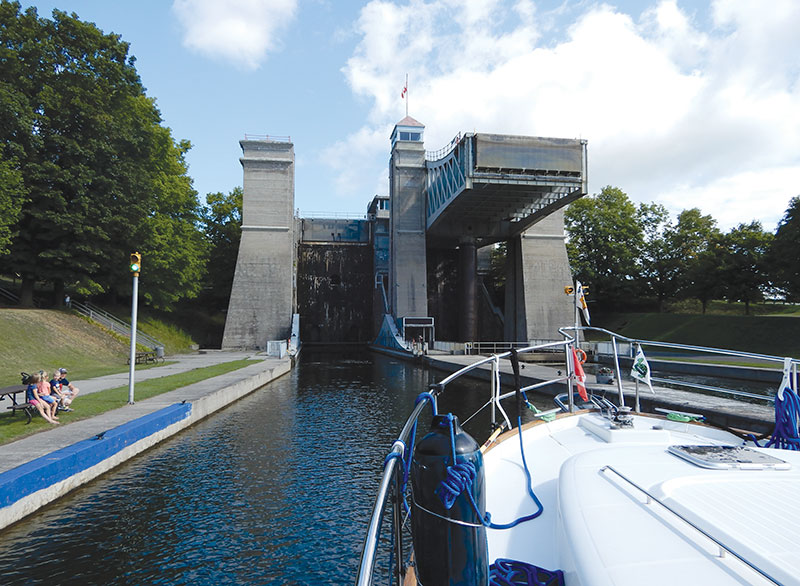
The two major lock attractions are the Peterboro Lift Lock and the Big Chute Marine Railway. We suggest planning a stop before each so you can walk up to the locks and watch the amazing process before you take your turn. In Peterboro, there is a great anchorage and marina in Little Lake that provides easy access to the lock. At the Big Chute, you can anchor or dock at the visitor center before taking your turn.
Georgian Bay
Port Severn is the entrance to Georgian Bay. Lock 45 in Port-Severn is small and can be very busy. It’s not uncommon to wait several hours to get through, and waiting space is limited. If you arrive late in the day, consider anchoring in the lake above the lock or at Starport Marina, then continuing in the morning.
Once in Georgian Bay, most Loopers plan a stop in either Midland or Penetanguishene. These are large towns with lots of resupply options, and both have marinas where you can have maintenance and repairs done. Once in Georgian Bay, there are a few boatyards, so they are good places to resupply, top off your fuel and change your oil.
Georgian Bay is an anchoring paradise. There are many small bays and inlets scattered among the 30,000 islands on the northern side of the Bay. Top anchorages include Frying Pan and Chimney Bay on Beausoleil Island, Franklin Island, Go Home Bay, Twelve Mile Bay, Henry’s Fish Restaurant & Seaplane Base, and the Killbear Provincial Park area. Town stops with marinas include Midland, Penetang, Perry Sound (with the Bobby Orr hockey museum) and Killbear. On our second Loop, we visited Tobermorey with Flower Pot Island, on the southwest side of the bay. It’s an amazing stop that many miss.
On the west side of Georgian Bay, you will reach Killarney and the famous Killarney Mountain Lodge. This is also a popular stop with a marina and fuel services. Be sure to check out the giant canoe paddle behind the lodge!
North Channel
Killarney is the gateway to the North Channel. Twenty miles beyond is Little Current (it’s an ironic name, as there can be a strong current through the area that reverses like a tide). Here you will also find marinas with fuel availability.
The North Channel is also an anchoring paradise with many bays and coves. You can go to shore for day hikes or explore by dinghy. Some of the most popular anchorages are The Benjamins, Baie Fine/The Pool, and Covered Portage Cove. Be prepared to add a stern anchor or line to shore, as some of the anchorages are tight. Also, secure your boat when unattended and don’t leave trash or food on deck, as bears have been known to swim out and raid boats. There are a few towns along the North Channel route with marinas and fuel services, but they are scattered. We’ve stopped at Gore Bay, Meldrum Bay, Blind River and Thessalon.
Keep in mind that most marinas and services close for the season on Labor Day. If you plan to stay late, be sure to confirm that fuel and marinas will be open when you arrive.
Checking into the U.S.
On the west end of the North Channel, you will reach Drummond Island and DeTour Village, where you can check back into the U.S. You can also check in via the CBP Roam App if you have pre-registered your vessel.
Another check-in option is Sault Ste. Marie. On our second loop, we opted to take the 40-mile side trip to the Soo Locks at the entrance to Lake Superior. Sault Ste. Marie has marinas on both the Canadian and U.S. sides of the locks. Here you can take lock tours, visit the Canadian Sea Plane Museum, and take a day-long train ride to Agawa Canyon.
This brings us full circle to Mackinac Island, where we started in our first article in Lakeland Boating. Be sure to check out the online archive if you missed any of our articles!
Next month, we will talk about what comes next, including popular side trips, the “Other Loops,” and options for selling your boat.
Top image: Entering Peterboro Lift Lock, Trent-Severn
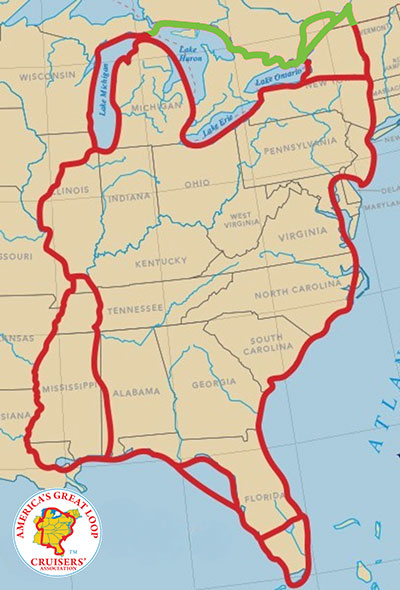
Map showing the Canada Loop section in green
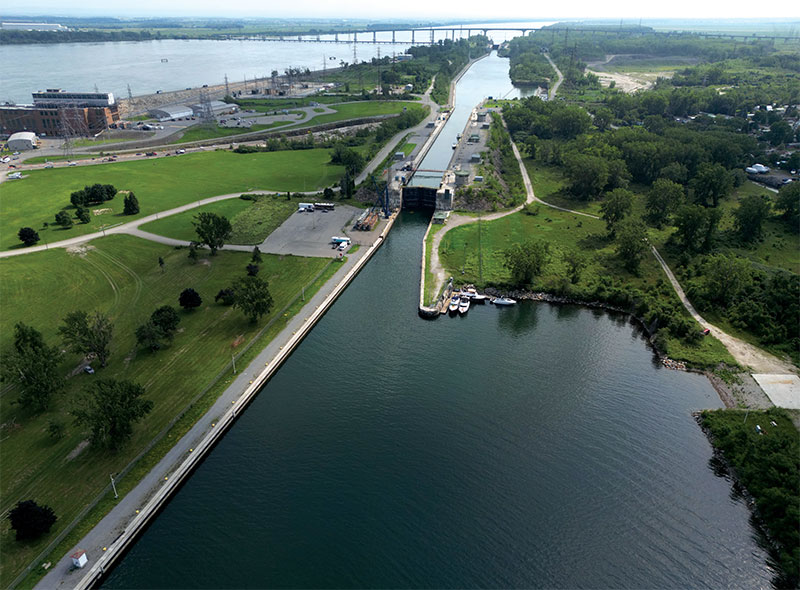
Beauharnois Lock, St. Lawrence Seaway
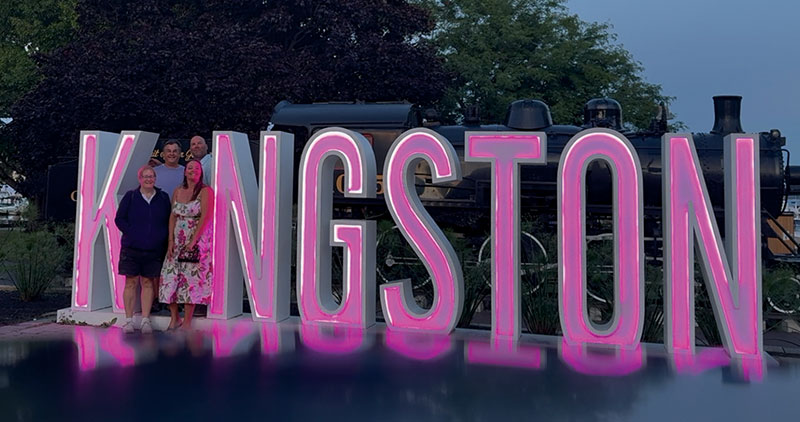
Kingston, ON
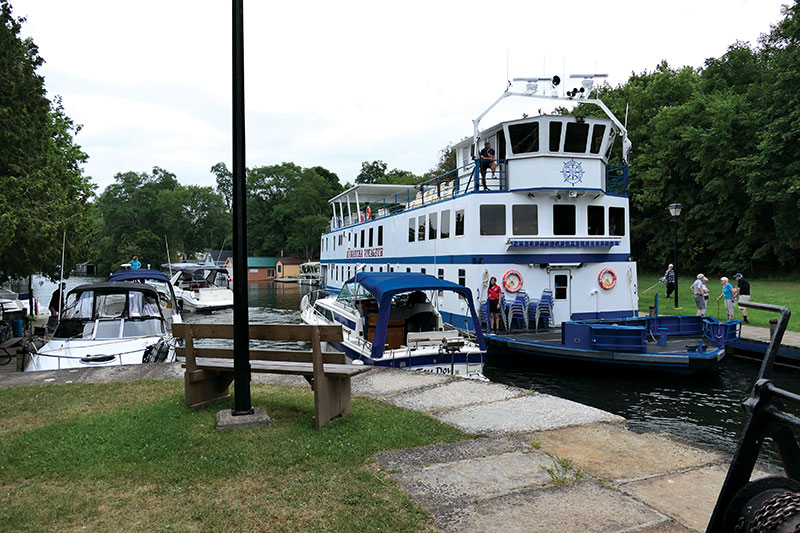
Kawartha Voyageur, Rideau Canal
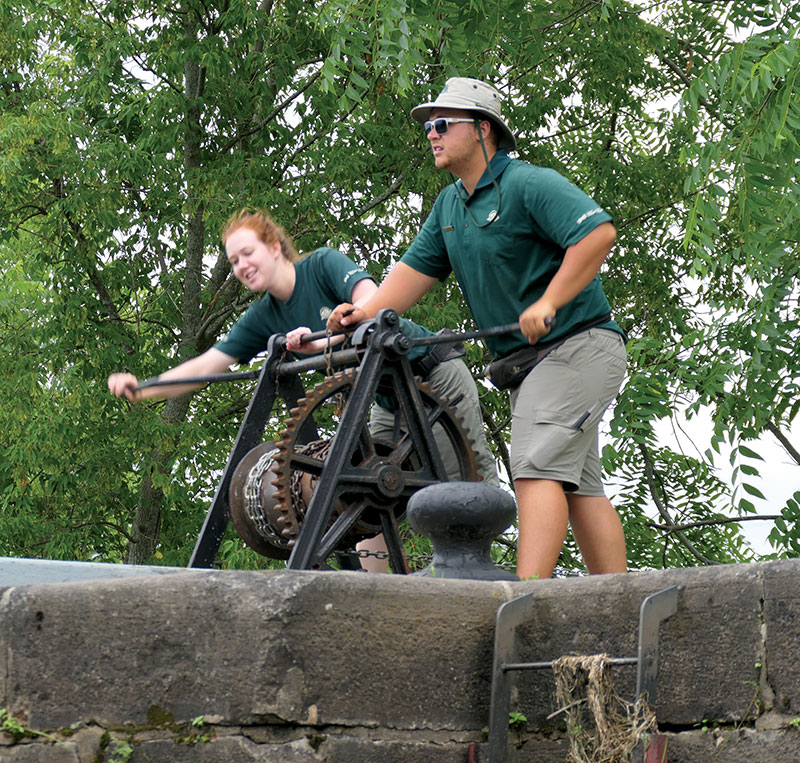
Hand cranking locks, Rideau Canal
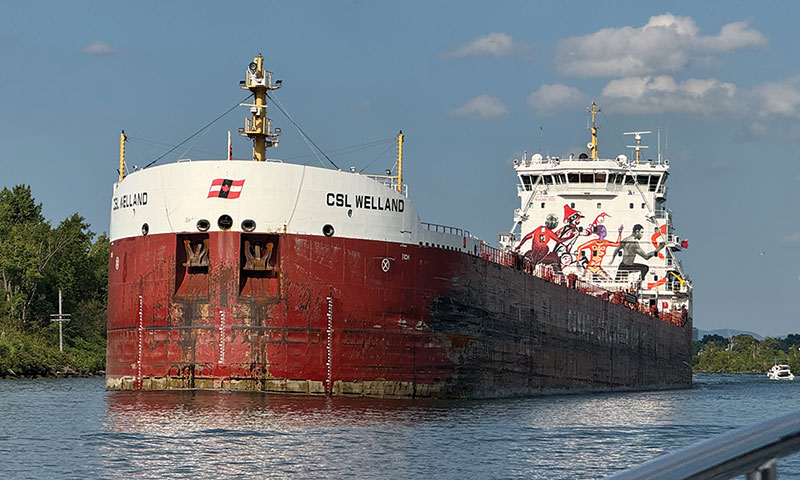
Passing a large ship on the St. Lawrence Seaway, Montreal, QC
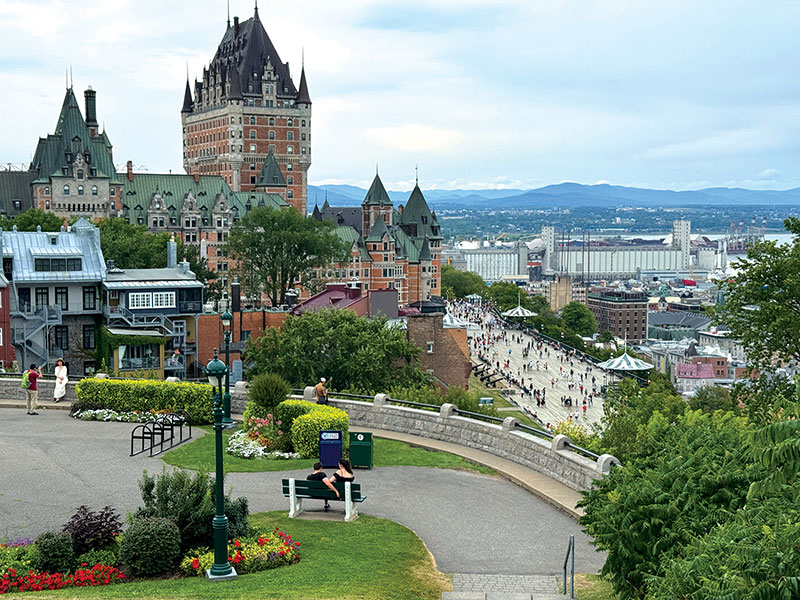
Quebec City, QC
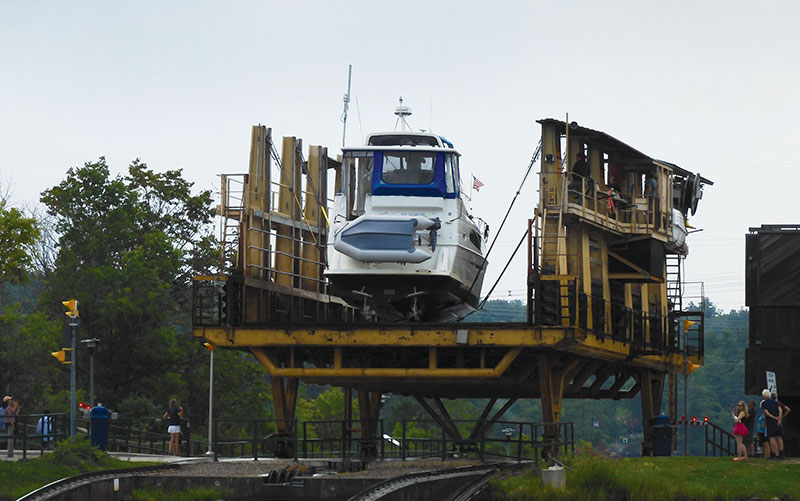
Big Chute Marine Railway, Trent-Severn
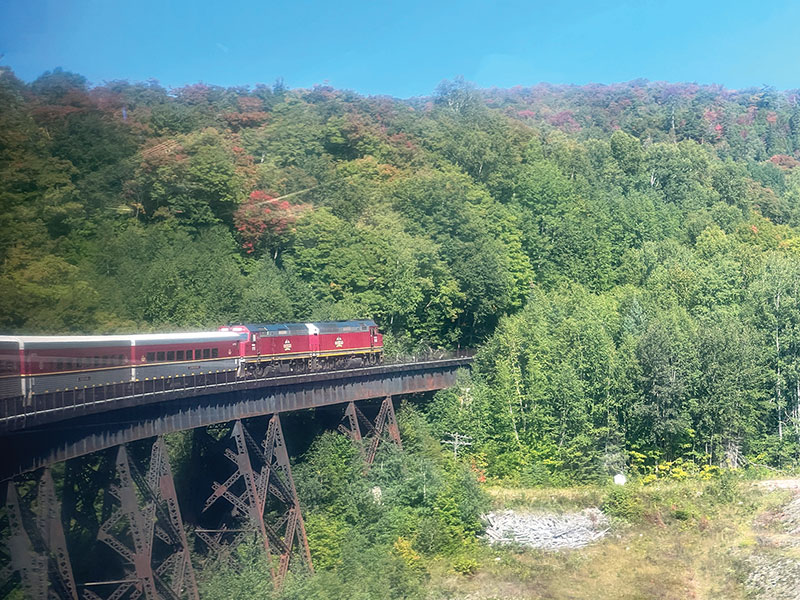
Agawa Canyon Train, Sault Ste. Marie, North Channel