Navigating the Great Lakes and river system portion of the Great Loop.
Story & photos by Tom & Brenda Lahey
In our next series of articles on America’s Great Loop, we will highlight some of the many route choices common among Loopers. Since many of the readers of Lakeland Boating will begin their Loop journey in the Great Lakes, we will start our series by covering the Great Lakes and river system.
Lakes Erie, Huron & Superior
Lake Erie and Lake Huron are not on the most common Looper routes; however, for those who choose to take the Western Erie Canal, or to stay in the U.S., taking Lake Ontario and passing through the Welland Canal, the route will take them through Lake Erie and Lake Huron on the way to Mackinaw Island and Lake Michigan.
Lake Superior is a side trip that more Loopers should take advantage of. On our second Loop, we visited Sault St. Marie at the entrance to Lake Superior and enjoyed the Soo Locks and both the U.S. and Canadian sides. It’s a great stop, and it also allows you to pass through the U.S. and Canadian locks and add Lake Superior to your list of accomplishments! Thunder Bay, Isle Royale National Park, and Duluth, Minnesota, are all popular stops on Lake Superior.
Lake Michigan
Most Loopers start their visit to Lake Michigan in Mackinaw City or on Mackinac Island, both of which are great stops with plenty to see and do. We visited Mackinac Island on both of our Loop trips, and it’s one of our favorite stops.
After entering Lake Michigan and passing under the I-75 bridge, Loopers are presented with a significant choice. Do they travel down the Wisconsin side or the Michigan side of the lake? Most Loopers choose to travel the Michigan side on their first Loop, as we did. On our second Loop, we decided to cross to the Wisconsin side from Frankfort, Michigan, to Sturgeon Bay, Wisconsin. I must say that we enjoyed both equally, and both sides have lots of interesting towns to explore. Here are a few of the popular stops on each side.
The Wisconsin side: On the Wisconsin side, there is the famous Sturgeon Bay and Door County. Sturgeon Bay is steeped in history and still features shipyards for the large bulk carriers seen on the lakes. There are several excellent marinas in Sturgeon Bay, and it is the gateway to Green Bay and Door County. Door County is a famous vacation destination with many small fishing villages and spectacular scenery. At the southern end of Green Bay is the city of Green Bay, home of Lambeau Field and the Packers.
Ports along the Wisconsin shore headed south to Chicago are all well protected. On our trip, we made stops in Kewaunee, Sheboygan, Port Washington and Milwaukee.
The Michigan side: The Michigan Side offers many more protected ports and lots to see and do. There is a lot of history and many small towns with great restaurants and microbreweries to explore. Popular stops include Petoskey, Harbor Springs, Traverse City, Leland, Frankfort, Muskegon and South Haven, among many others.
One could easily spend an entire boating season exploring Lake Michigan and still not see it all!
Chicago & the rivers
Loopers generally finish their exploration of Lake Michigan either in Chicago, staying in one of the marinas near Navy Pier and the Chicago River, or in Hammond, Indiana, at the Horseshoe Casino, near the Calumet River.
When entering the river system, a trip down the Chicago River through downtown Chicago is an architectural treat! Note that there are height and bridge schedule restrictions in the downtown area. We decided to take one of the architectural boat tours and let someone else drive so we could enjoy the view, then went to Hammond, Indiana, and entered the river system via the Calumet River.
Both the Chicago River and Calumet River join the Chicago Sanitary and Ship Canal near Lemont, Illinois. The Ship Canal is where you will encounter both the Electric Fish Barrier (at mile 295.5) and the infamous 19-foot, 6-inch railroad bridge (at mile 300.6).
For many Loopers, this will also be their first experience with larger locks.
Some advice about the locks
The locks on the Illinois River have experienced closures in recent years as they are maintained and upgraded. This has caused delayed openings into October and restrictions on passage for pleasure vessels. The AGLCA forum and the Army Corps of Engineers website are excellent sources of information on the current status.
We highly recommend the following:
• If you have never locked, watch one of the many YouTube videos to know what to expect.
• Try to group with other boaters in a flotilla as you transit the locks. The more pleasure craft that pass at one time, the easier it is on you and the lock operators.
• Assign one person to communicate with the lock operators so that they are not overloaded with phone and radio calls.
• Call ahead by phone (typically at least a day ahead) to let them know you are coming, and get information on the best time to transit.
• Be prepared to wait, sometimes hours or overnight. Don’t badger the lockkeepers by constantly calling; a cooperative attitude goes a long way. Remember that commercial traffic takes priority over pleasure craft.
• Check the Army Corps Locks website for lock status and to see how much traffic is waiting at a specific lock (tinyurl.com/ArmyCorpLockReport).
The rivers
Navigating the rivers is exciting and, to some, a bit boring. There are long stretches with little to see, and the rivers frequently take a winding course. You may cruise for an hour and pass within a half mile of where you were an hour before.
The Illinois, Mississippi and Ohio Rivers are all heavily commercial, with heavy barge traffic and industrial sites lining their banks. The Lower Mississippi River — the stretch from where it meets the Ohio River to New Orleans — is not a common route for Loopers and presents challenges due to a lack of marinas, fuel stops and anchorages, as well as the sheer volume of commercial traffic. Taking the turn-up the Ohio to Paducah, Kentucky, then joining the Tenn-Tom Waterway via the Tennessee River or the Cumberland River is the most popular Loop Route.
Here are a few pointers about cruising the rivers:
• Consider adding an AIS transceiver to your boat. This lets you see the tows around corners and, more importantly, lets the tows see you! We had barge captains reach out to us on both our trips with advice and warnings because they knew we were coming.
• Monitor both channels 16 and 13. Barges usually are on channel 13 and may not respond on 16.
• Respect the barges. They can take miles to stop and frequently span the entire width of the river. Communicate with them clearly and concisely.
• Marinas and, more importantly, fuel stops are far apart along the Illinois, Mississippi and Ohio Rivers. It is important to plan ahead and top off when you can.
• Watch water levels. River currents and the availability of anchorages can change dramatically during both high and low flows. Fuel in Grafton and Alton may not be available during high water.
• Keep an eagle eye out for logs and other debris in the river and in locks. Especially after heavy rain.
• Always have an alternate marina or anchorage planned. You may get stuck at a lock, or your intended destination is full or unavailable. Have current Waterway and Quimby’s guides handy!
Popular stops along the Illinois River include “The Wall” in Joliet, Illinois; Heritage Harbor in Ottawa, Illinois; and Peoria, Illinois. Loopers will need to plan a stop in Alton or Grafton, Illinois, where the Illinois River meets the Mississippi, to pick up fuel, as availability is extremely limited until you reach Paducah, about 300 miles downstream.
Once you reach Kentucky Lakes and the Tennessee River (Tenn-Tom waterway), the rivers become less industrial, and the number of marinas and fuel stops increases. There are some great marinas, both big and small, all along the route. For those who enjoy anchoring, there are also lots of small side channels where you can safely pull off for the night. While there is still commercial traffic on the Tenn-Tom, the tows are generally smaller, and the locks are more friendly toward pleasure boaters. When you reach Demopolis, Alabama, you will want to make sure you top up on fuel (and food)! From here until you reach Mobile, Alabama, 230 miles downstream, there is only one marina/fuel stop, Bobby’s Fish Camp, which may have limited availability. You will need to anchor out on this section.
When on the rivers, you will gain a solid appreciation of how much of our economy relies on the river system and how important it is to the transportation of goods. While the locks, barges and long winding stretches can be taxing, seeing this amazing part of America’s Heartland is an experience of a lifetime. The small towns, historic cities and riverside communities are unique, and the people are welcoming!
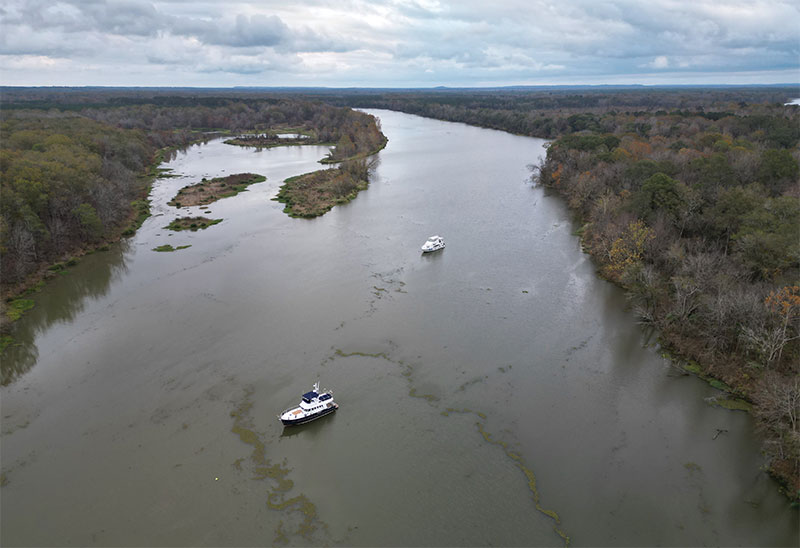
Top image: Anchored near Aliceville, AL
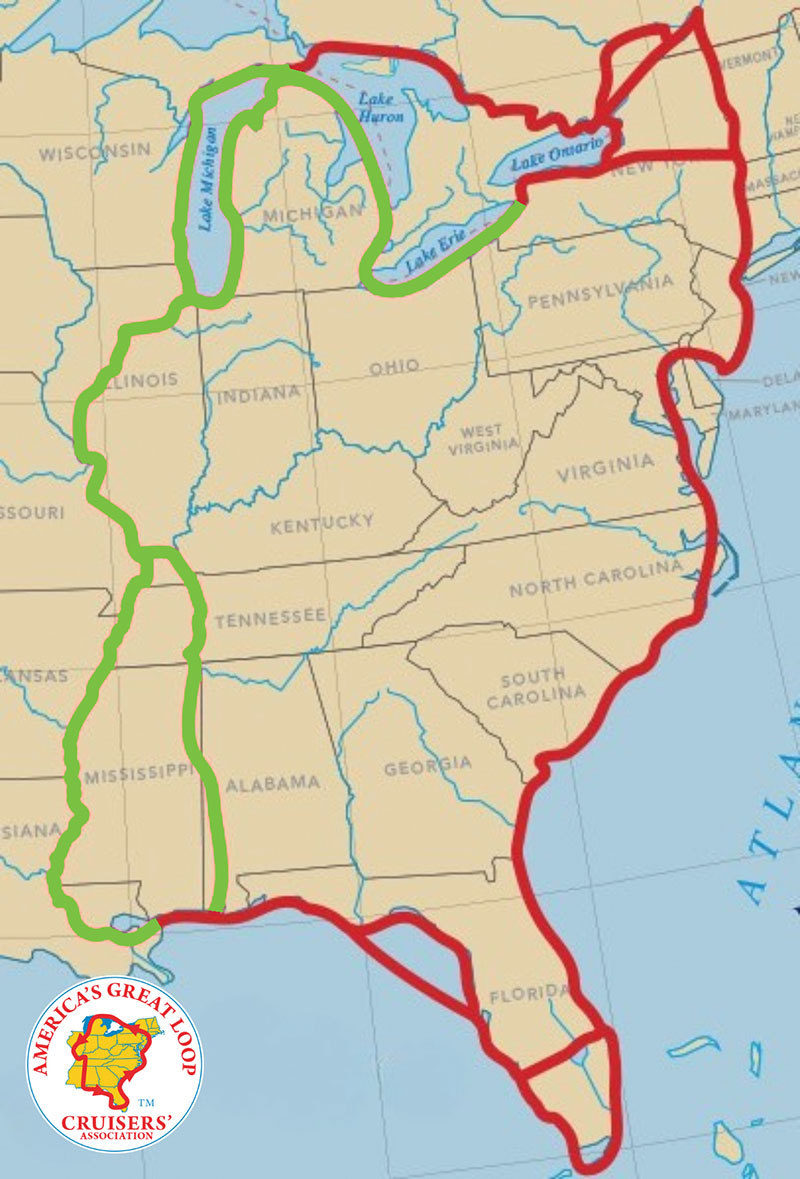
The Great Lakes and river systems highlighted in green
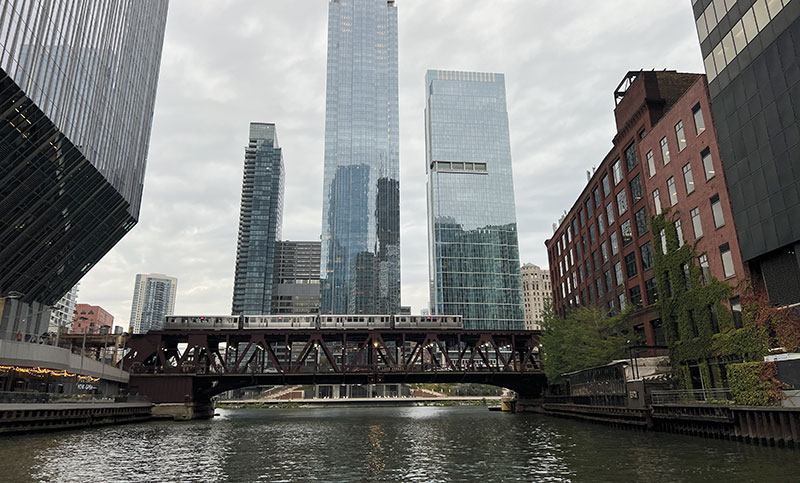
Chicago River, Chicago, IL
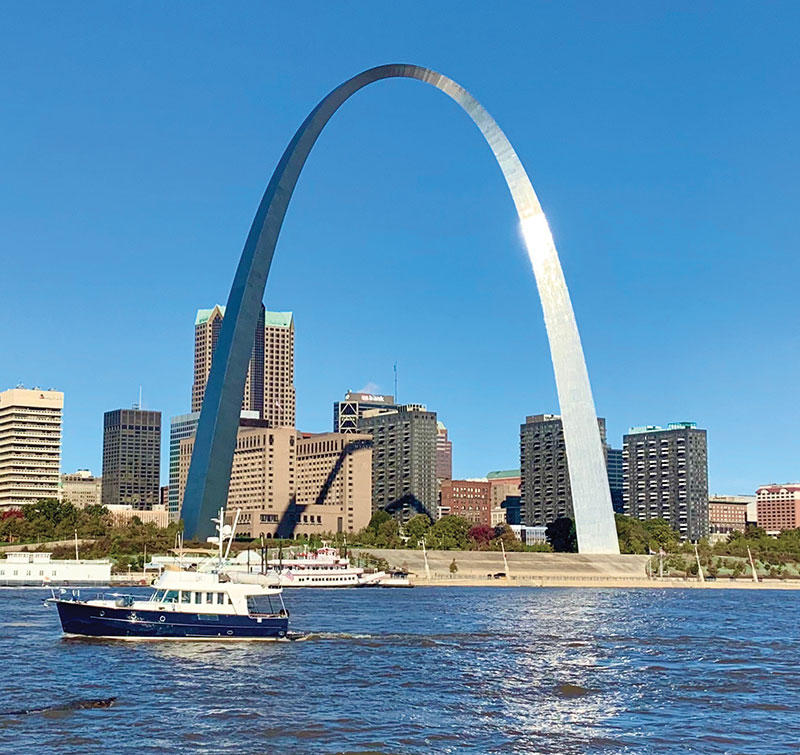
St. Louis Arch, St. Louis, MO
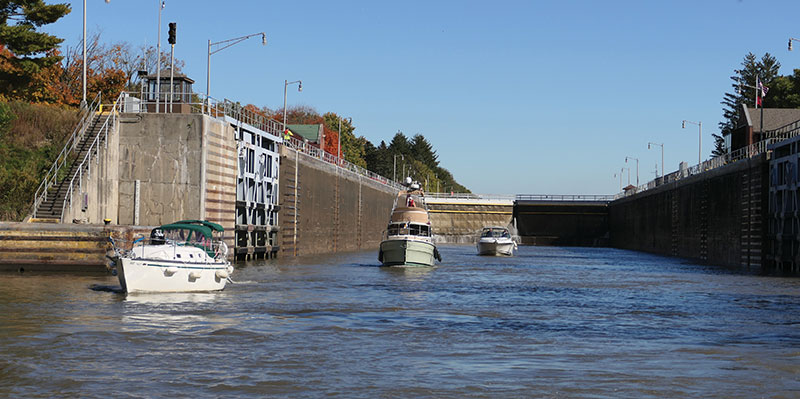
Leaving Starved Rock Lock, Utica, IL