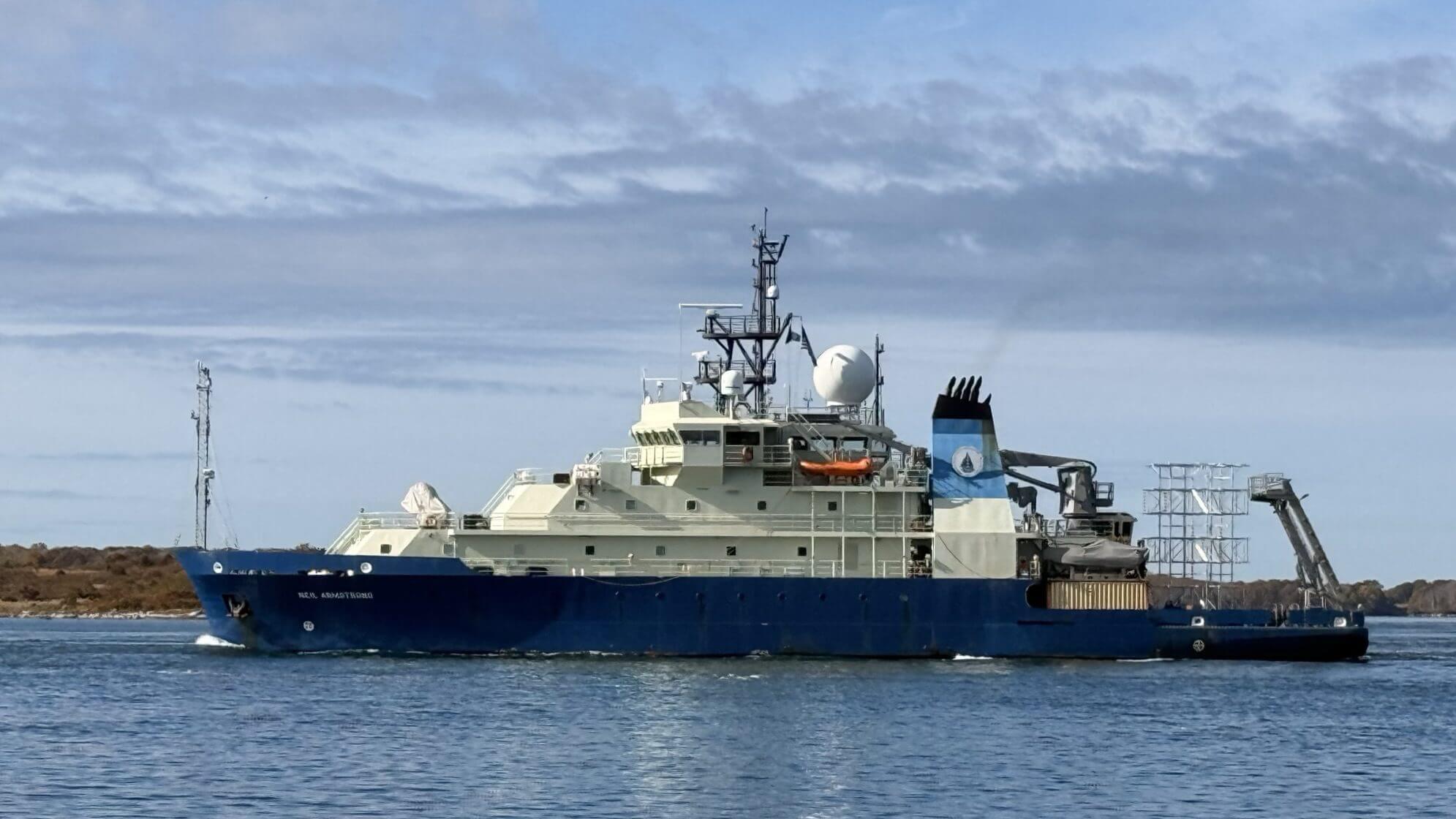
The Woods Hole Oceanographic Institution’s research vessel Neil Armstrong, a ship typically used for ocean science, began a 2,531 nautical-mile voyage on the Great Lakes to support an experiment to detect neutrinos by using Lake Superior’s natural water. Neutrinos are subatomic particles that rarely interact with matter, making them exceptionally difficult to detect, and scientists are studying them to help better understand the fundamental properties of the universe.
Called the Experimental Neutrino Detector, the project is led by the University of Minnesota Duluth and sponsored by the Defense Advanced Research Projects Agency, in cooperation with the U.S. Department of Energy’s Office of Science, Fermi National Accelerator Laboratory and Brookhaven National Laboratory.
“Our team has spent months designing and fabricating the large frames that will support this project,” said John Kemp, group operations leader for WHOI’s Mooring Operations and Engineering Group. “Getting these massive structures from Woods Hole to Lake Superior is a major logistical undertaking, but that’s only part of the challenge. Once on the lake, we’ll need to carefully lower each frame to the lakebed and precisely position them.”
The ship will spend 11 days navigating to the western end of Lake Superior, where it will transport five detector arrays several miles offshore near Two Harbors, Minnesota, and lower the frames onto the lakebed and install fiber-optic cables connecting the detectors to shore.
“This voyage demonstrates how the capabilities developed to support ocean science can enable scientific discovery in other environments,” said Rob Munier, WHOI vice president for Marine Facilities and Operations. “This is not a typical journey for Neil Armstrong, but it reflects the versatility of the vessel and crew, and the expertise of the project team. We’re proud to help make this innovative experiment possible.”
Follow the journey with the R/V Neil Armstrong ship tracker.