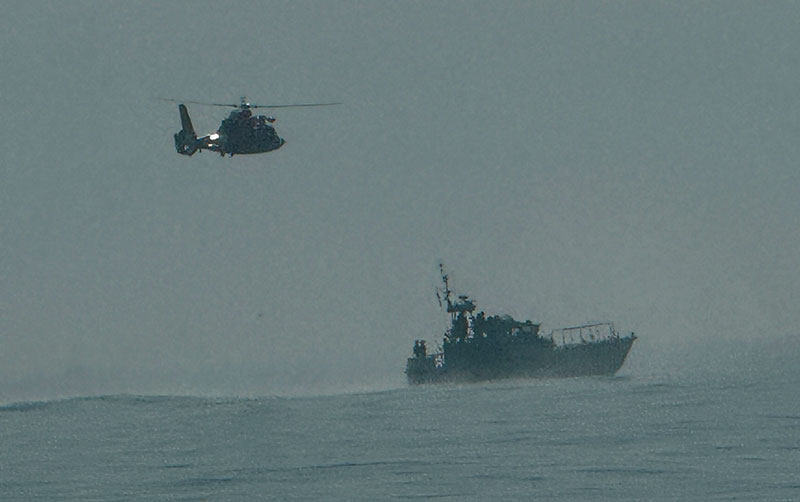
Keep you and your boat safe on the Great Loop.
Story & photos by Tom & Brenda Lahey
Safety on America’s Great Loop isn’t about fear or over-caution; it’s about preparation, awareness and smart decision-making that allows crews to enjoy the journey with confidence. In this month’s article, we will explore the key safety considerations every Looper should understand before casting off and during the adventure.
The weather is your biggest hazard
In our 27,000 miles of cruising, we’ve found the biggest hazard is weather. The good news is that you can control your exposure to weather risks. Keeping abreast of the weather — not just for the current day, but looking out for a week — will allow you to make informed decisions on whether you should venture out or stay put in a protected marina or anchorage.
We use a combination of weather apps, such as Windy, PredictWind and SailFlow, to get a picture of long-range wind and wave forecasts. Weather.com, Weather Bug and Weather Underground offer more real-time weather predictions. And while they can be a bit hard to understand at first, monitoring the National Weather Service Marine Forecast either through your VHF or online at forecast.weather.gov will give you marine-specific weather information.
Each boater has their own limitations regarding wind, waves and current. The area you are boating in will also dictate what conditions are safe. While you may cruise on a protected waterway during higher winds, crossing larger open bodies of water in the same conditions can present risks. Ensure you understand both your route and the predicted weather conditions for your cruise before deciding to cast off. Set your personal limits and stick with them. On the few occasions during our travels when we felt at risk due to the weather, we had second-guessed ourselves and left when we should have stayed put. Remember, this is “Pleasure Boating!”
When crossing the Gulf, the AGLCA forum offers advice and discussion amongst Loopers in the “You Make The Call” section. Also, all along the Loop, many marinas offer briefings that share local knowledge and advice. Even if the marina doesn’t have formal briefings, locals can provide valuable insight into conditions.
Properly maintained boats improve safety
Good maintenance practices on your boat improve your overall safety. Proper engine maintenance at regular intervals enhances your engine’s reliability. Ensuring your gear is properly stowed prevents accidental injuries or damage from unexpected waves or wakes. Monitor your fuel burn and ensure you have sufficient fuel reserves.
In our experience, many Loop-interrupting or Loop-ending issues could have been avoided with regular maintenance and inspections. Corroded through-hulls, old hoses, failed bilge pumps and loose fittings are the major causes of boats taking on water. Inspect all of your through-hulls, identify where your shutoffs are, and confirm they work. Carefully inspect all hoses, especially those connected to raw-water inlets, for cracks, bulges and chafing. Test your bilge pumps regularly and ensure that float switches function properly. Pay special attention to fuel lines and tanks for signs of leaking, and if your boat is equipped with propane appliances, be sure to include those in your inspection.
If you are not familiar with all the systems on your boat, consider hiring a mechanic or surveyor to conduct a thorough inspection before you depart.
Personal safety
In 10 years of cruising, we’ve only heard of a handful of serious incidents. When Looping, you will usually be with many other boaters, and as they say, there is safety in numbers. This is true both for personal safety and for situations where you encounter mechanical or navigation issues. There are occasional petty thefts (including reports of bears swimming out to anchored boats in Georgian Bay and raiding coolers). Electric bicycles on shore seem to be a favorite target, so bring them aboard when in doubt.
We’ve heard reports of a few boats being broken into when the owners are away, and from time to time, you will hear about kids unplugging power cords or untying boats at night. These incidents are rare, and a quick shout usually resolves the issue.
Weapons like firearms, pepper-spray and stun guns are not recommended. The Great Loop travels through as many as 21 states and two Canadian provinces. These present a myriad of federal, state and local regulations on possession and use. While it may never be discovered, if you are caught or use one, you risk being charged. It’s not worth it!
We’ve found that a good bright flashlight, a boating air horn, some solar motion lights on deck and a boat pole are a sufficient arsenal. Oh, and maybe a can of bear spray if you plan to go ashore in the wilds of Canada with a picnic basket.
Just like at home, awareness of your surroundings, common sense and taking a few minutes to secure valuables out of sight will lead to a safe Looping experience.
Fire safety
According to BoatUS Marine Insurance statistics, the leading cause of boat fires is electrical system malfunctions. Loose connections, overloaded circuits, corroded contacts and improperly installed batteries can all cause overheating and fires. A boat’s AC shore power system is another contributor to fires aboard, with worn or frayed shore power cables, loose connections at the boat or shore power pedestal, and overloading.
The electrical systems, especially on older boats, are frequently modified, often by owners who may not follow ABYC standards. Inspect your boat’s wiring and replace corroded or unused wiring. Ensure that any added electrical accessories are properly fused. Inspect (or have a licensed electrician inspect) both your AC and DC power distribution panels.
Many boat fires begin in the engine room, where there is often spilled oil, fuel and lots of other combustibles. Keep your engine room clean! Wipe up spills, and don’t store flammable materials in the hot engine compartment.
Protect you and your family by ensuring your boat’s fire extinguishers have not expired, and inspect them monthly. You should have a marine-rated extinguisher in each living space (berths, salon and galley). A fire blanket for your galley is a great addition. An automatic fire suppression system in the engine room is also highly recommended. Consider having older extinguishers inspected by a certified fire extinguisher specialist every few years.
Sophia’s Law requires all pleasure boats to have a working CO detector in any enclosed accommodation space, regardless of fuel type. Ensure your CO detectors are marine-rated, as household detectors are prone to malfunction in the humid, salty marine environment. While smoke detectors are not required, they are a good addition to ensure your safety. Because most fires start in the engine compartment, adding one there provides an additional layer of safety. As with all safety equipment, it’s important to inspect and test it regularly.
Required safety equipment
Every boater should be familiar with the required safety equipment for their boat’s size: Life jackets of appropriate sizes for adults and children, a throwable Type IV device, fire extinguishers, running lights, anchor lights, visual distress signals for coastal waters, a horn/whistle, CO detectors and required placards. Remember to regularly inspect your safety equipment and ensure it is easily accessible. Based on feedback from the Looper forums, the USCG has recently increased inspections, so be sure to inspect your boat before they do!
If you have a dog onboard, ensure it wears an appropriately sized life jacket when on deck and underway. Even though dogs are great swimmers, in rough water or at a distance from shore, they need help just like humans. We’ve heard of pets going overboard while underway, and the owners didn’t notice until much later.
Navigation
Up-to-date charts, typically electronic, are key to successful navigation; however, remember that chartplotters are just a representation of the waterway. Shoals change quickly, hazards appear and routes change due to construction or flooding. Watch the USCG notices to mariners and advisories from groups like Waterway Guides, Cruisers Net, Navionics and similar services. Most importantly, read the markers! Remember that your charplotter is pretty much a glorified video game; look outside — what’s there is reality! We can’t count the number of boaters who have run aground (including us) and said, “But the chart said…”
Suggested extra safety gear
The thing about safety gear is that you spend a lot of money on it, hoping never to use it! Here are a few items that we suggest are good investments.
First is an AIS transponder, one that both transmits and receives. This is one safety accessory that you will actually use! These are typically integrated into your chartplotter and show the position of other AIS-equipped vessels. We wouldn’t travel on the river system without one! Almost all commercial boats are AIS-equipped, so you can see them well ahead of time and not be surprised by a large tow taking up the whole river as you round a bend. Also, they can see YOU and will frequently reach out via VHF to give you advice on passing. Phone-based AIS apps are not a substitute; other boats can’t see you, and there are large areas without coverage.
On most of the Great Loop, you are in sight of land, but there are areas where you will be offshore, in large bodies of open water, or where cell service will be limited. Carrying an EPIRB or PLB (Personal Locator Beacon) provides a layer of security if you become disabled and need to contact rescue services. We carry a small ACR PLB in our “Ditch Bag,” along with a first-aid kit, water bottles, a flashlight and signal flares, “Just in case.”
Your most important piece of safety gear is common sense. If the weather looks bad, don’t go. If your boat is making a funny noise, investigate and fix it. If you’re going to spend the night at a public dock, lock things up and leave a light on. Hundreds of boats complete the Loop each year without experiencing any issues. The Loop is a safe, so don’t let anxiety taint your trip. See you on the Loop!
Top image: AIS and Radar showing targets in the fog, Atlantic City, NJ
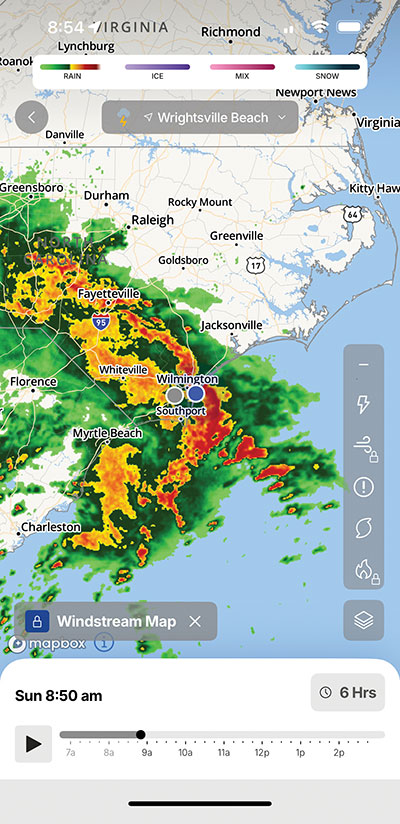
Watch weather radar, Cape Fear River, Southport, NC
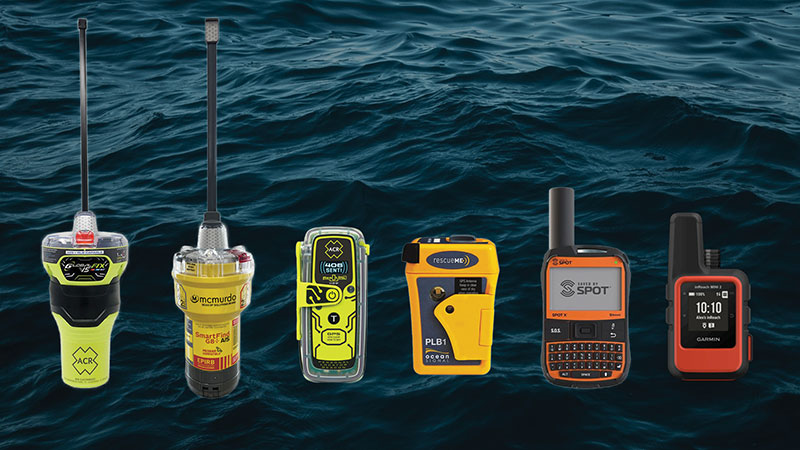
Safety transmitters, EPIRBs, PLBs and satellite communicators
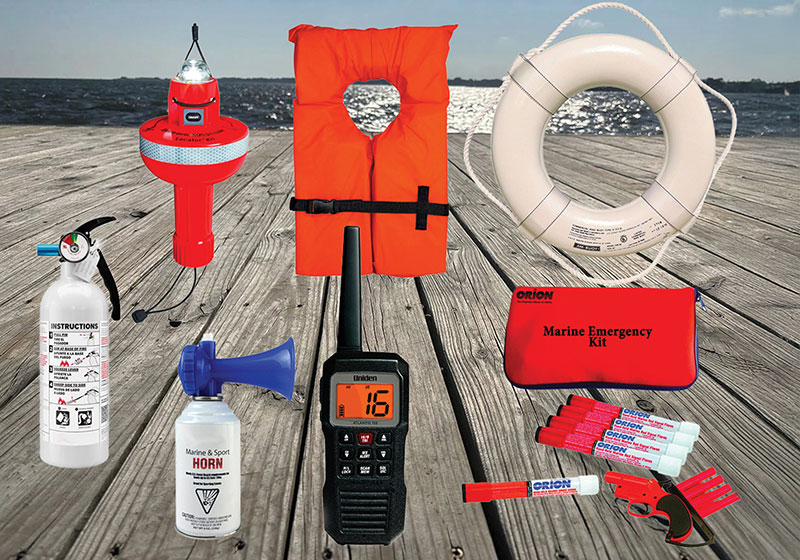
Safety equipment
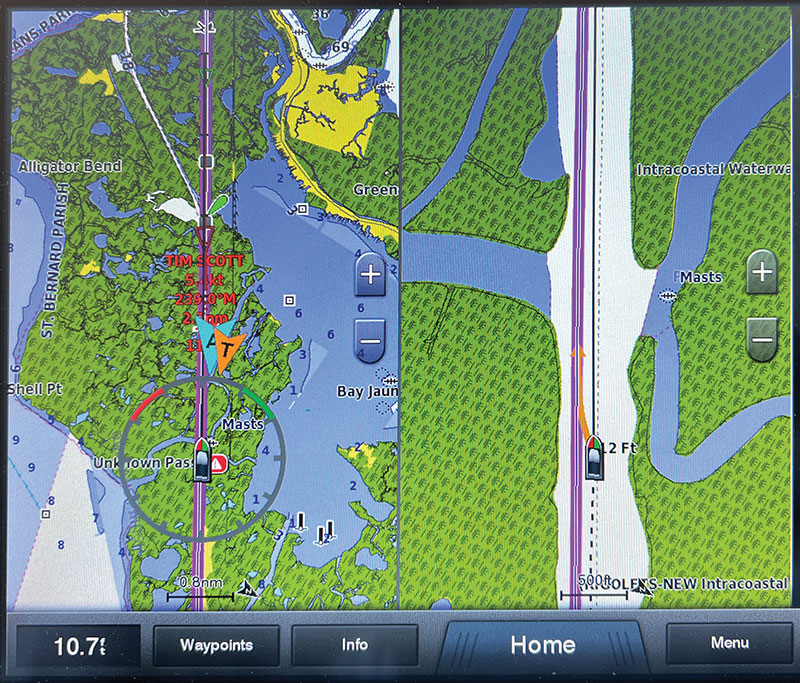
AIS view of what is ahead, Gulf Intracoastal Waterway, LA