Situated between two lakes on central Ontario’s historic Trent-Severn Waterway, the pretty city of Orillia is a hub of activity throughout the boating season.

Aerial / City of Orillia; Mariposa Folk Festival / Debra Halbot
Who wouldn’t like to spend their days in a place called Sunshine City?
As the inspiration behind Stephen Leacock’s 1912 short story collection “Sunshine Sketches of a Little Town,” the lovely community of Orillia, Ontario, is a must-see port of call and among the best-kept secrets on the Great Lakes.
Situated on the historic Trent-Severn Waterway linking Georgian Bay to Lake Ontario, Orillia’s position overlooking a narrows between lakes Couchiching and Simcoe has long made it a bustling transportation hub. Archaeologists can trace evidence of human settlement there dating back more than 4,000 years, long before Samuel de Champlain became the first European explorer to visit the region in 1615. Champlain promptly developed friendly relations with the local aboriginal peoples, establishing a fur trading post where Orillia’s municipal marina stands today.
The trading post was soon joined by a hotel, a tavern, a blacksmith and a shipwright, leading the government of the day to purchase the land along the shoreline from the local First Nations peoples in order to develop a larger settlement. By the mid-1800s, more than 200 people lived in what became known as Orillia, named by Upper Canada Lieutenant Governor Sir Peregrine Maitland from the Spanish word orilla, which means shoreline.
Orillia incorporated as a village in 1867, but it was the completion of the Trent-Severn Waterway in 1920 that drove its most explosive period of growth, as the new canal system brought a significant influx of boat traffic carrying people and goods. Today, the boat traffic is entirely recreational, including cottagers, cruising boaters and those traversing the Trent-Severn as part of the Great Loop. Accordingly, arriving by boat is still the best way to visit Orillia.
One would have to try very hard to miss Orillia when navigating the Trent-Severn waterway from either Lake Ontario or Georgian Bay, in view of its position at a prominent narrows between two large, inland lakes. You’ll want to stick to the marked channel and keep well clear of a carefully marked shoal located off Barnfield Point, but otherwise the approach is open and obstacle-free. For a visual guide, look for multiple church steeples on the south-west corner of Lake Couchiching, and the large condo building that sits immediately south of the marina. As you draw near, you’ll spot the marina’s two long breakwalls, each topped with shrubs to discourage seagulls.
Orillia’s municipal marina, properly known as the Port of Orillia, sits adjacent to the downtown core, making it the most convenient space for visitors. The marina offers more than 220 transient slips for vessels up to 80 feet in length. But what it does not have is a pump-out or fuel; for either of those you’ll need to visit one of several large private marinas located a stone’s throw away (see sidebar).
Welcome weary traveler
One of the joys of visiting Orillia is the simple fact that pretty well all of its key attractions lie within easy walking distance from the municipal marina.
The best way to find your way around is to simply go for a stroll. Orillia’s streets follow a straightforward grid pattern, making it tough to get lost. It’s fun to wander aimlessly through tree-lined streets and admire the architecture, but if you want to know more about the different heritage buildings you pass, the city offers three different downloadable walking tours that explain all (tripvia.tours/orillia-audio-walking-tours). These include a downtown and historical homes tour, the Millennium Trail tour with more than 30 sites along Lake Couchiching, and a tour of the Stephen Leacock Museum National Historic Site.
 Right in downtown, the historic Orillia Opera House, built in 1895, includes a 700-seat auditorium that has hosted artists ranging from The Marx Brothers and Glenn Gould to Oscar Peterson, KD Lang, Liona Boyd, Blue Rodeo, Bruce Cockburn and native son Gordon Lightfoot. As the largest professional live theater venue north of Toronto, the Opera House presents a diverse lineup of plays, concerts and presentations each summer with programming to suit every taste.
 The Orillia Museum of Art and History, on Peter Street, is easily spotted with its iconic clock tower. Built in 1894, the museum displays its extensive collection documenting the region’s settlement and cultural life, along with a range of art exhibits throughout the year. It can also provide private historical tours of the city on request.
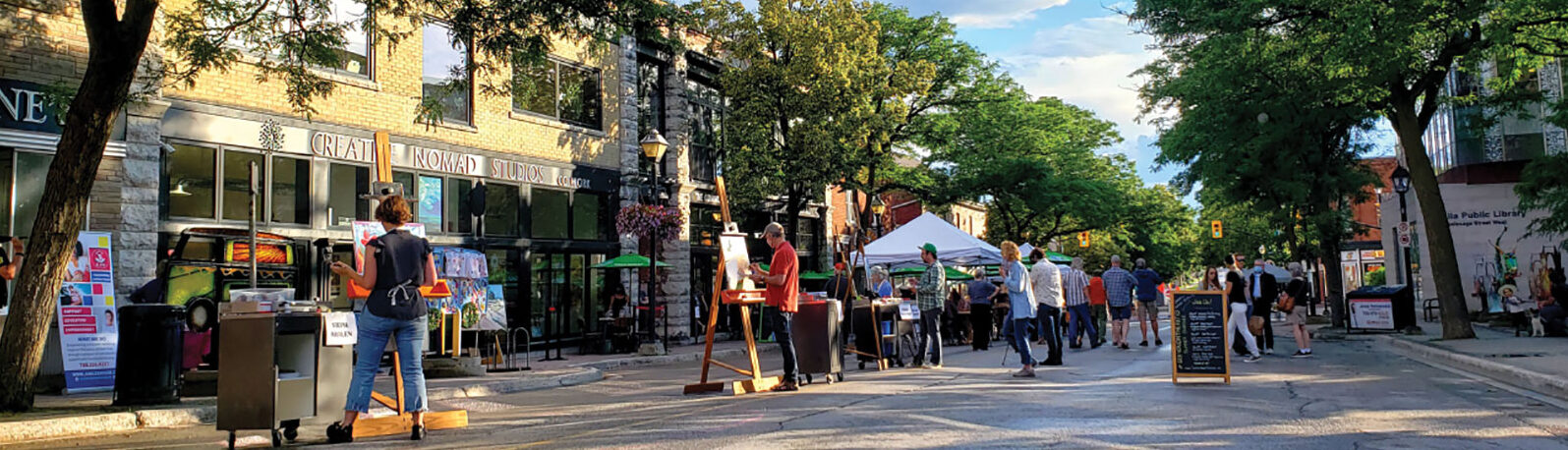
Mississaga Street, which runs straight west from the marina, is Orillia’s main drag with more than 150 different shops and galleries — and not a single big box store in sight.
When it comes time to wine and dine, visitors will be happy to know Orillia offers a wide range of fare from pub grub to fine dining. You’ll find more than 30 different restaurants on Mississaga Street alone, plus several bakeries with all manner of tasty desserts. That includes Wilkie’s Bakery, famous for its butter tarts, and Apple Annie’s for its baked goodies and ice cream. Kenzington Burger Bar and Studabakers are popular with locals, while Wadasi Sushi and The Common Stove offer sit-down fare. Mariposa Market is an old-fashioned, family-owned bakery and gift shop, popular for its Chelsea buns and Muskoka berry pies.

Orillia Opera House / City of Orillia; Orillia Museum of Art and History / Museum Facebook;
Millennium Trail system / Orillia & Lake County Tourism
Mississaga Street / City of Orillia
Marinas
Port of Orillia
705-325-1311, orillia.ca/en/living-here/marinas.aspx
Blue Beacon Marina
705-325-2526, bluebeaconmarina.com
Bridge Port Marina
705-326-7898, bridgeportmarina.ca
Marina del Rey
705-325-3051, delreymarina.com
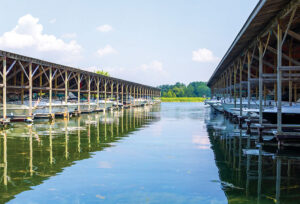
Mariposa Landing Marina (pictured below)
705-326-4660
 McGregor on the Water
705-689-9935, mcgregoronthewater.ca
Ojibway Bay Marina
705-326-5855, ojibwaybaymarina.ca
Starport Marina Inc.
705-325-3775, starportmarina.com
Mariposa Landing Marina / Facebook


Couchiching Beach / Orillia & Lake County Tourism


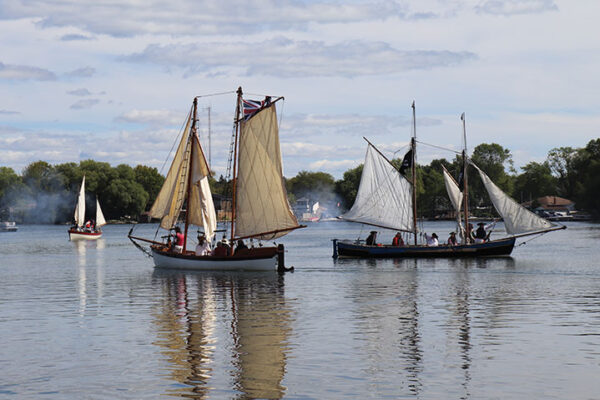
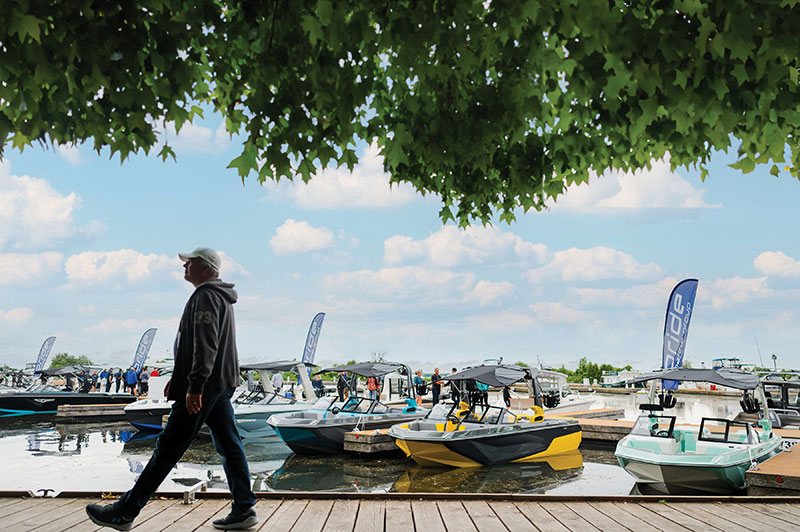
Orillia In-Water Boat Show / Orillia & Lake County Tourism; Apple Annie’s / Orillia & Lake County Tourism;
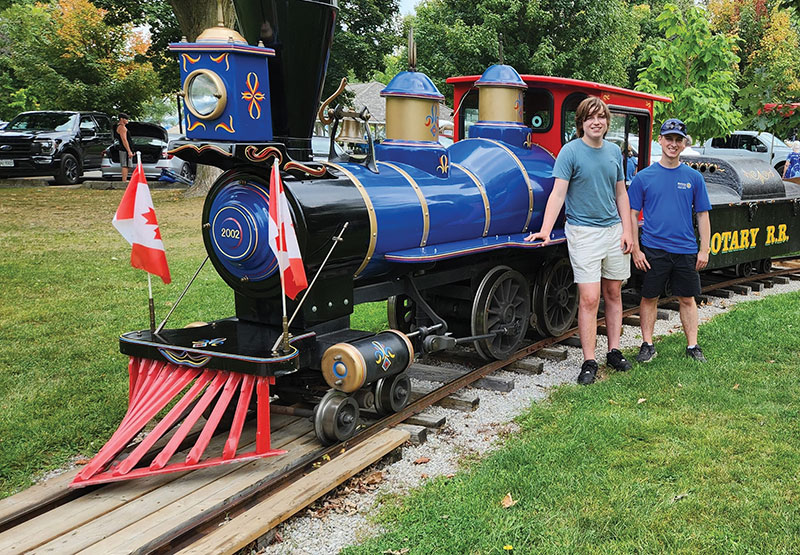
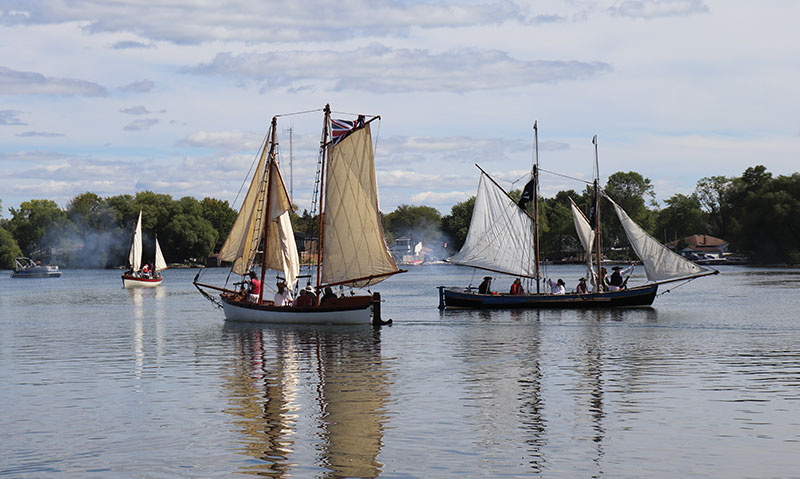
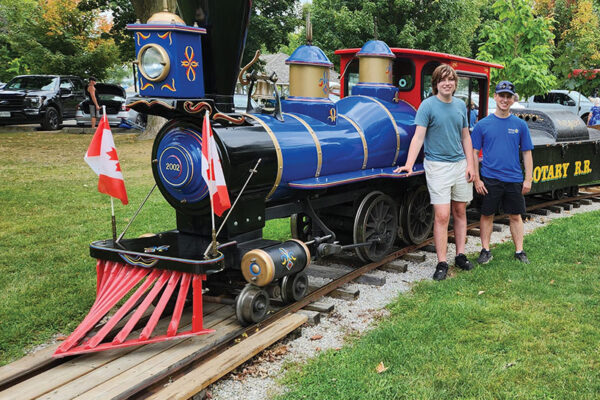
Rotary Club Mariposa Express / Rotary Club Facebook; Pirate Party / Orillia & Lake County Tourism
If you’re looking to reprovision the larder after a long sail from the big lake, a large Metro grocery store sits two blocks from the marina just off Coldwater Street. There’s also a farmers market that operates inside the public library on Andrew Street.
Orillia’s downtown core remains the city’s heart and soul. A new mixed-use waterfront development project adjacent to the municipal marina is on track for completion in spring 2026, bringing all-new shopping, dining and residential units to the Lake Couchiching shoreline. Dubbed Sunshine Harbour, the development is expected to further enhance the city’s waterfront, bringing new energy to what’s already an inviting port of call.
See and do
For visitors and residents alike, Orillia’s greatest attraction is its waterfront, with its sandy beach, miles of scenic trails, picnic areas and free Sunday night concerts all summer at the Orillia Waterfront Centre. There’s even a delightful replica steam train for kids of all ages. In all, the waterfront represents more than 21 acres of park space, making it a focal point for festivals and special events.
Ahh, yes, the festivals.
 Being a festive community, Orillia seems to have something going on just about every week through the summer boating season. The city’s online event calendar lists all the latest, but you’ll want to plan well in advance if you want to attend popular events like the In-Water Boat Show (held on June 12 –14 this year), the annual Christmas in June celebration (June 27), Mardi Gras (July 25), the Waterfront Festival (Pictured, August 7 – 9), the Pirate Party (September 4 – 6) or Couchiching Fest (September 19 – 20).
The biggest festival by far, however, is the annual Mariposa Folk Festival, held at Orillia’s Tudhope Park, in early July. Founded in 1961, the festival presents three days of music, arts, crafts and food, with more than 100 performances spread over 11 different stages. The biggest party on the lake, this year held on July 3 – 5, typically attracts crowds of around 20,000 people, which is impressive for a city with a population of just 30,000 permanent residents.
Did we mention it’s fairly popular?
Regardless of when you visit, Orillia never fails to delight with its vibrant streets, inviting patios, engaging events and first-class facilities for visiting boaters. And, of course, plenty of sunshine — exactly as one would expect from a place known as Sunshine City.
Orillia Waterfront Festival’s Dock Diving
Dogs contest / Orillia & Lake County Tourism
Gordon Lightfoot
 Perhaps no Orillia resident has achieved greater international success than Gordon Lightfoot, the legendary Canadian singer and songwriter who penned a string of hits through the 1960s and ’70s, including “Early Morning Rain,” “If You Could Read My Mind,” “Sundown,” “Carefree Highway,” “Rainy Day People,” and perhaps his most widely recognized ballad, “The Wreck of the Edmund Fitzgerald.”
Born in Orillia in 1938, Lightfoot sang in the choir of Orillia’s St. Paul’s United Church as a child, his smooth voice and patient delivery soon earning him regular spots on local radio. As a teenager, Lightfoot played guitar and sang in a number of different resorts in and around Orillia “for a couple of beers.” Around the same time, he also learned to play piano and drums, decisions he later said contributed to his approach to songwriting.
Lightfoot’s original compositions received steady airplay on a growing number of radio stations across Canada and the northern U.S. before a 1965 appearance on “The Tonight Show Starring Johnny Carson” rocketed him to international stardom. With his baritone voice and virtuoso guitar work, Lightfoot recorded 25 albums and 48 singles — many achieving gold and platinum status — over a career spanning more than 50 years.
Lightfoot passed away in 2023 at the age of 84. A statue entitled Golden Leaves — A Tribute to Gordon Lightfoot overlooks Lake Couchiching in Orillia’s Tudhope Park, just steps from the municipal marina.
Orillia & Lake County Tourism
Stephen Leacock
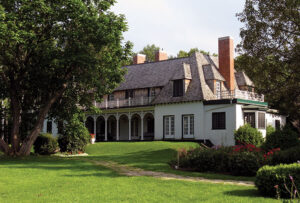 Author Stephen Leacock is widely credited with bringing the community of Orillia to the public eye after using it as the basis for the fictional town of Mariposa in his “Sunshine Sketches of a Little Town.” Born in England in 1869, Leacock’s family settled in Ontario, where he attended the University of Toronto, graduating with honors as an economist. He subsequently purchased an estate overlooking Lake Couchiching, where he spent his free time writing fiction, humor and short stories. Writing proved far more rewarding than Leacock’s day job, and soon became lucrative enough to allow him to quit the Monday to Friday grind and focus on writing alone. By 1915, Leacock was considered among the most popular humorists in the English-speaking world.
His former estate, overlooking the narrows between lakes Couchiching and Simcoe, has been designated as a National Historic Site in Canada and today operates as a museum.
City of Orillia