The loss and rediscovery of a pioneering Great Lakes freighter — and the families who keep her story alive.
When Annie Dennis was in second grade, her teacher asked each child to choose a historical figure they admired, then come to school dressed as that person. Annie chose her great-great-grandfather, cheerfully donning suspenders and a hat for her day as Harry Stewart of Algonac, Michigan.
Stewart made his mark in Great Lakes maritime history on August 30, 1892, when the steel freighter Western Reserve went down in a storm on Lake Superior. He was the sole survivor.
“I grew up knowing about it,” Dennis reflects. “The story was passed down through my family. As a child, I didn’t understand the gravity of it, but now that I’m an archivist and art historian, I have access to the tools that allow me to dive deeper.”
More than 130 years after Western Reserve was lost, and roughly 18 months after its wreck was found 60 miles northwest of Michigan’s Whitefish Point, Dennis is not alone in that reckoning. For families connected to the ship, the story has never belonged only to the past.
It continues to shape how each new generation understands what was lost — and what endured.
A ship for a new age
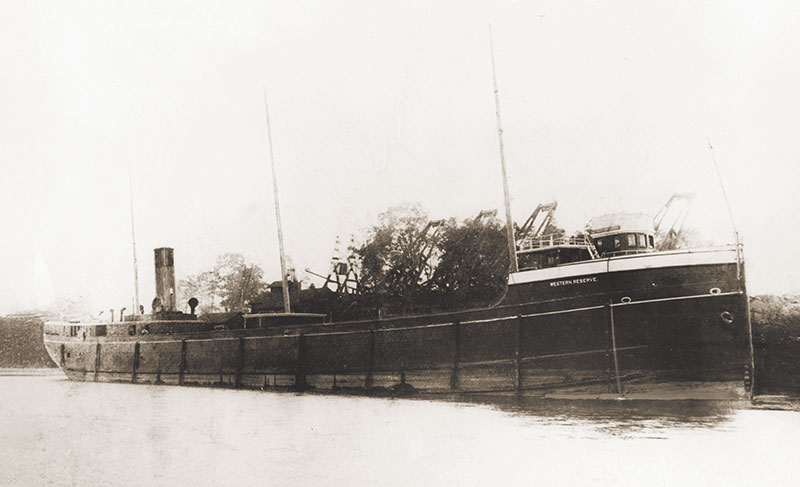
Built by the Cleveland Ship Building Company in the Cuyahoga River Flats just south of Center Street, the 300-foot Western Reserve was an exciting addition to the inland shipping fleet when she launched on August 20, 1890. As one of the first all-steel freighters built in the Great Lakes, she marked a bold departure from the wooden vessels that had plied these waters for centuries.
Captain Peter G. Minch, who took over the Minch Transit Company from father Philip Minch and became one of the region’s most influential shipping magnates, commissioned Western Reserve and designed her to safely carry record-breaking loads at impressive speeds. According to the Great Lakes Shipwreck Historical Society (GLSHS), which discovered the wreck, one newspaper even christened her “the inland greyhound.”
Two years after her launch, Capt. Minch brought his wife, Anna Catherine Delker Minch, and their two youngest children, Charlie and Florence, aboard Western Reserve. Confident in his ship and the future she represented, he invited his sister-in-law and niece to join them on a relaxing cruise to Two Harbors, Minnesota, via Lake Huron and the Soo Locks.
“The only cargo on that ship was his family,” says Corey Adkins, GLSHS communications and content director. “He wanted a nice vacation for them.”
“Throughout most of the trip, the three children, under the watchful eye of working sailors, romped on deck without a care, and the wives sunned themselves and enjoyed the lake breezes,” writes author William Ratigan in “Great Lakes Shipwrecks and Survivals.” “[The ship rode] high and empty on the smooth water, and was locked up through the Soo Canal at six o’clock Tuesday evening.”
The good weather held until they reached Whitefish Bay. While Capt. Minch and the ship’s master, Capt. Albert Myers, initially decided to shelter in a cove to await better conditions, they didn’t stay, weighing anchor and steaming into the open lake as night fell. They couldn’t have known a full gale was brewing.
“It’s hard to imagine that Capt. Peter G. Minch would have foreseen any trouble when he invited his wife, two young children and sister-in-law with her daughter aboard Western Reserve for a summer cruise up the lakes,” says Bruce Lynn, GLSHS executive director. “It just reinforces how dangerous the Great Lakes can be… any time of year.”
(Main photo) Western Reserve / credit Bowling Green State University
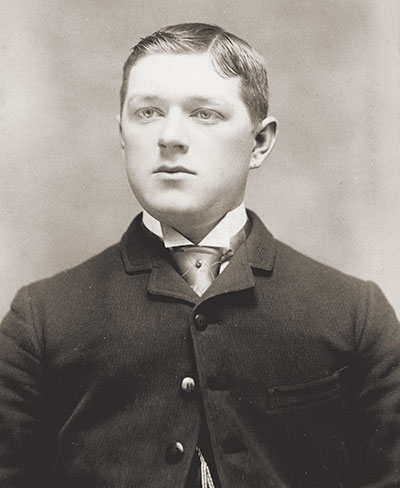
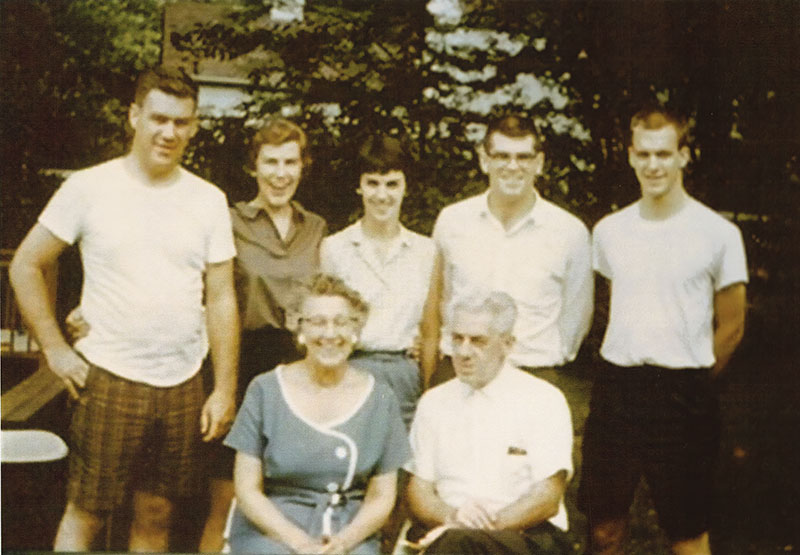
Harry Steward / courtesy of Annie Dennis
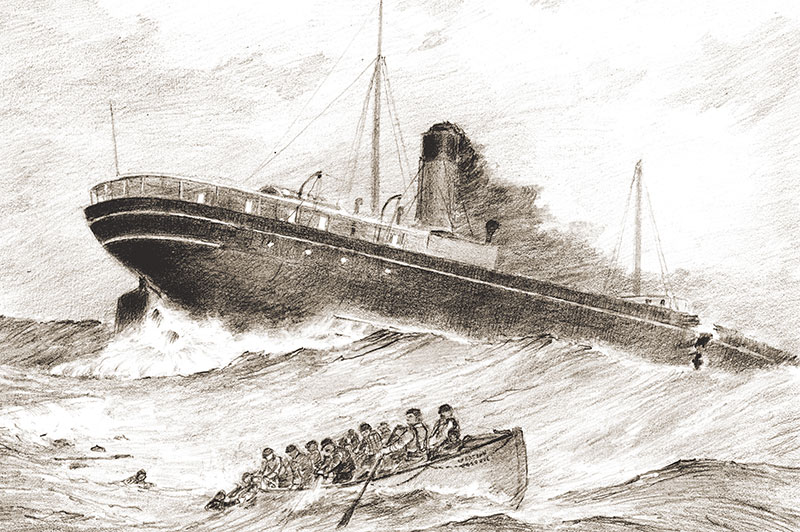
cracked Western Reserve / credit GLSM / Robert McGreevy
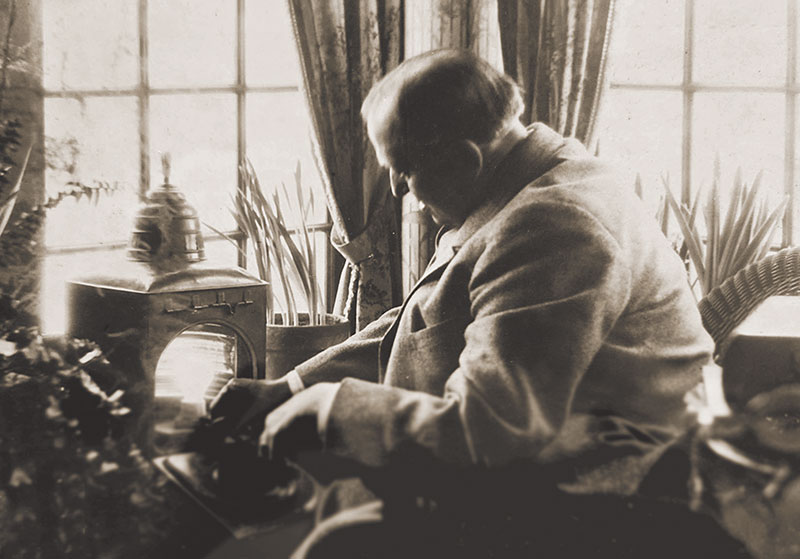
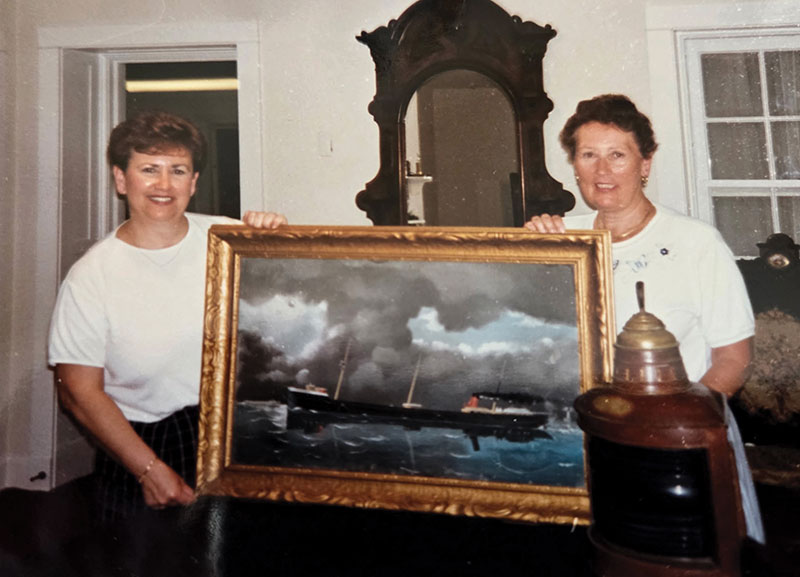
Philip J. Minch II, with Western Reserve’s starboard light, the only documented wreck artifact to wash ashore, at his home in Mentor, Ohio / Courtesy of Kathryn Bachtell Hanley
Against all odds
Around 9 p.m. on Tuesday, August 30, 1892, 23-year-old wheelsman Harry Stewart was off shift and asleep in his bunk, according to his great-great-granddaughter. Loud noises like gunfire woke him, and he heard shouting.
Stewart made a mad dash from his berth. In his hurry, he grabbed mismatched shoes and a pea coat made of traditionally thick, heavy wool.
“If Harry were here right now, he’d credit that coat with saving his life,” Dennis observes. “He was a fifth-generation islander (raised on Harsens Island in Lake St. Clair), and he was taught you do not go out on the lakes without that, no matter what time of year it is.”
When Stewart arrived on deck, the lanterns were out, and the big ship was cracking in half beneath his feet. In the heaving darkness, 23 crew members and six passengers rushed to board Western Reserve’s two lifeboats.
The broken ship’s two halves disappeared beneath the waves in just 10 minutes, yet somehow the crew managed to launch both boats successfully. Stewart just made it.
“Harry almost ran into the crack as the boat split,” Dennis shares. “He had to jump across it to get to the boats.”
One lifeboat capsized almost immediately, spilling its 12 occupants into the cold water. The 17 people aboard the other boat, which carried Capt. Minch and his five family members, were able to rescue two of them before rowing toward shore, 25 miles and 10 long hours away.
“Water kept coming in, so they were bailing with hats and anything else they could find,” Dennis says.
Stewart later recalled spotting another steamer during that harrowing night. To signal for help, they tried to set the women’s shawls on fire — but the fabric was too wet, and the other vessel never saw them.
He also remembered the moment little Florence was swept from her mother’s arms.
Eventually, they saw land, but any sense of relief was short-lived as the overloaded lifeboat capsized amid the breakers within a mile of shore. Stewart and fellow wheelsman Carlton Myers swam with all their might, but Myers was swept away as Stewart dragged himself onto a lonely stretch of coastline near what is now Muskallonge State Park.
“He mostly crawled the 12 miles to the Deer Park Life Saving Station,” Dennis says.
Capt. John Frahm later reported that Stewart knocked on the station’s door at roughly 2:30 p.m. — more than 17 hours after the sinking.
As the sole survivor, young Stewart was the only one to bear witness to what happened to 28 people who vanished with Western Reserve. He returned to Ohio quickly so he could meet with the rest of the Minch family and attend the funerals.
“He was close with them,” Dennis explains.
He was also a sailor at heart. Two weeks after the sinking, he was back in Algonac, taking his next assignment.
Stewart sailed the Great Lakes for 40 more years, staying with Minch Transit (later Kinsman Marine Transit Company) and working his way up to captain. Two of his commands were named Anna C. Minch and Philip Minch.
“He had a calling, a sense of purpose, and the wreck didn’t rob him of that,” Dennis says. “But it was deeply traumatic, and he didn’t like talking about it. He was private until near the end of his life, and then I think he knew it needed to be documented.”
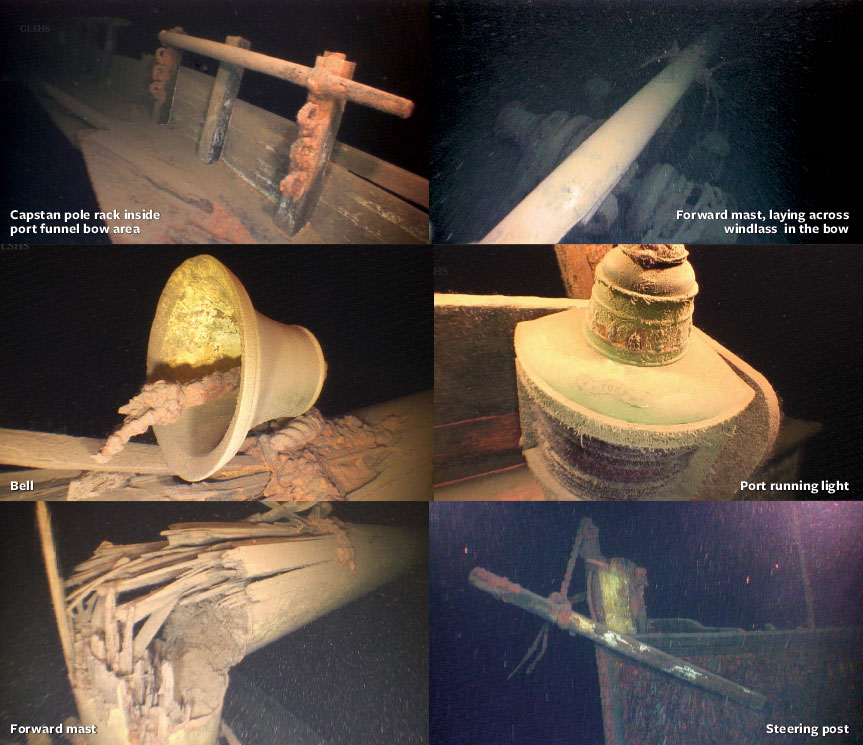
Western Reserve’s shipwreck photographed / credit Great Lakes Shipwreck Museum
Loss without erasure
While Capt. Peter and Anna Minch, two of their children and two relatives lost their lives in Lake Superior, the Minch family endured. Their four other children — Philip, Anna, Hattie and George — were not aboard the ship.
Nor was the family business left adrift. Capt. Minch’s mother, Anna Christiana Leimbach Minch, had already been managing the fleet for a few years. In the weeks after the tragedy, she stepped forward to steady both her grieving family and Minch Transit.
“When Peter drowned in 1892, Anna took over,” says Wally L. Braun, grandson of George Herbert Minch and son of Marion Minch Braun. “Peter’s eldest son, Philip, helped her.”
Philip Jacob Minch II was also a captain, and after his mother’s passing in 1905, he served as superintendent of the company. He was also the family steward of a single surviving artifact. Western Reserve’s starboard light was the only documented part of the ship ever known to wash ashore. He electrified the light, and it burned brightly in an east window at his home near Mentor, Ohio, until he died in 1944.
“I remember going to visit Great Uncle Phil at his home,” says Kathryn Bachtell Hanley, George’s granddaughter and the daughter of Grace Minch Bachtell. “I lived in Painesville, so we weren’t too far away.”
The lantern then passed to the Western Reserve Historical Society, which placed it on the front gable of Lawnfield, the Mentor home of U.S. President James A. Garfield. Today, it resides at the National Museum of the Great Lakes in Toledo, Ohio.
The Minch family sold their lake shipping business to Henry Steinbrenner and Sophia Minch Steinbrenner, Capt. Peter’s sister, in 1901. They renamed it Kinsman Marine Transit Company after the Minch family’s home street in Cleveland.
Their grandson, George M. Steinbrenner III, would later become the owner of the New York Yankees.
“Uncle Wally and I have done a lot of research, and many accounts will say that the entire Minch family was lost in the sinking,” says Anne Colton Rickard, Marion’s granddaughter and the daughter of Nancy Braun Colton. “Then they’ll focus on the connection to the Steinbrenners through Sophia. But we’re still here.”
“We have three Philips in our family named after Capt. Peter’s father,” adds Patty Braun Poeppelmeyer, another granddaughter of Marion Minch Braun. “The family still worked together, still built ships. The company went on, and it was an important one in the Great Lakes. People don’t realize that.”
Indeed, a decades-old article in Great Lakes Review remarks, “The name of Minch has been synonymous with lake shipping for three generations.” And the family ensured that each new generation would benefit from the hard work and innovation that preceded them.
“My mother, Marion, had stock in Kinsman from her grandmother,” Wally Braun says.
When Kinsman Marine Transit Company liquidated in 1965, a significant chapter in the Minch family history closed. A more powerful legacy was carried on, however, with the story itself.
Nancy Braun Colton spent hours researching the Minch family and Western Reserve. Her mother gave her a book titled “Memories of the Great Lakes,” which was precious to her.
“She was so passionate about that ship and our genealogy,” says her daughter, Catherine Colton Dunlap.
For the Minch descendants, remembering Western Reserve has never been abstract. They visited the places where the Minch story unfolded, stood where early family members lived and worked, and did their part to preserve their history.
“I lived in Cleveland for many years, and in the 1970s, my sisters Martha and Nancy and I went up to Vermillion,” Wally Braun remembers. “It was really wonderful. We saw Capt. Philip Minch’s home and the mausoleum at Woodlawn Cemetery. We also went to Kinsman Street in Cleveland (where the Minch family moved in the 1870s) to see where Anna and Philip and other family members lived. The homes are all gone now.”
“My family moved to Mentor when I was in the fifth grade, and we saw the Garfield house and lantern,” says Sue Braun Symmonds, granddaughter of Marion Minch Braun. “My sister Patty was a docent there in high school.”
“This connects all of us,” adds sister Patty Braun Poeppelmeyer. “It instills a sense of pride in our family heritage.”
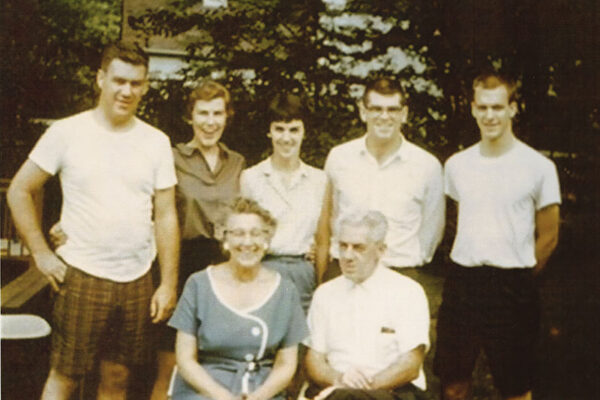
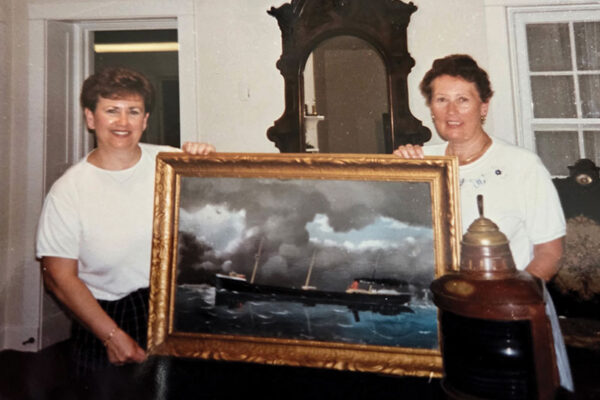
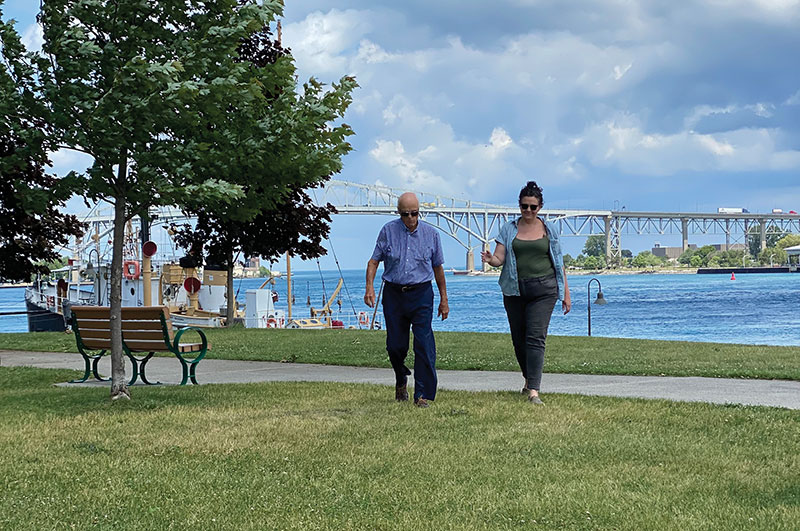
(Top left image): Marion Minch Braun and Walter Braun celebrate their 40th wedding anniversary in 1969 with their children (left to right) Phil, Martha, Nancy, Dick and Wally / courtesy of Catherine Colton Dunlap; (Top right image): Susan Bachtell Petefish and Kathryn Bachtell Hanley, great-granddaughters of Capt. Peter G. Minch, with the starboard light and a painting of Western Reserve. The family donated both items to the Great Lakes Historical Society in Toledo, Ohio, in 1997 / courtesy of Kathryn Bachtell Hanley; (Bottom image): Annie Dennis with her grandfather Frank Baxter, Harry Stewart’s grandson, in 2021 / courtesy of Annie Dennis
Found at last
For generations, the Minch and Stewart descendants have carried their family stories forward through memory, artifacts and careful research. What remained missing was the ship herself, along with confirmation of how she was lost on that stormy night in 1892.
Her absence would endure for more than a century, but it finally came to an end in late summer 2024. Using side-scan sonar aboard its research vessel David Boyd, GLSHS made the initial discovery roughly 60 miles northwest of Whitefish Point.
Later expeditions with remotely operated vehicles confirmed the ship’s identity and condition. Western Reserve sits with her broken back at a depth of approximately 600 feet, with the bow section resting on top of the stern.
GLSHS Director of Marine Operations Darryl Ertel says the knowledge of how she came to rest there, in a sudden storm so far from shore, “made an uneasy feeling in the back of my neck. A squall can come up unexpectedly… anywhere, and anytime.”
Once the news of the discovery became public in March 2025, the word quickly spread in the national press — and in the Minch and Stewart families. For many, the discovery connected present-day headlines with the stories they’d known and the relationships they’d cherished all their lives.
Wally Braun says he found out about it through a niece, who in turn found out from her brother.
“I knew they’d been looking for shipwrecks in the Whitefish Bay area, but I was quite surprised they found the ship,” he remembers. “My sister Nancy collected so much history, and the discovery brought back a lot of memories.”
“It was exciting news to all of us in my family,” says Dorothy Minch Zeiser, George Herbert Minch’s granddaughter and daughter of George Irvin Minch. “We knew all about Western Reserve as kids. My dad talked a lot about it.”
“We definitely were excited,” Sue Braun Symmonds agrees. “It makes it real.”
For Annie Dennis, the discovery of Western Reserve offered a gift as well. Her grandfather, Frank Baxter of Algonac, was Harry Stewart’s grandson, and she bonded with him over their shared interest in the Great Lakes, maritime history and their own family story.
“A year before they found the ship, he told our family, ‘They’re gonna find it,’” Dennis remembers with a smile. “Thankfully, they found it six months before he died, so he got to see it. He was thrilled, like all of us. The shipwreck society was amazing; they shared the raw footage, and my grandfather was transported to his grandpa’s ship. The technology blew him away.”
She says the wreck also confirmed Harry Stewart’s story about the ship breaking up. GLSHS’s Corey Adkins agrees.
“The two parts of the ship are lying on top of each other,” he says. “She sank straight down. The mast broke and fell over the side. Everything Harry Stewart said was right.”
“When you see the wreck, it really hits you,” Dennis observes. “That added a whole new layer of interest for my family, because this is still so real for us. After all this time.”
The story lives on
With the wreck now located and identified, the story of Western Reserve returns to where it has always lived: Among the people whose lives are shaped by it. For Annie Dennis, the story, the Great Lakes and her family heritage are all profoundly intertwined.
“Not only was Harry the fifth generation on Harsens Island, he was part of a long line of Stewarts who sailed the lakes,” she explains. “He grew up around the industry. He was born to it.”
Her grandfather lived on the St. Clair River just minutes down the road from where his grandfather grew up. Dennis herself is the ninth generation to be born and raised in the area, and she drives home from work along the Lake St. Clair shoreline.
“There’s something about the water,” she reflects. “It’s a magnet, a center of gravity for me and my family. Our history here deepens our connection to this place and our love for the lakes, which can give and take away.”
When asked about the legacy of Western Reserve, Dennis is thoughtful. She says she would like people to remember that, despite its loss, the ship contributed something to the evolution of Great Lakes shipping.
“I want this to be known as a complex story, not just a tragedy, because it’s deeper and richer than that,” she says. “It’s also an incredible story of survival, not just for Harry, but for the Minch family members who carried on. The sinking wasn’t the only thing that mattered. Their lives were about so much more, and we need to centralize that.”
The Minch family members agree, noting they would like their forebears to be remembered for their strength and resilience.
Lorien Zeiser Sargolini, daughter of Dorothy Minch Zeiser, says the wreck’s discovery reignited her interest in the family history. And it has given her something more.
“It provides a sense of meaning,” she explains. “These were hardworking, smart, resourceful people.”
The family’s younger generations share their passion and pride. Georgie Rickard, Nancy Braun Colton’s granddaughter, is helping to organize a Minch family reunion at the Great Lakes Shipwreck Museum in Whitefish Point on August 30, 2026 — the 134th anniversary of the sinking.
“Grandma Nancy talked about Western Reserve and her research findings with my mom, Anne, almost every time they got together,” Rickard says. “Now it’s a passion project for me, too.”
The Minch descendants and GLSHS have invited Annie Dennis to join them for their gathering in Michigan’s Upper Peninsula. There, on the shores of Lake Superior, they will commemorate their shared history together.
“History doesn’t just belong to the past,” Dennis says. “It belongs to all of us. It lives and breathes because these stories are now ours.”
Crew and Passengers of Western Reserve
Records indicate 29 people were aboard Western Reserve when she sank on August 30, 1892. The list below reflects the names confirmed through available historical sources. Each remains an important part of this story.
* Capt. Peter G. Minch, 44, vessel owner
* Mrs. Anna C. Delker Minch, 44
* Charlie Minch, 9
* Florence Minch, 6
* Mrs. Mary Englebry, 36, Anna’s sister
* Bertha Englebry, 10, Mary’s daughter
* Capt. Albert Myers, ship’s master
* Wheelsman Carlton Myers, 19, Albert’s son
* Wheelsman Harry Stewart, 23
* First Mate Fred Engalls
* Second Mate Charles LeBeau
* Watchman Daniel Forbes
* Watchman Schuyler Stewart, Harry’s cousin
* Deckhand M. Coffee
* Deckhand Albert Davenport
* Deckhand R. Longfield
* Deckhand Daniel Stickney
* Deckhand Daniel O’Donnell
* Deckhand John Wilson
* Chief Engineer William H. Seaman
* Second Engineer Charles Wells
* Fireman Horace Burroughs
* Fireman S.T. Hatten
* Fireman John Latcham
* Oiler Martin Klauser
* Oiler Robert Simpson
* Steward Bert Smith
* Assistant Steward George Davis