For generations of boaters, New York’s Lake George isn’t just a destination. It’s family.
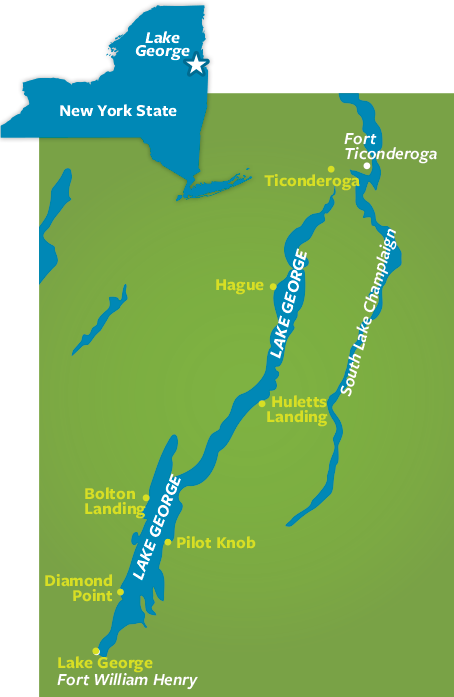
“The lake’s 32 miles long,” I say, studying the map. “So we should be at the hotel in Ticonderoga in, what, 45 minutes or so?”
After a slight pause, my husband replies, “I think it might take a bit longer than that.”
We have just entered the village of Lake George, New York. I look up to see bumper-to-bumper traffic and throngs of people on Canada Street, which is lined with restaurants, clothing boutiques, and little shops selling everything from ice cream and fudge to olive oil and pizza. I even spot an arcade.
We aren’t going anywhere quickly. It’s a summer evening up north, after all.
We briefly debate turning around and taking Interstate 87 north before cutting across to Ticonderoga. But we don’t want to miss the opportunity to see the western shore of Lake George for the first time, so we press on.
Within just a few miles, we are glad we did. The bustling tourist energy of the village gradually gives way to lakeside resorts, mom-and-pop motels, marinas and undisturbed stretches of woodland.
The road twists along the shoreline, providing tantalizing glimpses of cobalt blue water before plunging into the trees again. On the opposite shore, thickly forested mountains catch the evening’s golden light.
Farther north, around Bolton Landing, we spot Adirondack-style homes peeking through the trees and boats bobbing quietly at private docks. Development thins, and by the time we reach the northern end of the lake, it feels less like a resort destination and more like a retreat.
We arrive in Ticonderoga just in time for dinner. Over the next few days, as we celebrate the wedding of dear friends at the Northern Lake George Yacht Club (NLGYC) at Friends Point, we learn why so many families return to this pocket of Adirondack Park year after year, and generation after generation.
Generations at the lake
Lake George captivated artists and writers visiting the southern Adirondacks in the early 19th century — so much so, they compared it to the great lakes of Europe and christened it the “Queen of American Lakes.” One notable visitor was James Fenimore Cooper, whose trip directly inspired his 1826 novel “The Last of the Mohicans.”
The lake remained a draw a century later. Not only did it famously attract painter Georgia O’Keeffe and photographer Alfred Stieglitz, but the 10-mile stretch of shoreline between Lake George Village and Bolton Landing was also once known as Millionaires’ Row.
Here, wealthy families such as the Astors, Morgans, Rockefellers, Vanderbilts and Whitneys built vacation estates reminiscent of those at New York’s Tuxedo Park and Georgia’s Jekyll Island. Yet unlike those enclaves, Lake George also nurtured more rustic camps — especially farther north — and remained at heart a boating destination, where life revolved around the water.
Some of those camps have been cherished by the same families for decades.
Chris Mayer’s first memory on Lake George involves trying to take a nap in the bilge of his father’s Star one-design racing keelboat on the Fourth of July. His parents put their toddler on a cushion so he wouldn’t get wet, and every time they tacked, he rolled.
Mayer grew up in Schenectady, New York. In the early years, his family would make day trips to the lake to go sailing or rent a campsite at Hearthstone Point for a week.
Then his dad found a piece of land on Northwest Bay, north of Bolton Landing.
“It had a tent platform and a small converted pumphouse, which had screens and a roof,” Mayer remembers. “My parents would sleep in the tent, my two brothers and I slept in the pumphouse, and the Star was at the dock.”
Several vacation cabins sat nearby, and Mayer says his father grew tired of people wandering through the property. He decided to sell it in 1955, and the next year, he bought a piece of land on Forest Bay in Hague, just north of Friends Point.
“There were all sorts of camps set up that had 50 or 100 feet of lakefront, so it was tight in places, but the waterfront and views are outstanding,” Mayer says. “That was the beginning of the Friends Point and Forest Bay associations, and we got in on the front end.”
Property owners mutually care for their roads and shared woodlands, which are protected in perpetuity.
From Forest Bay, it was (and remains) an easy 1-mile walk south to the NLGYC, where the sailing bug bit Mayer hard. He started racing cat-rigged N-10 turnabouts as an elementary school student, and he says he’ll never forget the long courses or the tricky conditions.
“Sailing on the lake could be tumultuous at times, and these were not high-performance boats,” he recalls with a chuckle. “They were sluggish. I’d be out there with my younger brother, and we’d have drifters and squalls. One time, a squall came through and took out the whole fleet! Everyone went over.”
When Mayer was 15, his father bought him a Comet, a classic 16-foot racing dinghy with a hard-chine planing hull and a large mainsail. Its performance was high octane compared to an N-10.
“It was sleek and fast, and soon everyone at the club had graduated from turnabouts to Comets,” Mayer says. “The first few races were like bumper cars. No one slowed down — they just kept going.”
The young sailors still sailed long courses, with upwind beats that left them exhausted. The stronger the wind, the more times they went around, but Mayer’s love for the sport never wavered.
“I mostly raced out of the club, but I also sailed in the Finger Lakes,” he says. “We had a big Buick, and all of a sudden my dad had this 17-year-old kid asking, ‘Hey, can I use the car?’”
As a father raising two daughters of his own, Mayer found himself spending time on the lake a little differently. The girls weren’t sailors, but they loved swimming, snorkeling and waterskiing.
“They swam like otters,” he says. “I have three grandchildren now, and we pile everyone into our 21-foot Bayliner to go out to the islands, hang out, swim and fish. My grandson loves to find the fish when he’s snorkeling.”
The Mayer family cabin is small, but everyone fits, and the youngest generation is learning to do their part to help maintain the camp. It’s all worth it, he says, to see multiple generations enjoying a place he has loved all his life.
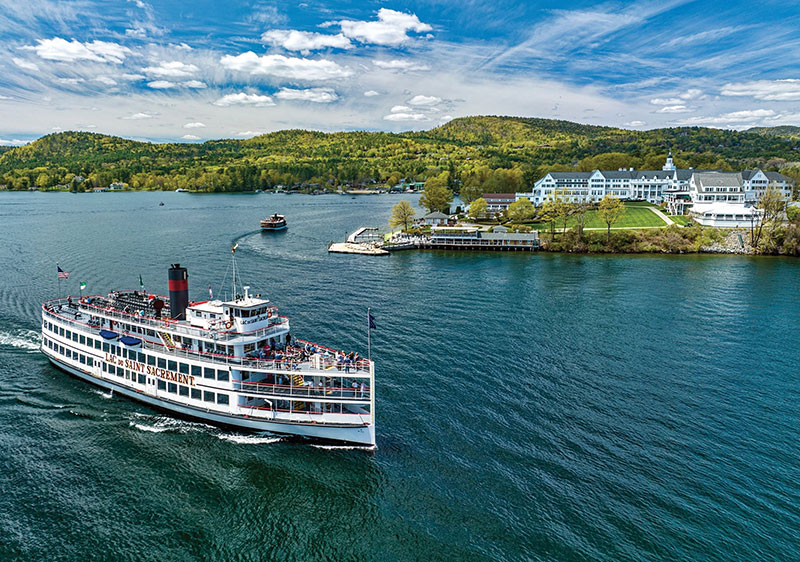
(Main photo) Lake George Steamboat and The Sagamore Resort | credit Lake George Steamboat Facebook
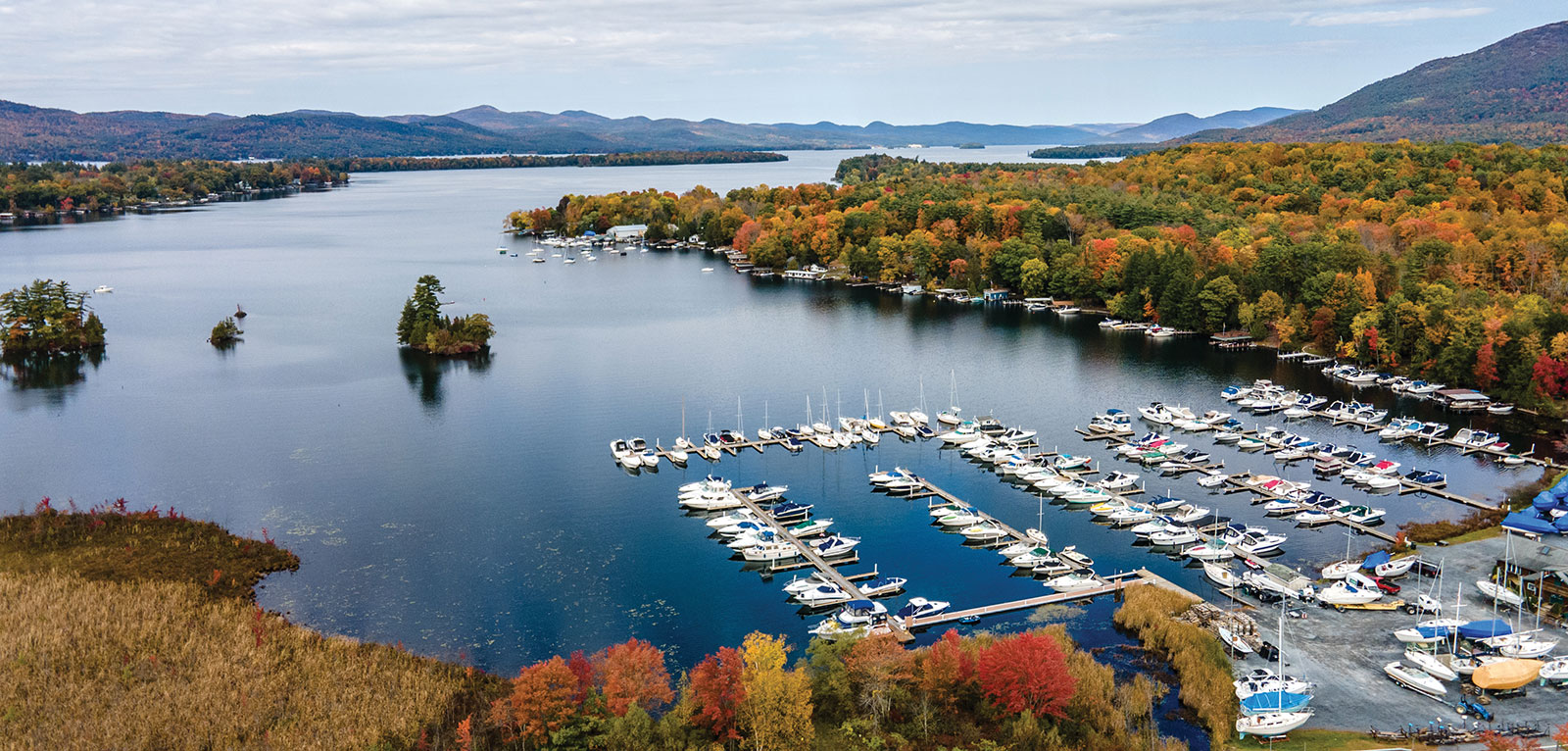
Cleverdale, New York, and Harris Bay Yacht Club | credit Lake George Regional Chamber of Commerce & CVB/Frank Cavone
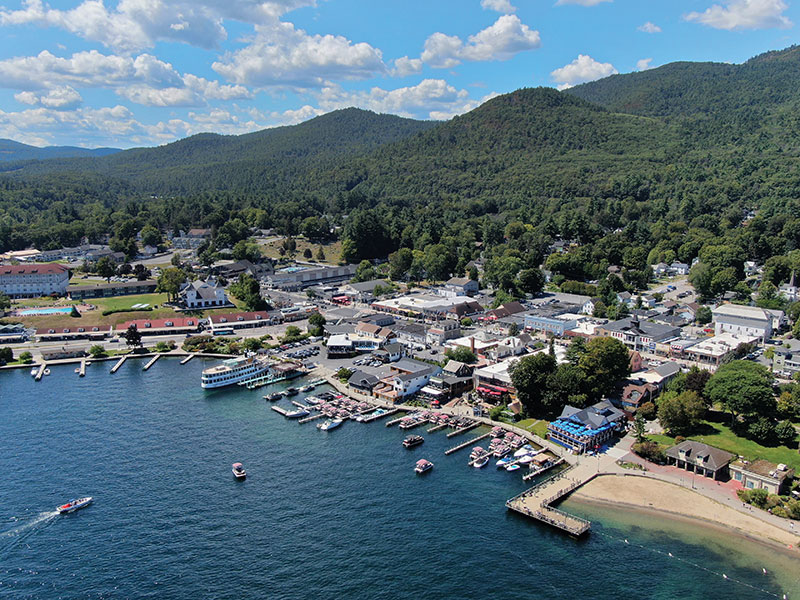
Lake George Village | credit Wiki/Hayden Soloviev
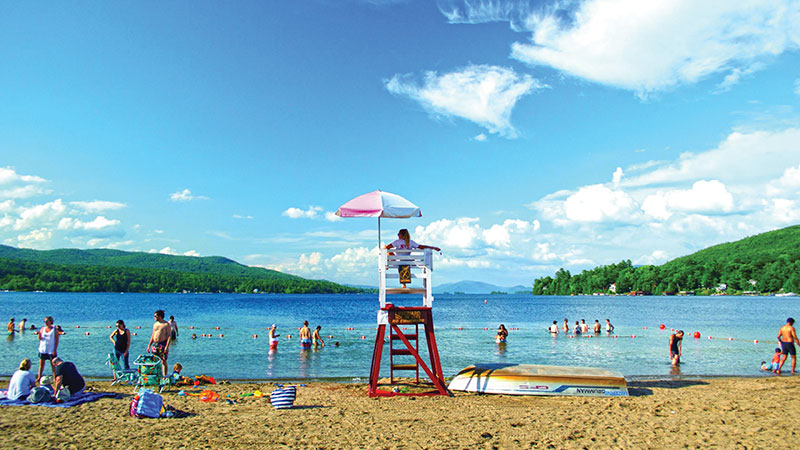
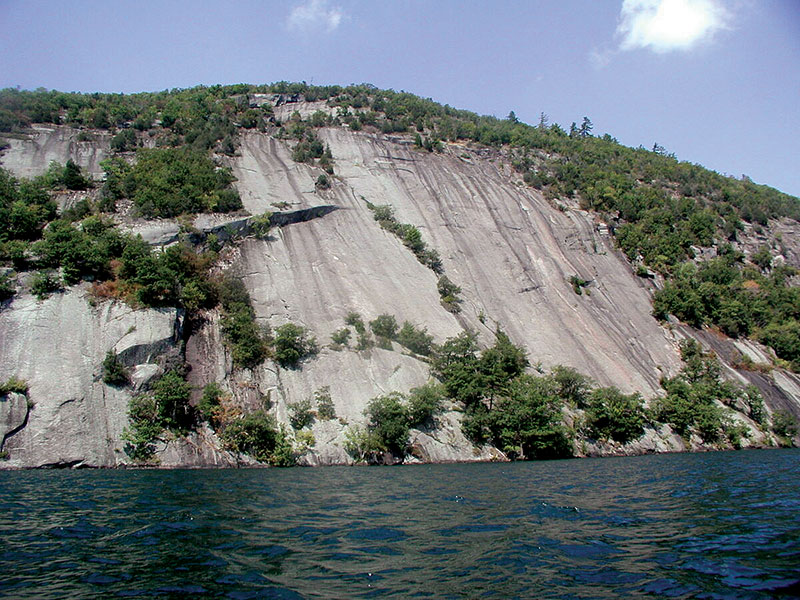
Top: Million Dollar Beach | credit visitadirondacks.com
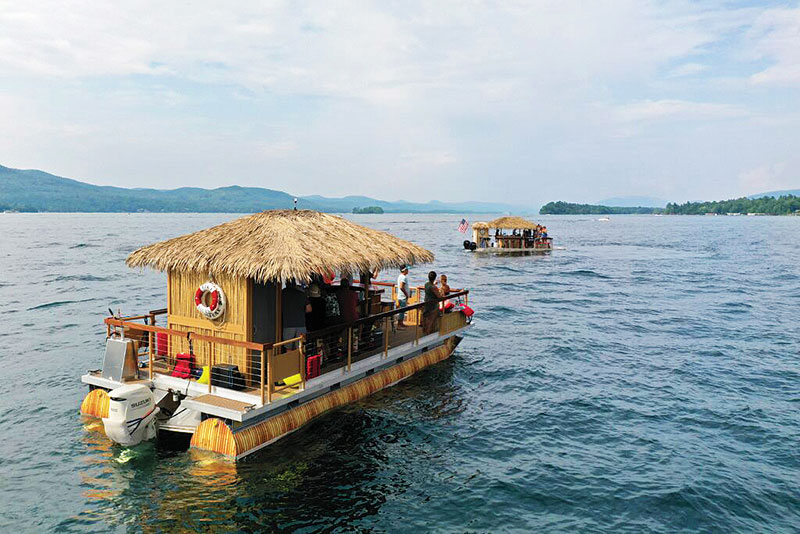
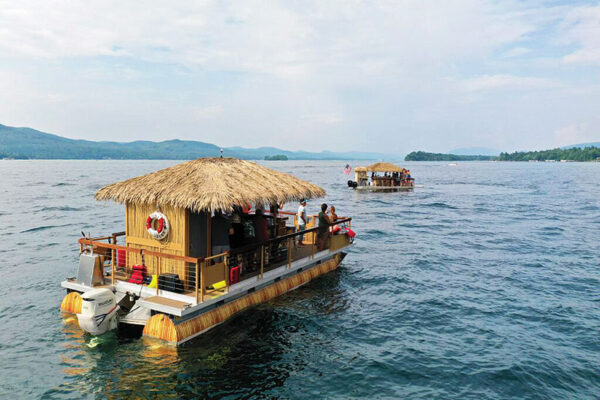
Bottom left: Original Tiki Tours | credit Lake George Regional Chamber of Commerce & CVB
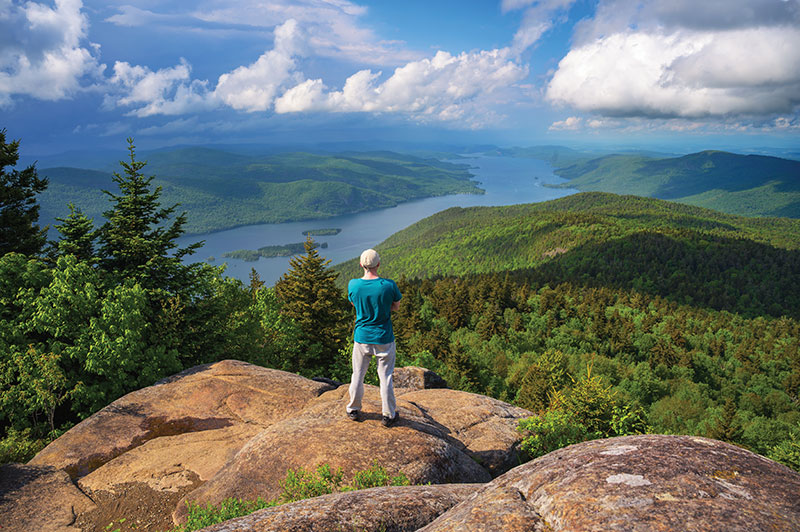
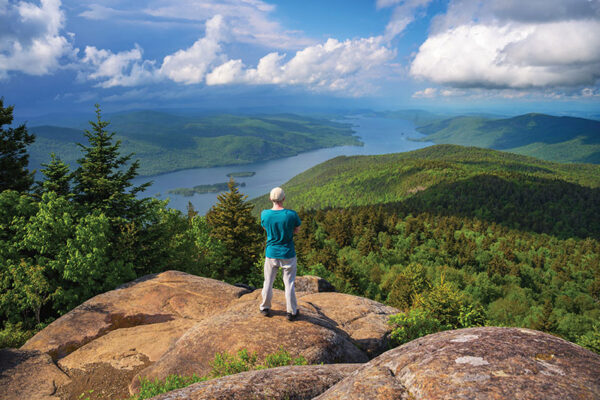
Bottom right: Black Mountain overlook | credit Nick Fox
Adirondack adventure
It’s not difficult to understand the appeal. Stretching 32 miles through southeastern Adirondack Park with a maximum width of 2.5 miles, Lake George is one of the clearest, cleanest lakes in the United States.
Carved during the last ice age, it reaches depths of roughly 200 feet and is continuously replenished by cold mountain streams and springs. More than 170 islands dot its impossibly blue waters, many of them permanently protected state lands.
According to the Lake George Association, more than 90% of the lake’s watershed remains natural forestland, “with nearly half of the forested acreage publicly owned by New York State and constitutionally protected as a forever-wild Forest Preserve.”
The water is breathtakingly clear, and on a calm day, the mountains seem to float above their reflections. Like the Mayers, generations of families have spent summer days cruising from one bay to the next, dropping the hook to swim, picnic and linger in the cool water.
Children leap from swim platforms or jump from rocks, snorkel around the islands and, like Mayer’s grandson, search for fish in hidden places. Lake George has a two-story fishery, with warm-water fish like perch and bass, as well as cold-water species such as lake trout and salmon.
Meanwhile, sailors chase afternoon breezes, paddlers slip into shallow coves, and watersports enthusiasts cast off the docklines at dawn.
“I used to waterski all the time in the morning,” Mayer says. “At 7 a.m., the lake would be perfect and flat. It was so good. I grew up with a group of guys and girls who were really into slalom skiing. I’m in my 70s now — it’s too fast, and the wake is too punishing. But back then, man, we’d jump the wake, ski backward, even barefoot ski. That’s rough until you learn how to do it.”
Racing continues at NLGYC, and Mayer reports the courses are shorter these days. He sails a Laser, one of 10 in the fleet, and he’s enjoying every minute of it.
“It’s a feisty boat, and you have to be in shape,” he says. “I encourage the younger people to catch me!”
Not all the adventures are topside, however. Lake George offers many treasures to those who turn their gaze beneath the waves, either as a snorkeler or scuba diver.
“There are so many places to see underwater,” Mayer says. “Across from Silver Bay, there’s a jumping rock, and if you go just south of there, you’ll see a round structure that the glacier left behind. It’s maybe 20 or 30 feet in diameter. Really cool.”
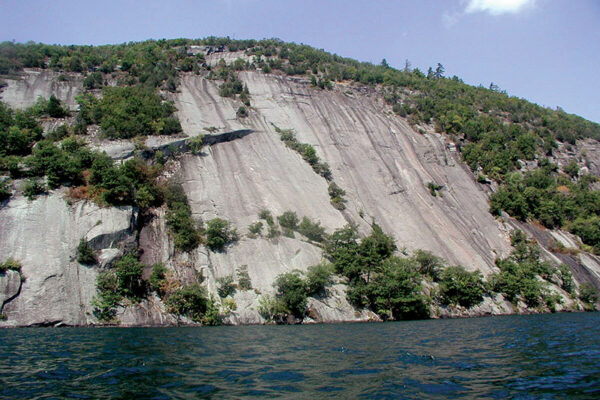
Other good spots for underwater glacial geology include the Rogers Rock Slide and Black Mountain Point. Visitors should note that while surface temperatures can reach 75-78 degrees Fahrenheit in midsummer, a 3- to 5-millimeter wetsuit is recommended for longer outings.
“The visibility is awesome,” Mayer says. “Be intrepid. If you’re snorkeling, take a breath and go deep. There’s another jumping rock across from the yacht club, and you can find all sorts of lost articles on the bottom.
“If you’re scuba diving, it’s fun to spend time on the grassy knolls in the middle of the lake,” he continues. “A bunch of perch will come out and look at you!”
Some sites bring history to life. A good example is the Ghost Fleet of 1758, which lies at the southern end of Lake George in one of the lake’s three Submerged Heritage Preserves.
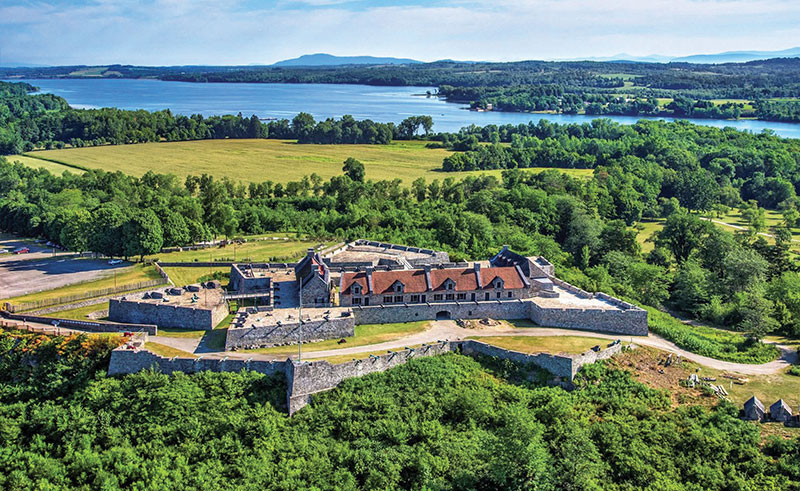
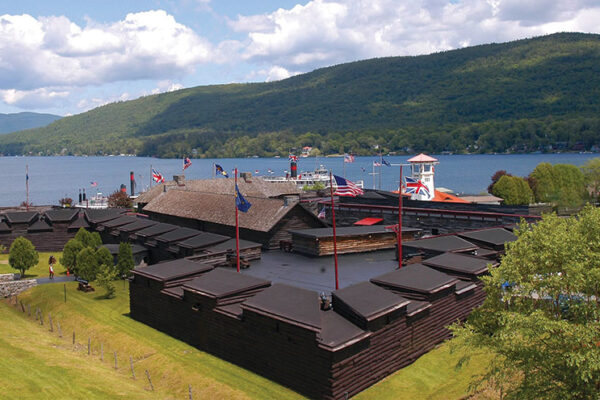
On July 5, 1758, during the French and Indian War, British General James Abercrombie launched an armada of approximately 900 boats from the southern end of Lake George. The fleet included flat-bottomed bateaux, sloops and a seven-sided battery called the Land Tortoise. The general intended to use the vessels to attack the French at Fort Carillon, later renamed Fort Ticonderoga.
Despite the combined force of approximately 15,000 British and colonial troops, the attack failed. That autumn, the British scuttled more than 260 of the vessels in shallow water, hoping to protect them from French raids over the winter.
The majority were retrieved the following spring — but not all. Two centuries later, in 1960, divers discovered the remnants of seven flat-bottomed bateaux about a mile north of the Fort William Henry site, resting at depths of 25 to 50 feet.
They also found the Land Tortoise radeau 2 miles north of Lake George Beach. At 107 feet, it’s a more advanced dive.
According to the New York Almanack, the 52-foot, seven-sided ship is believed to be “the sole survivor of a distinct class of military vessel only used on Lake George and Lake Champlain in the 18th century.” The Smithsonian has designated the Land Tortoise as the oldest intact war vessel in North America.
“Launching an armada of 900 boats on Lake George to take over the French fort at Ticonderoga — I try to wrap my head around it, but I can’t,” Mayer says. “When you’re here, you realize the French and Indian War was very local.”
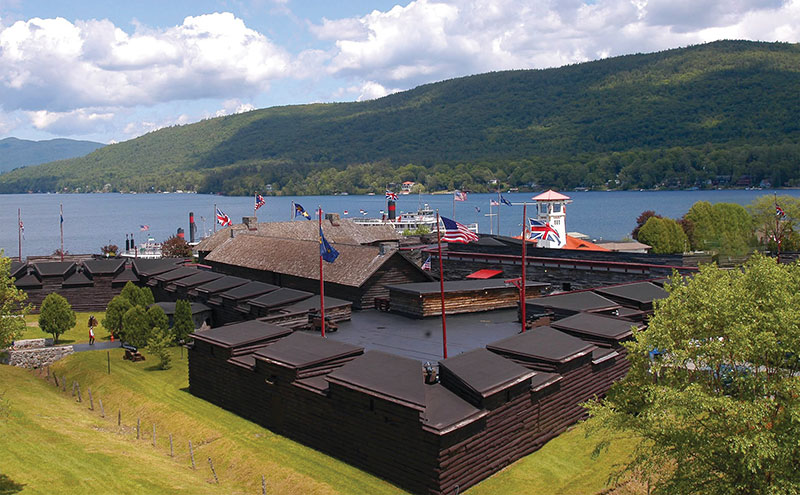
From “Fort Ti” in the north to Fort William Henry in the south, history is never far away on Lake George. Yet for families like the Mayers, the lake’s greatest legacy is found in the traditions that continue to unfold along its shores.
Another chapter begins
A heat wave is on the way, bringing stifling 100-degree temperatures from Florida to Maine. But we can’t feel it yet at Lake George, where a fresh afternoon breeze cools the terrace at the NLGYC.
We spot the vintage Chris-Craft before we hear the rumble of its engine. Together with the crowd, we stand quickly, craning our necks to get a better view.
Chris Mayer’s daughter, Lauren, sits with her parents and sister in the gleaming wooden runabout, beaming and waving both hands toward all the loved ones ashore. One in particular, our friend Joseph, matches her radiant smile as they begin married life together.
That evening, after the farm-to-table supper has been cleared, I stand with Mayer in one of the clubhouse’s wide-open windows. As the jazz band starts to play behind us, the lake takes on an almost unearthly glow in the fading light.
When I ask how it feels to see his daughter married and generations of family and friends gathered together in this place, he smiles and says, simply, “This is what it’s all about.”
In that moment, and for so many reasons, I suddenly understand why Thomas Jefferson noted in a 1791 letter to his daughter that Lake George is “without comparison, the most beautiful water I ever saw.”
BOATING ADVENTURE
Lake George has boating regulations that differ from those of many other lakes. Anchoring and mooring restrictions apply in some areas, and boaters should consult current maps and regulations before heading out. The Lake George Park Commission provides official boating maps and guidance.
Regulations & safety: lgpc.ny.gov/boating-lake-george
Marinas, launches & rentals: lakegeorgechamber.com/attractions/boating
visitlakegeorge.com/outdoors/on-the-water/boat-launches
Lake George Islands Day Use Area & Camping: Reserve day-use sites and boat-access-only island campsites through the New York Department of Environmental Conservation.
PLAN YOUR TRIP
Lake George Regional Chamber of Commerce & CVB: lakegeorgechamber.com